‘I am a living statue’: How DR Congo’s most famous soccer fan is keeping Patrice Lumumba’s legacy alive

‘I am a living statue’: How DR Congo’s most famous soccer fan is keeping Patrice Lumumba’s legacy alive
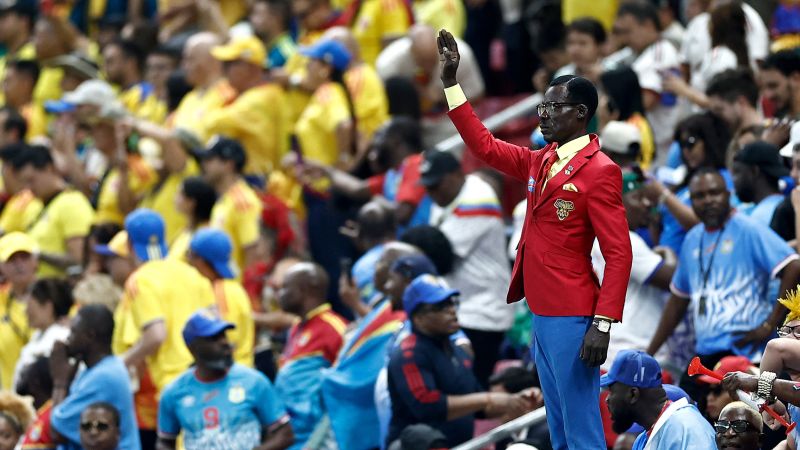
I am a living statue – When the Democratic Republic of Congo made its debut at the World Cup, the moment carried immense historical weight. It marked the nation’s second appearance on the global football stage, a return to the spotlight after a 52-year absence since its earlier participation as Zaire in 1974. Yet, beyond the excitement of the game, the crowd in Mexico was watching for one man in particular: Michel Kuka Mboladinga, the unofficial 12th player for the Congolese team. Known as “Lumumba Vea”—a title echoing the spirit of the nation’s first prime minister—Mboladinga’s presence was as much a part of the match as the players themselves. His role transcended mere fandom; it became a powerful act of remembrance and resistance.
A Symbol of National Pride
For the DRC’s opening match against Portugal, Mboladinga stood motionless on a pedestal, his right arm raised high, a pose that drew comparisons to the nation’s revolutionary leader. This ritual, which he perfected during the 2025 Africa Cup of Nations in Morocco, has since become a defining image of Congolese identity. The connection between Mboladinga and Patrice Émery Lumumba is not accidental. The man who bears a striking resemblance to the late prime minister has dedicated his life to embodying his legacy, transforming the act of cheering into a silent tribute.
“Patrice Lumumba is a symbol of unity—the one who taught Congolese to stand and to be proud,” Mboladinga told CNN Sports from Mexico on Monday night.
More than six decades after Lumumba’s assassination, his memory remains deeply intertwined with the national psyche. His 1960 Independence Day speech, delivered in Léopoldville (now Kinshasa), still resonates as a call to defiance and self-determination. Standing before King Baudouin of Belgium—the great-great-nephew of Leopold II—Lumumba’s words ignited a sense of pride among Congolese, declaring, “We shall show the world what the Black man can do when working in liberty, and we shall make the Congo the pride of Africa.”
The Legacy of a Leader
Patrice Lumumba’s leadership, though brief, left an indelible mark. After just three months in power, he was ousted by President Joseph Kasa-Vubu and later executed in 1961. His assassination was a turning point, not only in Congolese history but also in the broader narrative of African decolonization. Lumumba’s struggle against Belgian colonial rule, which began with King Leopold II’s establishment of the Congo Free State in 1885, symbolized a fight for autonomy and dignity. His vision of a unified Congo stood in stark contrast to the divisions that followed.
Historians and activists continue to honor Lumumba’s contributions. Dr. Reuben Loffman, an expert in African history at Queen Mary University of London, called his 1960 speech “a defining moment of the 20th century.” “It wasn’t just about independence; it was about proving that Congolese could lead and define their own future,” Loffman explained. “The Cold War context made his words even more potent, as the U.S. and USSR viewed him as a communist threat.”
A Living Monument in Motion
While thousands of fans in the stands celebrated with songs and dances, Mboladinga’s stillness spoke volumes. His pose, frozen in time, mirrored Lumumba’s unwavering resolve. This silent vigil has become a ritual that draws attention to the historical struggles of the DRC, reminding viewers that sports are not just about victory but also about cultural and political meaning.
Mboladinga’s dedication is rooted in the belief that Lumumba’s spirit must never fade. “He’s my inspiration,” the fan said. “Even though he was killed, his ideas live on. Every time I raise my hand, it’s a reminder of the fight for freedom.” His act has been embraced by many, including the Congolese team’s supporters, who see him as a bridge between the past and present. The team’s first goal in the World Cup—scored by Yoane Wissa in the 45th minute—was met with cheers, but Mboladinga’s stillness added a layer of solemnity to the moment.
The Shadow of Colonial Rule
Lumumba’s rise was a direct challenge to colonial authority. His 1960 speech, which criticized the systemic racism imposed by Belgium, was a rallying cry for independence. “Although this independence of the Congo is being proclaimed today … no Congolese will ever forget that independence was won in struggle,” he declared. These words, delivered during a time of global upheaval, captured the essence of a nation reclaiming its voice.
However, Lumumba’s influence was short-lived. Within three months of his speech, he was removed from power, a move that set the stage for his tragic downfall. Military forces led by Mobutu Sese Seko—a leader who would later rule the country for 32 years—captured him and transported him to Katanga, where he was tortured and executed by firing squad. His body was initially buried in a shallow grave before being dismembered and dissolved in acid, leaving only a single gold-crowned tooth as a relic of his legacy.
Reviving a Forgotten Icon
Despite the efforts to erase his memory, Lumumba’s image has persisted through the decades. Mboladinga’s presence in the stands ensures that his story is not just remembered but reenacted. By mimicking the posture of the late prime minister, he creates a visual echo of the struggles and triumphs that shaped the DRC. This connection is especially meaningful in a country where Lumumba’s name is often invoked in discussions about national identity and political reform.
The DRC’s World Cup campaign has also brought renewed attention to Lumumba’s contributions. As the team competes on the international stage, Mboladinga’s silent vigil serves as a reminder of the country’s journey from colonial subjugation to self-governance. His actions have inspired others, with fans across the nation adopting similar gestures of respect, transforming stadiums into spaces of collective memory and pride.
From Stadium to History
Mboladinga’s role as a living monument is a testament to how historical figures can transcend their era. While Lumumba’s political career was cut short, his ideals have found new life in the hands of those who carry his torch. The DRC’s World Cup appearance, coupled with Mboladinga’s iconic pose, has sparked conversations about the intersection of sports and history, highlighting how the Beautiful Game can be a platform for cultural expression.
As the team’s matches continue, the crowd in Mexico will likely see more than just a football game—they will witness a celebration of resilience. Mboladinga’s unyielding presence, a tribute to a leader who once stood up against oppression, ensures that Lumumba’s legacy is not confined to textbooks or monuments. Instead, it lives on in the hearts of those who dare to remember and honor the past through their actions in the present.