Wyndham Clark builds early 4-shot lead at US Open with lowest 36-hole score at Shinnecock

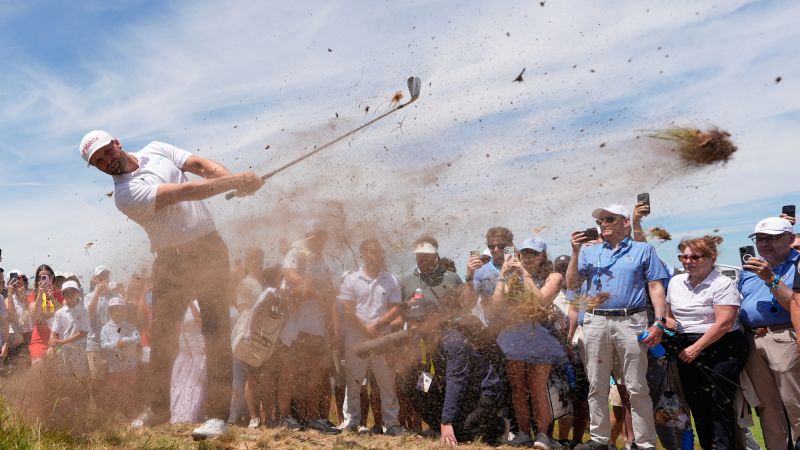
Wyndham Clark Sets US Open 36-Hole Record, Builds Four-Shot Lead at Shinnecock
Wyndham Clark builds early 4 shot – Wyndham Clark continues to make his presence felt at Shinnecock Hills, where he has now established himself as a formidable contender for the 2026 U.S. Open title. The 28-year-old golfer carded a 69 in the second round, which combined with his first-day score, secured him a 7-under 133 total. This performance not only marks the lowest 36-hole score ever recorded at Shinnecock Hills but also positions Clark four shots ahead of the field heading into the final two days. The 2026 tournament has seen dramatic shifts in momentum, with the course’s conditions playing a pivotal role in shaping the competition.
Clark’s Steady Performance Contrasts Last Year’s Struggles
While the course has been a daunting challenge for many, Clark has navigated its brutal layout with composure, a stark departure from his experiences in 2025. Last year, he faced a tough time at Oakmont, where he missed the cut and vented his frustration by smashing a locker. This time, however, his focus remains on steady execution. His final hole of the second round was a critical moment, as he sank a 35-foot birdie putt from the slope of the 18th green. This shot, combined with two earlier birdies, helped him finish with a 69 and maintain his lead.
“I really felt like I could be in double digits (under par),” Clark said. “But you know, the great thing about that is I didn’t feel like I had my best, and I still am leading as of right now. Hopefully, I can bring my A-game on the weekend.”
The US Open has always been a proving ground for golfers, and Shinnecock Hills is no exception. Clark’s current position echoes the 2004 tournament, where Phil Mickelson and Shigeki Maruyama also shared the halfway lead. However, Clark’s 133 total is one shot better than their 134, showcasing a new benchmark for the course. The 2004 event saw the field average 78.7 in the final round, a figure that might be relevant as the 2026 version promises to be even more demanding.
Competitive Field Shapes the Mid-Week Landscape
Behind Clark, the field is tightly packed, with several players vying for the top spots. Xander Schauffele, known for his consistent performance in major championships, posted a 66 to finish at 137. Matt Fitzpatrick, a former U.S. Open champion, managed a 70 after birdies on his final three holes. Both Schauffele and Fitzpatrick are part of a group that includes Sam Stevens and Tom Kim, who also scored 69 and 67 respectively. The course, which began to dry in the afternoon, has forced players to adapt to its evolving characteristics, with the sun’s intensity increasing the difficulty.
Scottie Scheffler, still in pursuit of a career Grand Slam, recorded a 68 after missing just two fairways and hitting all 10 greens. His score places him at 140, alongside Rory McIlroy, who struggled after a shaky start to the back nine. McIlroy’s three consecutive bogeys early in the afternoon threatened his chances, but he remains optimistic about the tournament’s unfolding.
Shinnecock’s Challenge Intensifies as Weather Shifts
As the weekend approaches, the course is expected to become even more unforgiving. The USGA has already adjusted its setup to favor speed and firmness, and with the sun shining brighter, the greens are likely to test players’ precision. Clark, who is now seven strokes ahead of the pack, believes his position is a strong indicator of his potential. “If there’s a course where you feel like you still have a chance if you’re seven back going into the weekend like I am, it’s definitely this one,” McIlroy remarked, acknowledging the competitive nature of the event.
Despite the challenging conditions, several high-profile names have yet to falter. The cut was set at 4-over 144, and the 10 players who advanced are just one short of the 2004 record. That year, the tournament saw an average of 78.7 in the final round, suggesting that the current 2026 field may face a similarly tough test. Meanwhile, the tournament’s unique setup, including a fog delay and the need to resume play at 6:35 a.m., has added an extra layer of complexity for participants.
Niemann’s Controversial 9 Turns Into a Major Penalty
Among the most memorable moments of the second round was Joaquin Niemann’s incident on the 15th hole of the first round. After hitting two drives off the property and then discarding his club in frustration, the USGA penalized him two shots for unsportsmanlike conduct. This turned a potential 9 into an 11, yet Niemann bounced back with a remarkable 65 in the second round, finishing at 3-over 143. His resilience highlights the unpredictable nature of the US Open, where even setbacks can be overcome with determination.
“All the frustration that came inside me and had my club in my hand, and I couldn’t resist to throw it away,” Niemann said. “There was no people, obviously. No one there. I’m not proud of it, but yeah, sometimes all the expectation of trying to play well and things doesn’t go your way, you get frustrated. And that was me there.”
Niemann’s penalty may have impacted his overall standing, but his performance still places him in contention. Collin Morikawa, who matched Niemann’s 65, ended up in sixth place, five strokes behind the leader. Justin Thomas and Sam Burns, who were part of the final group last year, are now at 139, a position that keeps them in the running for a top-three finish.
Course Conditions and Strategic Adjustments
The weather has been a key factor in shaping the tournament’s dynamics. While the wind was less intense than on Thursday, the course remained relatively soft, with greens being sprayed early in the morning. However, as the day progressed, the sun’s heat made the fairways harder and the putts more demanding. This shift has required players to adjust their strategies, with those who have adapted reaping the rewards. For example, Clark’s ability to maintain composure under pressure has allowed him to remain a step ahead of the competition.
The long day for players was not just a result of the course’s difficulty but also due to the logistical challenges of resuming the first round after a fog delay. The 10-hour gap between the end of the first round and the start of the second round tested the mental and physical endurance of all participants. Clark’s 64 in the second round, the lowest start in U.S. Open history, underscores his ability to thrive in such conditions. His performance has set a high bar for the rest of the field, who must now find ways to close the gap.
As the 2026 U.S. Open moves toward its conclusion, the focus remains on Clark’s potential to extend his lead. The course, with its reputation for being unforgiving, has not yet deterred him from aiming for victory. With the final two rounds set to test every aspect of a golfer’s game, Clark’s consistency and composure may prove crucial. Meanwhile, the tournament has also demonstrated the importance of adaptability, as seen in the performances of players like Niemann and Morikawa, who have shown that even the most unexpected challenges can be overcome.
Looking Ahead: A New Era of Golf Innovation
The 2026 U.S. Open is not only a test of skill but also a showcase for the evolving landscape of golf. With the sport’s equipment industry already valued in the billions, the integration of AI into training and performance analysis could soon revolutionize how players approach major championships. This technological advancement is particularly relevant as the course continues to present new challenges each day, requiring athletes to push their limits in ways previously unimaginable.
As the final rounds draw near, the 2026 event has proven to be a high-stakes spectacle. From Clark’s record-breaking 36-hole score to Niemann’s dramatic penalty, the tournament has delivered a mix of triumphs and setbacks. The USGA’s decisions, including the strict enforcement of rules, have added an extra layer of strategy to the game, ensuring that the competition remains as fierce as ever. With the course set to get drier and faster, the final two days promise to be a thrilling conclusion to a storied week of golfing history.