Fact check: Trump’s false and unproven claims about the Reflecting Pool

Fact Check: Trump’s Claims About the Reflecting Pool’s Damage
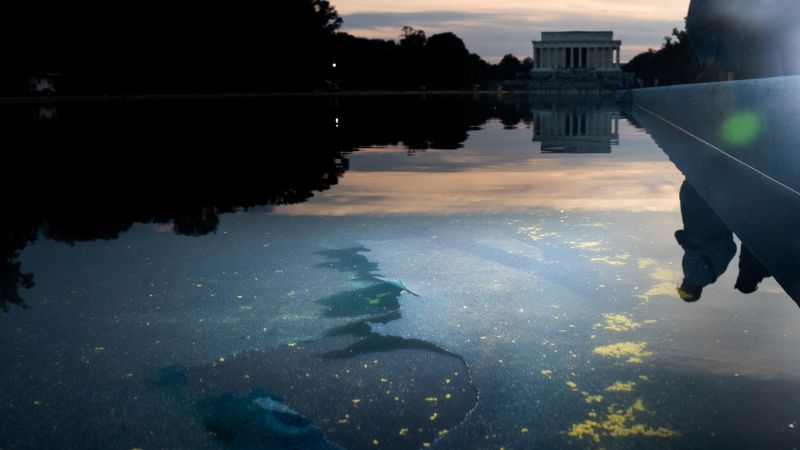
Fact check – President Donald Trump has sparked debate with a series of assertions regarding the Lincoln Memorial Reflecting Pool, which he claims has been marred by vandalism rather than the recent restoration efforts. His statements, made without substantial evidence, have drawn scrutiny from fact-checkers and journalists alike. Trump’s narrative centers on the idea that the visible damage to the pool—specifically a long gash—was inflicted by individuals wielding knives, not by the repair work conducted under his administration. This claim has been inconsistent, with Trump adjusting the length of the gash over the course of a few days, further complicating the factual accuracy of his remarks.
The Vandal Allegations and Shifting Descriptions
On Saturday, Trump posted a social media message claiming that the pool’s problems were caused by “Vandals” who had slashed its surface. He suggested that his version of the pool had “worked perfectly” until these acts of vandalism created a 250-foot-long gash. However, this portrayal has been challenged by experts. The New York Times reported that internal government documents revealed only two cuts in sections of foam between the pool’s expansion joints, which were not directly linked to the peeling “American flag blue” coating or the algae outbreak. Despite Trump’s insistence, the pool’s condition has not been pristine since it was refilled in early June.
“While National Park Service workers found two cuts in sections of foam between the pool’s expansion joints, those were not directly related to the ‘American flag blue’ coating that is now peeling, or to the algae that has turned the pool a bright shade of green.” — New York Times
Trump’s descriptions of the gash have varied over time. On Saturday, he claimed it was 250 feet long, then on Monday, he adjusted it to 300 feet, and by later Monday, it had grown to 350 feet. By Tuesday, he referred to it as “numerous slashes over a very long 350-foot length.” This inconsistency raises questions about the reliability of his claims. The Times noted that while the documents did mention two 171-foot blade cuts, they did not specify how these cuts were made or who was responsible. This lack of clarity undermines Trump’s narrative that the damage was intentional and severe.
The Algae Outbreak and Water Quality Concerns
Even before Trump’s latest claims, the pool’s condition had already been the subject of public criticism. Algae was visible within days of the pool being refilled in early June, contradicting the Trump administration’s assertion that the water had been made “crystal clear.” This inconsistency has led to skepticism about the effectiveness of the repair project. The algae issue, while not directly tied to the vandalism claims, highlights the challenges of maintaining the pool’s appearance after extensive work.
On Tuesday night, Fox News aired a video provided by the Interior Department, which the agency claimed showed people vandalizing the pool. The footage depicted two individuals standing near the pool’s edge, bending or crouching to reach into the side for several seconds while others walked around them. However, the video does not clearly show the creation of two 171-foot gashes, as Trump’s team suggested. Despite this, the video was used to support the idea that vandalism was the primary cause of the damage. Jesse Watters, a Fox host, acknowledged the ambiguity, stating, “We don’t know if they’re committing a crime.” This uncertainty adds to the debate over the pool’s condition.
“We don’t know if they’re committing a crime.” — Jesse Watters, Fox News
Trump’s Mischaracterization of Obama and Biden’s Efforts
Trump’s claims about the reflecting pool extend beyond the recent damage. At a Monday event, he asserted that the two-year repair project under former President Barack Obama had left the pool “never even opened.” This contradicts the historical record, as the pool reopened in August 2012 and has been accessible for most of the time since. There have been short closures for maintenance and repairs, including a period in October 2012 and a longer shutdown from 2015 to 2016 due to construction near the memorial. However, these closures have been exceptions, not the norm, over the past 13 years.
Trump has also exaggerated the cost of Obama’s repair project, stating it cost “over $100 million.” In reality, the contract was approximately $35 million. When CNN inquired in May, Trump’s White House could not provide evidence to support his higher figure. Similarly, he claimed that former President Joe Biden had spent tens of millions to address the pool’s issues, but the Biden administration did not pursue any major repair projects. Chuck Sams, who served as the National Park Service director under Biden, told CNN in May that a cost estimate of “above $100 million” for a “full rehabilitation” had been received, though no action was taken.
These mischaracterizations of past administrations’ efforts suggest a pattern of Trump’s tendency to reframe facts to fit his narrative. By attributing the pool’s problems to vandalism rather than the natural wear and tear of time, he aims to shift blame away from the repair project and onto external actors. This strategy aligns with his broader approach to presenting issues as being the result of deliberate sabotage rather than routine maintenance.
Despite the lack of concrete evidence, Trump’s claims have continued to gain traction. His ability to reshape the narrative through inconsistent descriptions and selective emphasis on specific details has fueled public confusion. As the investigation into the alleged vandalism progresses, it remains to be seen whether the evidence will support his assertions or reveal alternative explanations for the pool’s condition. In the meantime, Trump’s statements serve as a reminder of the importance of verifying claims with reliable data and clear documentation.
Fact-checkers and media outlets will continue to scrutinize the situation, ensuring that the public is informed about the true state of the Reflecting Pool. While Trump’s claims may capture attention, they must be evaluated against the facts. The pool’s history, from its construction in the 1920s to its recent restoration, provides a context that Trump has overlooked in favor of a more sensational narrative. By doing so, he not only challenges the credibility of the repair project but also spreads misinformation about the contributions of previous administrations.
As the debate over the pool’s condition unfolds, the key will be to distinguish between proven facts and unproven allegations. Trump’s shifting descriptions of the gash, combined with his claims about Obama and Biden’s spending, illustrate the need for careful examination of evidence. The goal is to ensure that the public receives accurate information, free from the influence of political rhetoric and selective storytelling.