Appeals court says Trump is unlawfully constructing White House ballroom

Daftar Isi
DC Circuit Blocks Trump’s White House Ballroom Construction, Setting Stage for Supreme Court Battle
Goldlaner.com – A federal appeals court has delivered a significant setback to President Donald Trump’s ambitious renovation of the White House, ruling that the executive branch overstepped its authority by proceeding with construction of a massive new ballroom without congressional approval. The two-to-one decision issued Friday by the DC Circuit Court of Appeals not only halts the project temporarily but also establishes a precedent that could reshape how future administrations approach historic preservation at the nation’s most iconic residence.
Congressional Authority vs. Executive Power
The court’s opinion, written without attribution, emphasized that the question of whether such an expansive addition belongs at the White House falls squarely within legislative jurisdiction rather than executive discretion. “Whether or not a massive ballroom should be constructed is for Congress to decide and is not a matter for Executive self-help,” the judges wrote in their detailed analysis.
The National Trust has shown, compellingly, that Congress has not ceded unfettered authority to the Executive Branch to dramatically redesign, reshape, and reconstruct the White House – the People’s House – to fit a particular President’s desires.
The ruling came in response to a lawsuit filed by the National Trust for Historic Preservation, which argued that the ballroom project fundamentally altered the historic character of the White House without proper legislative oversight. The preservation group had challenged the construction after the East Wing was demolished last year to create space for the new facility.
Judicial Division and Political Context
The composition of the three-judge panel reflected the political landscape of federal appointments. Judges Patricia Millett, nominated by Barack Obama, and Brad Garcia, selected by Joe Biden, formed the majority. Judge Neomi Rao, a Trump appointee, issued a vigorous dissent that challenged both the legal foundation and the scope of the ruling.
The majority opinion, which extends beyond one hundred pages, represents what legal analysts are calling one of the most pointed judicial rebukes in the ongoing saga surrounding Trump’s White House renovations. The court’s decision pauses implementation for two weeks, providing a window for the president to seek review from the nation’s highest court.
We will be immediately appealing to the United States Supreme Court, Trump wrote on Truth Social, calling on the nation’s highest court to overturn the decision in its entirety.
Construction Progress and Project Scale
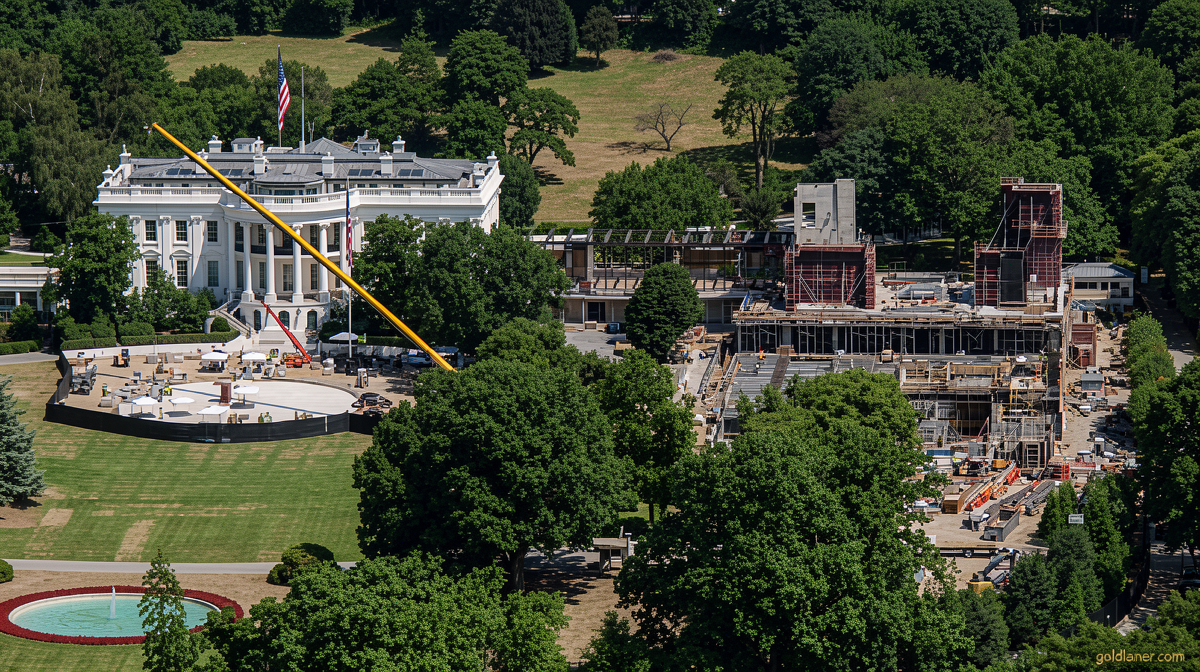
Despite the legal challenges, above-grade construction on the ballroom commenced in the spring and has advanced substantially. Visual documentation shared by the president this week displays multiple tiers of concrete support columns and metal reinforcement bars surrounded by heavy construction machinery, including a prominent tower crane.
The proposed ballroom spans approximately 89,000 square feet according to lead architect Shalom Baranes, considerably larger than the Executive Mansion’s 55,000 square feet. Trump has maintained personal involvement in design decisions ranging from floor layouts to marble specifications, and projects a completion date of summer 2028—an accelerated schedule that would conclude several months before his term ends.
Broader Legal Challenges
The ballroom dispute forms part of a wider constellation of legal challenges targeting Trump’s various projects within the District of Columbia. Additional lawsuits question his modifications to the Reflecting Pool, his initiative to construct an American counterpart to Paris’s Arc de Triomphe, and his proposal to convert a public golf course into exclusive private links.
An earlier federal judge in Washington, DC, had already ordered a halt to all above-ground ballroom construction in April pending congressional authorization. The appeals court’s Friday decision effectively reverses that temporary permission and clarifies that the entire undertaking requires legislative blessing.
Dissent and Standing Arguments
Judge Rao’s dissent focused on what she characterized as judicial overreach and questioned whether the National Trust possessed the legal standing to initiate the lawsuit. She criticized US District Judge Richard Leon, who initially ruled against the project last spring, for prioritizing the preservation group’s aesthetic concerns over Trump’s national security justification.
The district court seized supervision of construction at the White House, and my colleagues affirm this judicial overreach, Rao wrote in her dissenting opinion.
Implications and Reaction
Brent Leggs, president and CEO of the National Trust, welcomed the ruling as a victory for democratic participation in preserving historic landmarks. “This is a great day for our country and for the American people’s right to voice their opinions about the historic places they cherish, including the White House,” Leggs stated.
Trump characterized the decision as politically motivated and potentially dangerous, describing it as a national security threat that could compromise the safety of White House personnel. The ballroom sits atop a classified underground bunker complex designed to upgrade aging subterranean infrastructure—a detail the president highlighted on Friday as evidence of the project’s critical importance.
The Supreme Court’s eventual consideration of this case could establish lasting boundaries on executive authority regarding historic properties, potentially influencing how future presidents navigate the intersection of modernization and preservation at the White House.
Related Reading
Frequently Asked Questions
What is Appeals court says Trump is unlawfully?
Appeals court says Trump is unlawfully is the main topic of this guide. The article explains the context, practical details, and next steps readers should understand.
Why does Appeals court says Trump is unlawfully matter?
Appeals court says Trump is unlawfully matters because readers are looking for a useful answer, not just a short summary. Good content should match search intent and help them decide what to do next.