Martha Lillard, last US polio patient using iron lung, dies at 78 in Oklahoma

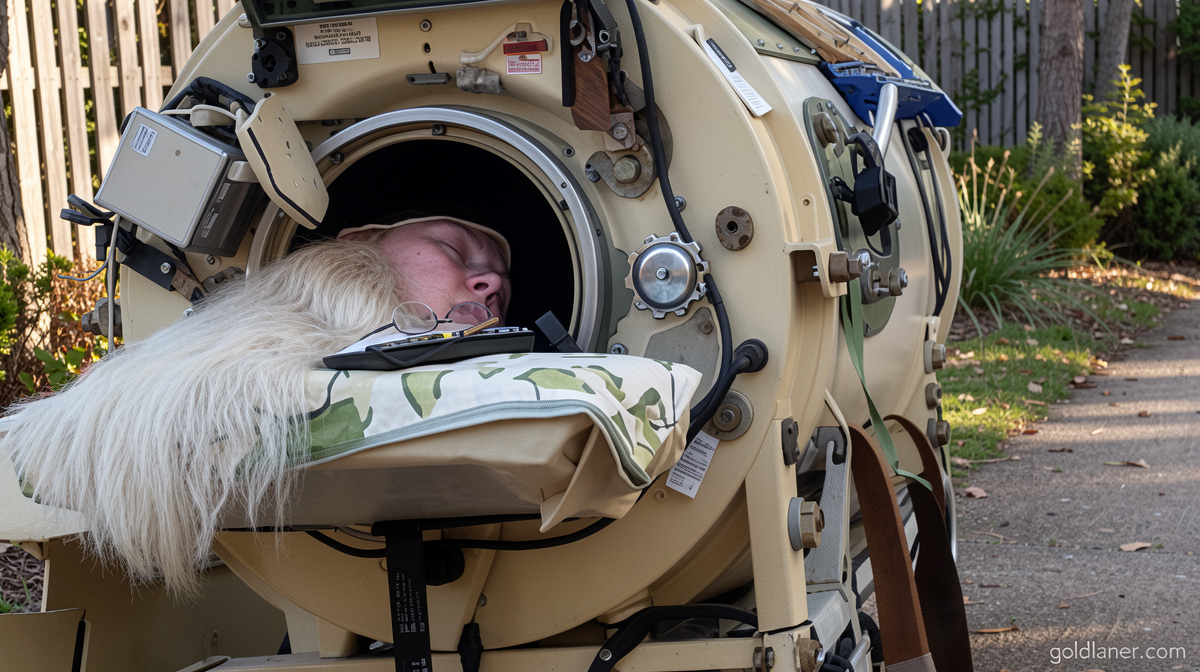
Martha Lillard, America’s Final Iron Lung Polio Survivor, Passes at 78
A Life Defined by Resilience
Martha Lillard last US polio patient – Martha Lillard’s remarkable journey through life came to an end on June 26 in Oklahoma, where she passed away at the age of 78. She held the distinction of being the last person in the United States who relied on an iron lung to breathe. Her younger sister, Cindy McVey, shared this news with the Associated Press on Friday, revealing that medical professionals had once predicted Martha would not survive beyond her twentieth birthday. Despite this prognosis, McVey noted that her sister possessed tremendous enthusiasm and determination to thrive despite her circumstances.
The circumstances surrounding Martha’s passing have been attributed to complications from long-haul COVID-19, according to McVey. However, an official death certificate documents chronic pulmonary failure and post-polio syndrome as contributing factors to her passing. For decades, Martha slept within the cylindrical iron lung apparatus that surrounded her entire body. The machine functioned by manipulating air pressure within the chamber, which pushed air into and out of her lungs with each breath.
Education and Daily Life
During her childhood years, Martha attended grade school for only two hours daily, receiving tutoring for the remainder of her educational day. When she reached high school age, she enrolled at Shawnee High School through an innovative phone system. This technology enabled her to communicate with both teachers and fellow students via an intercom installed in her classroom. Her family also enjoyed road trips to Missouri, facilitated by a specially designed trailer. Her father would telephone hotels ahead of time to confirm they possessed doors wide enough to accommodate the iron lung.
Remarkably, Martha even learned to operate a vehicle for a period of time. “To me, it was just normal,” her sister recalled, now 75 years old herself. Polio once stood as one of America’s most terrifying illnesses, with yearly outbreaks generating thousands of paralysis cases. The illness predominantly impacted young children. Medical professionals introduced vaccines beginning in 1955. The Centers for Disease Control and Prevention reports that a nationwide immunization effort reduced American cases to under 100 annually during the 1960s and below 10 throughout the 1970s. By 1979, officials declared polio eliminated within the United States, indicating it no longer circulated regularly among the population.
Love and Connection Through Technology
The internet eventually provided Martha with opportunities to stay informed and explore numerous subjects, including her own condition that left her paralyzed from the neck downward. Through physical therapy, she recovered partial functionality in her left arm and gained use of her legs. Nevertheless, she could only move her left arm horizontally at waist level. Despite being unable to reach overhead, Martha maintained independence for many years, cooking her own meals and managing daily responsibilities alone.
Online platforms also facilitated Martha’s romantic connection. Following the September 11, 2001, terrorist attacks, she sought greater understanding of the events. Within a chat room, she encountered a man residing in Egypt. Their digital correspondence spanned more than two decades, according to McVey. Martha wed Baha Salh in February after he successfully secured a visa permitting travel to Oklahoma. “They were really soul mates,” McVey expressed. “He’s extremely brokenhearted.”
Final Years and Legacy
During the coronavirus pandemic, Martha contracted COVID-19 on two separate occasions. Prior to her infections, her lung capacity measured below 25 percent. The final five years of her existence found her unable to venture outside her home as breathing grew increasingly difficult. For the preceding two years, she remained inside the iron lung almost continuously, McVey explained.
McVey characterized her sister as both artistic and creative. Martha composed poetry and wrote musical pieces throughout her life. She also authored her own obituary, which a local funeral home subsequently published online. In her writing, Martha mentioned serving as a Humane Society volunteer. “She was an avid Beagle lover and assisted in animal rescue as a cross poster on Facebook,” she had written. Martha later revised her obituary to state she “died of long-haul Covid 19,” though McVey added the specific date of her passing.
In recent years, both sisters desperately searched for someone capable of repairing the iron lung, one of several machines Martha had owned throughout her lifetime. “But since she’s the last one, we don’t need that anymore,” McVey said through tears.