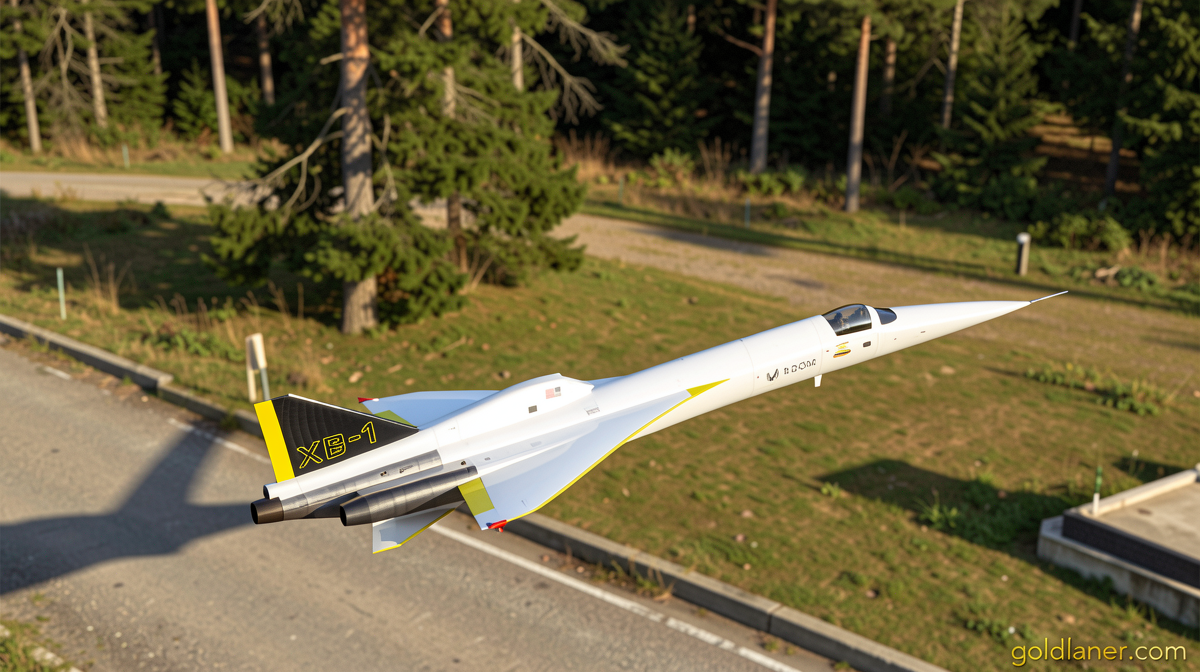
Supersonic flight is making a comeback decades after the Concorde. But one big hurdle remains

Daftar Isi
A New Dawn for Supersonic Aviation: Breaking the Sound Barrier Without the Sound
Goldlaner.com – Half a century after the last commercial supersonic jet touched down, the aviation industry stands on the precipice of a revolutionary transformation. The Federal Aviation Administration’s recent proposal to overhaul decades-old regulations could finally unlock the skies for faster-than-sound passenger travel, promising to shrink transcontinental journeys from hours to mere minutes while potentially eliminating the very noise that once grounded these remarkable aircraft.
The Oklahoma City Experiment That Changed Aviation Forever
The year was 1964, and the skies above Oklahoma City echoed with an unprecedented phenomenon. Military aircraft conducted a six-month campaign of deliberate sonic booms, creating 1,253 thunderous explosions that rattled windows and startled residents below. This ambitious test program, orchestrated by the Federal Aviation Administration, sought to understand how ordinary Americans would react to the prospect of supersonic commercial flight.
The results proved complicated. While a University of Chicago survey of 3,000 Oklahoma City residents revealed that 73 percent believed they could tolerate the sonic booms, the immediate aftermath told a different story. The FAA fielded approximately 12,400 complaint calls from frustrated citizens, and the agency ultimately had to compensate numerous locals for damaged windows and walls. These lawsuits and complaints would prove instrumental in shaping aviation policy for decades to come.
The consequences rippled through Congress, which in 1971 withdrew funding for Boeing’s ambitious supersonic aircraft project, the 2707. This decision left only two competitors in the passenger supersonic arena: Europe’s Concorde and the Soviet Union’s troubled Tupolev Tu-144. Then came the decisive blow in 1973, when the FAA effectively prohibited civilian supersonic flight over American land by restricting civil aircraft to speeds below Mach 1, the sound barrier.
Concorde’s Lonely Reign and the Long Wait
Concorde emerged as the sole commercial supersonic airliner, gracing the skies between 1976 and 2003. When it entered passenger service in January 1976, British Airways and Air France initially offered only two routes: London to Bahrain and Paris to Rio de Janeiro. Transatlantic service to New York City’s John F. Kennedy International Airport did not commence until late 1977, following a United States Supreme Court decision that lifted a noise-related ban imposed by the Port Authority of New York and New Jersey.
Unable to traverse land masses in North America and much of Europe, Concorde eventually limited itself to connecting New York with Paris and London, alongside premium charter flights to exclusive holiday destinations. The aircraft’s operational life ended after a devastating crash in 2000 that claimed 113 lives, followed by a brief return to service. Only fourteen Concorde aircraft ever entered commercial operation, and none found a successor.
The FAA’s Bold New Vision
Now, in June 2026, the FAA has proposed reimagined regulations that could transform supersonic travel. The document outlines a fundamental shift from speed-based restrictions to noise-based standards, simultaneously repealing the 1973 prohibition. The agency aims to complete these new standards by mid-2027, potentially opening American skies to supersonic passenger flights for the first time in over fifty years.
It’s a long time in coming. I think it’s a welcome legislation, and I would say NASA and the US industry have been pushing in this direction for a very long time.
These words from Juan Alonso, a professor in the department of aeronautics and astronautics at Stanford University in California, capture the sentiment of aviation experts who have watched this moment approach for decades.
Understanding the Sonic Boom Challenge
When any aircraft or spacecraft exceeds the speed of sound, it generates a powerful shock wave that produces what we know as a sonic boom. On the ground, this manifests as a loud, explosion-like bang capable of startling pedestrians and occasionally cracking windows. Emerging research has even suggested that the noise levels generated by these booms may influence human health over extended periods.
The challenge for modern aviation is not merely technical but also social. While the 1964 survey showed public tolerance, the subsequent wave of complaints demonstrated that even a minority of affected residents could derail an entire program through legal action and political pressure.
Two Paths to Quiet Supersonic Flight
Two distinct approaches are currently being developed to make future supersonic passenger planes compliant with the FAA’s new noise regulations. Colorado-based Boom Supersonic, explicitly referenced in the FAA proposal, plans to employ physics-based solutions that prevent sonic booms from reaching the ground entirely, regardless of aircraft design. This approach focuses on shaping the aircraft to distribute pressure waves more evenly.
NASA, meanwhile, is conducting flight tests with its experimental X-59 aircraft, which is specifically engineered to reduce the intensity of the sonic boom rather than prevent it altogether. The X-59’s distinctive design aims to create a softer “thump” rather than a sharp “bang,” potentially making supersonic flight over populated areas far more acceptable to communities below.
What the Future Holds
The success or failure of these divergent solutions will determine not only how rapidly supersonic travel returns to American skies but also how many passengers ultimately benefit from this technological renaissance. The post-Concorde era could look dramatically different, with the FAA’s new proposal indicating exact thresholds of sound pressure that will define acceptable supersonic operations.
As the aviation industry prepares for this potential revolution, the question is no longer whether supersonic flight can return, but whether it can return without repeating the mistakes of the past. With new regulations, advanced engineering, and decades of accumulated knowledge, the dream of fast, quiet supersonic travel may finally be within reach.
Related Reading
Frequently Asked Questions
What is Supersonic flight is making a comeback?
Supersonic flight is making a comeback is the main topic of this guide. The article explains the context, practical details, and next steps readers should understand.
Why does Supersonic flight is making a comeback matter?
Supersonic flight is making a comeback matters because readers are looking for a useful answer, not just a short summary. Good content should match search intent and help them decide what to do next.