Why these adults are suddenly obsessed with a kids toy from the late ’90s

Adults Reviving a Childhood Toy: Beyblade’s Unexpected Resurgence in Asia
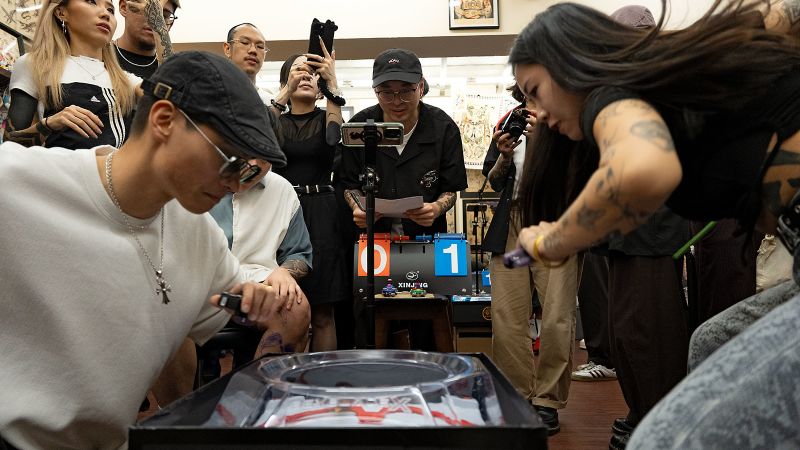
Why these adults are suddenly obsessed – In the heart of Hong Kong’s vibrant nightlife, a tattoo parlor has transformed into an unexpected battleground for a toy once confined to childhood playrooms. The usual sounds of needlework and the occasional gasp from a client giving way to the metallic clinks and plastic scrapes of spinning tops colliding. This shift marks a fascinating trend: adults, once disengaged from the whims of their younger years, are now gathering in this modest space to compete with Beyblades—a Japanese toy that sparked a craze over two decades ago. The once-familiar battle of the spinning tops has reemerged as a cultural phenomenon, drawing fans from Japan to Thailand and beyond.
A Toy’s Comeback in the Adult World
What began as a children’s toy in the late 1990s has found a new audience in adulthood. The customizable spinning tops, originally designed for competitive play, are now the centerpiece of community events in cities like Hong Kong, where they’ve taken over spaces traditionally reserved for tattoos and street food. The game’s simplicity—launching a plastic-stripped top onto a circular arena to outlast opponents—has captivated a generation that once dismissed it as trivial. In a world dominated by smartphones and digital distractions, these kinetic battles offer a rare, tactile form of connection.
At The 59 Tattoo, a local establishment in Wan Chai, the room has become a temporary coliseum. Tiff Tam, a 28-year-old employee, described the scene with a mix of excitement and disbelief. “I’m ready to put up a fight,” she said, showcasing her collection of nearly $400 worth of Beyblade sets. Her enthusiasm highlights the shift in perspective for many adults who’ve rediscovered the toy’s appeal. “At first, I just didn’t see the draw,” she admitted. “But once I started playing, I felt that rush of tension, excitement, and rivalry.”
From Tradition to Trend: The Beyblade Legacy
Beyblade’s roots trace back to Japan, where it was inspired by the traditional spinning top *beigoma*. The toy’s name, a portmanteau of “Bey” and “blade,” reflects its fusion of cultural heritage with modern design. First introduced in 1999 by Takara, the toy quickly became a global sensation. Its appeal lay in the customization of its components, from colored rings to weapon-themed names like “Saber Samurai” and “Arrow Wizard.” Players would battle on a circular plastic panel, or “stadium,” with the goal of keeping their top spinning longest.
Despite its initial popularity, Beyblade’s dominance waned in the early 2000s, only to resurface in recent years. Today, the toy’s revival is driven by a mix of nostalgia and the allure of competitive play. Fans are now creating makeshift battle zones in parks, gyms, and shopping malls, even repurposing Chinese woks as unconventional arenas. Social media has amplified this resurgence, with viral videos showcasing epic clashes and fueling demand for rare models.
Reconnecting Through Competition
The game’s resurgence has also sparked a sense of community. At a suburban park in Tseung Kwan O, dozens of players gathered for a weekly tournament, their excitement palpable as they prepared to face off. “We play together even though we weren’t close before,” said Hui, a co-organizer, describing the unexpected camaraderie fostered by the toy. The event, once a casual game, has become a regular fixture, drawing participants of all ages. In one match, a 30-year-old competitor named Tria John Bernard Benito shared his story: “I didn’t get to play as a kid because they were too expensive. Now, I can afford them and enjoy the thrill.”
For Marcus Yuen, the parlor’s founder, hosting these tournaments is more than a business move—it’s a way to relive his own childhood memories. “When I was younger, kids would gather in the park to battle,” he recalled. “But as we grew older, those toys were left on the shelf.” Reintroduced to the game by a younger colleague, Yuen found himself captivated again. “It’s pure happiness to see friends and strangers come together in this way,” he said, reflecting on the simplicity of the game’s appeal.
A Cultural Phenomenon Reshaping Social Spaces
As Beyblade’s popularity grows, it’s reshaping how people interact in urban settings. In Hong Kong, fans have turned makeshift stadiums into hubs of activity, with some traveling to Japan to secure the most coveted sets. These rare models, once sold for a few dollars, are now fetching up to $80 online, thanks to scalpers capitalizing on the demand. The game’s revival has also influenced local businesses, with tattoo shops like The 59 Tattoo temporarily closing early to accommodate matches.
The rise of Beyblade has sparked discussions about its broader cultural impact. Leo Tsoi, CEO of Toys “R” Us, noted the revival is “quite unprecedented.” Unlike fleeting trends, this one has a unique ability to bridge generational gaps. “It’s not just about nostalgia,” he said. “It’s about the shared experience of competition, strategy, and fun.” The toy’s simplicity—no screens, no Wi-Fi—has made it a counterpoint to the fast-paced, digital-centric lifestyle of modern society.
While the game’s origins are steeped in tradition, its modern appeal lies in its adaptability. Whether it’s a group of friends in a mall or a stranger in a park, the Beyblade community thrives on the thrill of the unexpected. The tournaments, often judged by a referee shouting “3, 2, 1, go, shoot!” as players release their tops, are a testament to the toy’s enduring charm. For many, it’s not just about the competition—it’s about rekindling the joy of childhood play in a world that often forgets its roots.
As the craze continues to spread, it’s clear that Beyblade is more than a toy. It’s a symbol of a collective longing for tangible connections, a reminder that the best moments of play often come from the simplest of games. In the neon-lit streets of Hong Kong and the bustling neighborhoods of Tokyo, the spinning tops are spinning again—this time, with adults at the helm, proving that some childhood passions never truly fade.