
What happened when a White man carrying a large wooden cross met a Black man at the nation’s largest Confederate monument
A Different Path to Stone Mountain: When Faith Met History
The Unexpected Pilgrimage
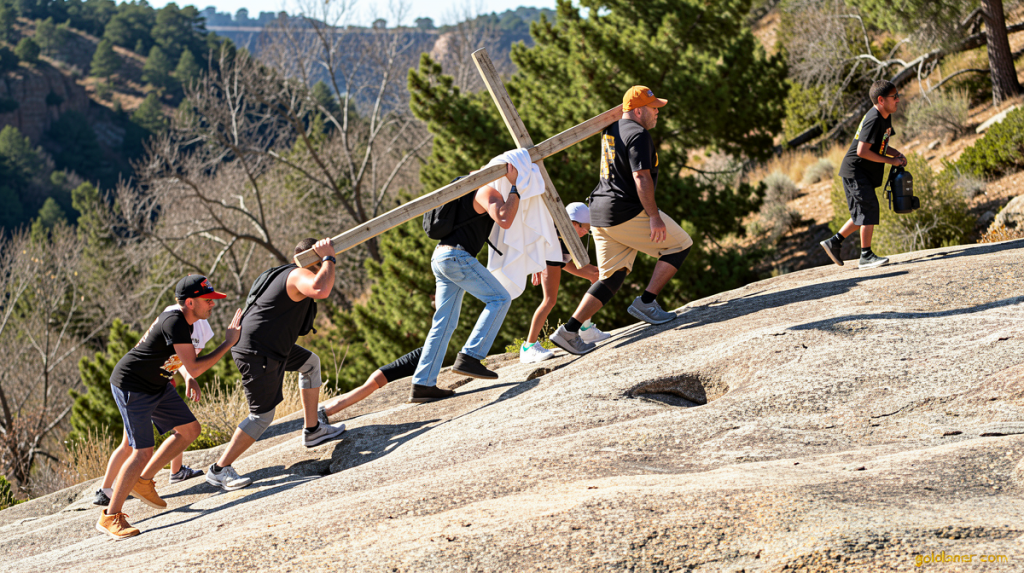
goldlaner.com – On Independence Day, Jean Shifrin found herself navigating a steep trail when an unusual procession caught her attention. Squinting against the bright morning light, the photographer watched as a White man and two Black men made their way upward, carrying an eight-foot wooden cross between them. The group moved with purpose, their footsteps echoing on the slippery incline.
At the front marched a Black man with the sturdy build of a football player. He balanced the cross’s head on his left shoulder, calling out in a commanding voice, “Yessir! Yessir!” Behind him, a White man with sun-reddened, tattooed arms supported the center beam. A third man, also Black and solidly built, brought up the rear of the procession.
Following this trio was a lively crowd. A young boy clutched a Bible while a middle-aged Chinese woman repeatedly encouraged them with “Jiayou!”—Mandarin for “Keep going!” Shifrin, a slender sixty-eight-year-old photographer, had seen many peculiar things on Stone Mountain, but this scene was particularly striking.
A Monument’s Complex Legacy
Stone Mountain rises 825 feet above the Atlanta area, a massive granite formation that has earned the nickname “Mount Rushmore of the Confederacy.” The enormous carving etched into its face depicts three Confederate leaders—Robert E. Lee, Thomas “Stonewall” Jackson, and Jefferson Davis—riding on horseback. This sculpture towers over the presidential faces at Mount Rushmore and stands as America’s largest Confederate monument.
The mountain’s history runs deep and complicated. It served as the birthplace of the modern Ku Klux Klan and remained a gathering point for White supremacist organizations for decades. Simultaneously, it became a focal point for Black Lives Matter demonstrators and others advocating for the removal of Confederate symbols. More than six hundred such monuments still dot the American landscape.
For Shifrin, a Jewish woman who had personally experienced antisemitism, the mountain once represented pure prejudice. “I was revolted,” she recalled of her first encounter with the carving in the 1990s. “The more I learned about the history of it and how it was started — it just got uglier and uglier.”
Healing and Transformation
Yet Stone Mountain has evolved. Shifrin discovered it became a sanctuary during a difficult period when a genetic condition threatened her mobility. The mountain transformed from a symbol of hatred into a place of personal healing.
Today, the area functions almost as a “mini-United Nations,” welcoming people of diverse backgrounds. Visitors come to exercise, meditate, and celebrate together. The transformation began decades ago and continues today as changes are made to the monument itself.
Shifrin’s photography revealed something unexpected: the men carrying the cross were motivated by more than religious devotion. Their actions challenged conventional narratives about Confederate symbols and demonstrated that dismantling monuments doesn’t always require destruction.
Roots of the Monument
The Stone Mountain carving emerged from beliefs similar to those that drove Southern secession. Alexander Stephens, the Confederate vice president, articulated these views in his famous “Cornerstone Speech.” He declared that the Confederacy rejected the Declaration of Independence’s assertion that “all men are created equal.”
“Our new government is founded upon exactly the opposite idea,” Stephens stated. “Its foundations are laid; its corner stone rests upon the great truth that the Negro is not equal to the White man; that slavery, subordination to the superior race is his natural and normal condition.”
The memorial project began in the early twentieth century, championed by a Confederate widow who initially wanted to include KKK members in the carving. Construction spanned more than fifty years, finally completing in 1972. The surrounding Stone Mountain Park opened on April 14, 1965—exactly one century after Abraham Lincoln’s death.
Shifrin’s encounter with the cross-bearers on that Fourth of July revealed that Stone Mountain holds multiple stories. The monument carries within it not only the weight of its controversial past but also the possibility of new meanings being forged by those who visit it.
