
These people say worshiping ancient Greek gods is a route to modern happiness
A Modern Path to Ancient Divinity in Athens
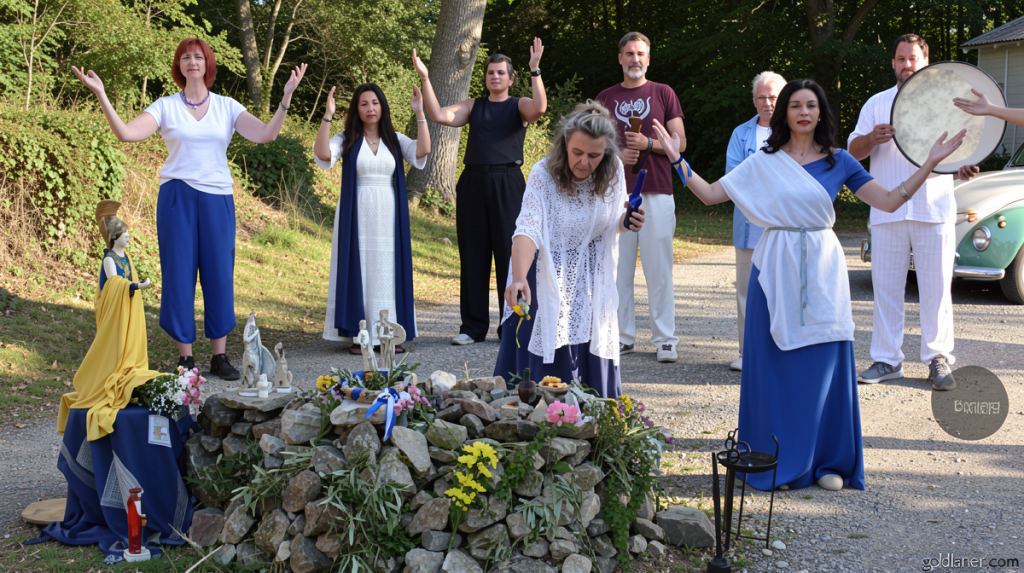
goldlaner.com – Within the bustling streets of Athens, a quiet but vibrant spiritual movement continues to thrive. Participants clad in white ceremonial garments emerge from behind a banner positioned before a modest cave entrance. A semi-circle of men and women of various ages gathers as a procession winds around a stone altar. One woman carefully sets a small statue of Athena—the ancient deity of wisdom—at the rear of the altar while fragrant frankincense fills the air. Though the setting evokes scenes from millennia past, this is decidedly contemporary life. Labrys, a dedicated community practicing modern Hellenistic or Greek Polytheism, maintains these traditions not merely as cultural heritage but as living faith in the twenty-first century.
The gathering marks Plynteria, an age-old Athenian celebration dedicated to purifying Athena’s sacred image. Labrys supports both communal ceremonies and personal home worship, honoring the deities familiar to us through classical masterpieces such as Homer’s “The Odyssey.” Christopher Nolan’s upcoming summer film adaptation of this epic poem adds yet another layer to the ancient narrative, featuring an ensemble cast that includes Matt Damon portraying Odysseus and Zendaya as Athena. Yet for certain Labrys members, the movie represents something more complex. Named after the double-edged axe—a revered symbol within both Minoan and Greek civilizations—Labrys views Hollywood’s treatment of Greek mythology as evidence of how Western pop culture has distanced contemporary Greeks from their ancestral past.
Voices of Cultural Reclamation
Christos Panopoulos, who co-founded Labrys and adopted the religious name “Pandion” in honor of two legendary Athenian kings, expresses disappointment regarding Greek representation in Nolan’s production and similar endeavors. “It’s an appropriation,” he stated while fellow members constructed a stone altar for the ceremony. “You don’t have one Greek actor.” His concern extends beyond casting choices. He believes the outside world has created an artificial boundary between ancient and modern Greece, treating the former as property belonging to everyone while excluding Greeks from controlling how their own stories are narrated. He suspects Hollywood would never attempt such a maneuver when depicting ancient Indian narratives.
Panopoulos emphasizes that Labrys practitioners are neither historical re-enactors nor participants in a revival movement. Instead, they represent a continuous thread of religious practice woven through Greek history. Even Greek Orthodox Christianity, which became the dominant faith after Emperor Theodosius I prohibited pagan sacrifices and shuttered temples toward the close of the fourth century CE, absorbed elements from earlier traditions. Deities were transformed into religious icons; Poseidon, for instance, evolved into Saint Nicholas, protector of seafarers.
Personal Spirituality and Divine Connection
For individuals like Panopoulos, these ancient narratives remain deeply relevant to contemporary understanding. After years of spiritual searching during his adolescence, he discovered that polytheism aligned most closely with his existing beliefs and experiences. “Because I’m Greek, I happen to be born here, the closest thing is Greek polytheism,” he noted. He acknowledges with a gentle smile that his faith did not arrive through dramatic divine intervention—Zeus did not descend to issue commands. Rather, it developed gradually as a sense of alignment with something greater.
Greek Polytheism provides Panopoulos with a framework for comprehending the world and his place within it. He and his community may attribute significance to Zeus or Apollo in ways that other traditions reserve for God, Allah, or other supreme beings. “The myths and the religious acts are like a symbolic language to do something, in order to achieve something,” he clarified. “And what we want to achieve is a connection with the divine. This is the point.”
Labrys operates alongside other organizations serving Greek Polytheists. The group originated from a 2007 separation from the Supreme Council of Ethnic Hellenes, known as YSEE. Panopoulos characterizes this division as stemming from YSEE’s excessive emphasis on political matters rather than spiritual practice. Critics have long accused YSEE of advancing aggressive anti-monotheistic positions alongside far-right political ideology.
