
These Gen Zers are into a new kind of clubbing and it’s more prayer than party
Gen Z’s Spiritual Rave: A New Era of Bhajan Clubbing in India
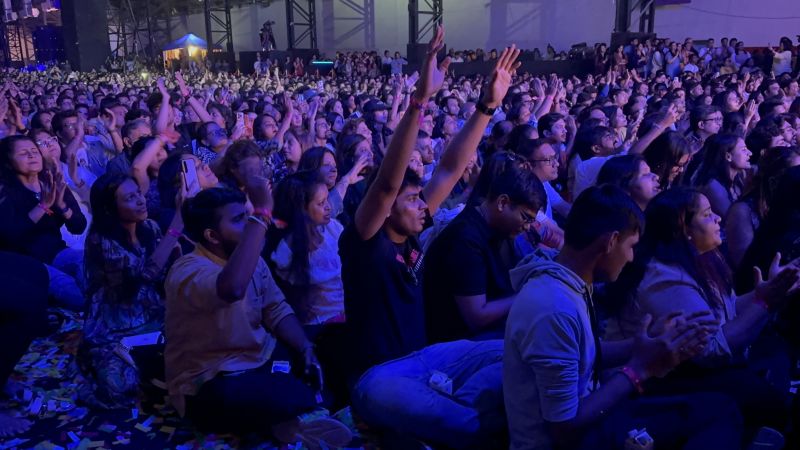
These Gen Zers are into a new – As night descends over Mumbai, a city pulsing with commercial energy, the atmosphere inside a sprawling venue transforms into something unexpected. The space, once a hub for corporate gatherings, now hums with a different kind of rhythm. Thousands of attendees, ranging from young professionals to teenagers, have gathered, their excitement palpable. Event staff are busy scanning QR codes and securing wristbands, while friends capture moments with their phones. The air is thick with anticipation, and as the doors open, the crowd flows in, shedding their shoes and settling cross-legged on the floor. This is not your typical clubbing scene.
From Temples to Dance Floors: The Rise of Bhajan Clubbing
Inside, the lights flicker lower, casting a soft glow over the assembled group. The first notes of music reverberate through the space, but they are far removed from the electro beats or pop anthems that usually define nightlife. Instead, the sound is a familiar one to those who have attended religious processions or visited temples: devotional Hindu hymns, known as bhajans. These ancient songs, traditionally sung in reverence to deities, now echo through a modern, ticketed event that blends spirituality with the energy of a rave. The crowd rises as the music swells, their voices joining in unison to chant and dance, creating a wave of collective euphoria.
“It was like a spiritual awakening,” said Jill Veera, 25, a first-time attendee. “The atmosphere was so intense, it felt like we were all connected in a way I’ve never experienced before.” Her description captures the essence of this movement, which has taken root in India’s urban centers and is reshaping how young people engage with spirituality. Unlike traditional gatherings, these events are designed to be immersive, with production values that rival those of electronic music festivals. Smoke machines swirl in the air, giant LED screens display visuals, and the beat of the bhajans propels the crowd into a state of communal celebration. Yet, the absence of alcohol and drugs is striking. “Here, the focus is on the music and the shared experience,” added Veera. “Even the buttermilk we sip feels like a form of celebration.”
Reviving Tradition in a Modern Context
The bhajans themselves are centuries-old, rooted in India’s spiritual heritage. They have long been a part of temple rituals and religious processions, their melodies carrying prayers and devotion. But the contemporary twist lies in the setting: large venues, professional staging, and a crowd that mirrors the vibrant energy of a nightclub. This fusion has caught the attention of Gen Z, who are increasingly seeking alternatives to the party culture that dominated previous decades.
“The theatrics are what make it appealing,” explained Dhwani Paradia, 26, who attended the event with her younger sister. “We grew up with electronic music and concerts, so the visual elements and the beat here feel like a natural evolution of that experience.” Her sister, Fiyoni Paradia, 23, echoed this sentiment. “Even the backdrops are similar to techno shows,” she said. “It’s like the spiritual aspect has found a new home in the world of entertainment.”
At the heart of this movement is Backstage Siblings, a duo that has reimagined bhajans for a younger audience. Raghav Agarwal, one half of the group, told CNN that their goal is to bridge the gap between tradition and modernity. “Bhajan clubbing isn’t about replacing the old with the new,” he said. “It’s about making spirituality accessible in a way that resonates with today’s generation.” His sister, Prachi Agarwal, emphasized the inclusivity of the events. “People come here with grandparents, friends, or dates,” she said. “It’s a space where everyone can feel at ease, whether they’re seeking a deeper connection or just a good time.”
A Cultural Shift and Economic Impact
The trend’s popularity has not gone unnoticed. Saregama, a revered music label with roots tracing back to the 19th century, has endorsed the movement, signaling its mainstream appeal. Online, the events have gained traction, with videos of chanting crowds and emotional moments like strangers hugging or dancing barefoot amassing millions of views. These gatherings, though rooted in tradition, are also part of a broader cultural shift that challenges rigid rituals and redefines spiritual engagement.
India’s religious and spiritual economy, valued at over $58 billion in 2025, is poised for growth as younger generations seek more dynamic expressions of devotion. Bhajan clubbing has emerged as a symbol of this change, blending ancient practices with contemporary aesthetics. Critics, however, argue that the trend risks commercializing spirituality, reducing it to a spectacle rather than a deeply personal experience. “It’s easy to see the appeal,” said one social media user, “but does it still hold the same meaning when it’s staged like a concert?”
Despite the debate, the movement has found support among India’s political elite. Leaders from the ruling Hindu-nationalist Bharatiya Janata Party (BJP), including Prime Minister Narendra Modi, have publicly praised the gatherings. In a speech, Modi highlighted how Gen Z’s embrace of bhajan clubbing reflects a return to “authentic” spiritual values. “It’s heartening to see young people reconnect with their cultural roots,” he said. “These events show that devotion can thrive in the modern world without losing its essence.”
Gen Z and the Sober Curious Movement
Bhajan clubbing is part of a global trend known as “sober curious,” where young people are opting for alcohol-free celebrations. This movement, which has gained momentum in Europe and America, is now taking hold in India, where Gen Z is redefining what it means to “have a good time.” For many, the appeal lies in the combination of music and mindfulness. “It’s a way to enjoy yourself without compromising your values,” said Jill Veera. “You can dance, connect, and feel spiritual all at once.”
Event organizers have deliberately crafted these spaces to encourage introspection and community. The absence of intoxicants creates an environment where participants can focus on the music and their shared experience. “The energy here is pure,” said Fiyoni Paradia. “There’s no distraction, just the music and the moment.” This has led to a unique kind of engagement, where the crowd’s reactions—tears, laughter, and spontaneous dance—reflect a deeper emotional connection. For some, it’s a spiritual retreat; for others, it’s a new form of social interaction. Either way, the events have become a testament to the evolving relationship between youth culture and tradition.
As the trend gains momentum, it raises questions about the future of spiritual practices in India. Will bhajan clubbing remain a niche movement, or will it become a mainstream phenomenon? With its blend of old and new, the events offer a glimpse into a generation that is redefining spirituality for the digital age. Whether it’s the hypnotic chants, the immersive visuals, or the sense of community, Gen Z is finding a way to celebrate their faith—and themselves—without the need for a drink.
“This isn’t about giving up fun,” said Raghav Agarwal. “It’s about finding a way to enjoy life that aligns with who we are.” For him and his sister, the movement is a creative outlet, a means to honor their heritage while appealing to a contemporary audience. As more young people flock to these gatherings, the line between prayer and party continues to blur, creating a new kind of cultural experience that is both sacred and electric.
Bhajan clubbing is more than just a trend; it’s a reflection of Gen Z’s desire to merge tradition with modernity. In a world where spirituality is often seen as outdated or confined to temples, these events offer a fresh, inclusive space where faith can be experienced through movement, music, and collective joy. As the movement grows, it challenges the notion that spirituality must be solemn or reserved. Instead, it presents a vision of devotion that is dynamic, accessible, and alive—proving that the soul of India’s ancient practices can thrive in the 21st century.
