More than 45 dead in Myanmar town after massive blast in building storing explosives

Myanmar Town Suffers Devastating Blast, Over 45 Killed
More than 45 dead in Myanmar – On Sunday, a massive explosion rocked a building in northeastern Myanmar, leading to the deaths of more than 45 people and injuring around 70 others, according to rescue workers and independent media. The incident occurred in the village of Kaungtup, located within Namhkam township, approximately 3 kilometers south of the Chinese border. This region has been under the control of the Ta’ang National Liberation Army (TNLA), an ethnic armed group that has been involved in sporadic conflicts with Myanmar’s central government.
Rescue Efforts and Casualty Reports
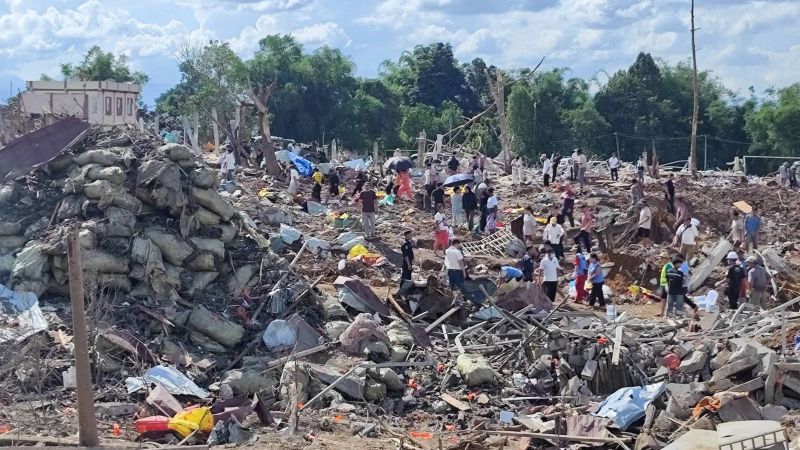
Rescue personnel on the scene estimated that 46 bodies, including six children, had been recovered by Sunday evening. These remains were then transported for cremation, as per the initial findings. A second rescue worker, who spoke without revealing their identity due to security concerns, reported that 74 injured individuals had been taken to the township hospital for treatment. However, discrepancies emerged as some sources, including local media, suggested the death toll could be as high as 50 to 55. Photos and videos shared by Myanmar-based outlets like Shan State’s Shwe Phee Myay news agency showed the aftermath, highlighting the extent of damage to structures and the debris scattered across the area.
“We’ve recovered 46 bodies so far, and the situation is still unfolding. Many of the injured are in critical condition,” said one anonymous rescuer, speaking to The Associated Press.
The explosion, which took place around noon, was attributed to a storage facility holding explosives for mining activities. Chinese state broadcaster CCTV noted the event caused multiple fatalities and widespread injuries, though it did not specify exact numbers. The report indicated that residential homes in the vicinity suffered severe damage, with over 100 buildings reported to be affected. The TNLA, which controls the area, stated in a Telegram statement that gelignite had been stored by its economic department for use in mining and stone quarrying operations. The group confirmed an ongoing investigation to determine the cause of the blast.
Conflict Context and Ethnic Groups
The TNLA is part of the Three Brotherhood Alliance, a coalition of ethnic armed groups that has been engaged in a protracted struggle for greater autonomy. Since late 2023, the alliance and its allies launched a significant offensive against the military in the region, leading to the TNLA’s control over Namhkam township. The group had previously signed a ceasefire agreement with Myanmar’s military in October 2025, following China-mediated discussions. However, tensions persist, with sporadic skirmishes reported between the TNLA and government forces.
Meanwhile, the broader conflict in Myanmar continues to escalate. The country has been in turmoil since the military coup on February 1, 2021, when the armed forces overthrew the elected government led by Aung San Suu Kyi. This event sparked nationwide protests, which were met with brutal suppression, prompting many civilians to join the resistance. Now, large swaths of the nation are engulfed in armed conflict, with various ethnic groups challenging the central government’s authority. The TNLA’s control of Kaungtup underscores the ongoing struggle between local rebel groups and the military.
Impact of the Explosion
The blast has left a profound impact on the local population. In addition to the casualties, the destruction of over 100 homes in the surrounding area has displaced numerous families. Rescue operations are still in progress, with teams working tirelessly to locate survivors and assess the full scale of the disaster. Local authorities have pledged to provide immediate relief, including medical aid and temporary housing for those affected. The extent of the damage has also raised concerns about the safety of the explosives stored in the facility, which could have been a catalyst for the tragedy.
Experts have pointed out that gelignite, commonly used in mining and rock blasting, can become unstable if not stored properly. This instability may have contributed to the explosion’s severity. The TNLA’s economic department was reportedly responsible for managing the explosives, but the lack of clear storage protocols might have played a role in the incident. The group has not yet confirmed whether the explosion was intentional or accidental, though its involvement in the storage process is undeniable.
Broader Implications for Myanmar’s Conflict
The explosion in Kaungtup adds to the growing list of incidents that have intensified the conflict in Myanmar. Since the 2021 coup, the country has experienced a series of attacks, with ethnic armed groups leveraging their control over rural areas to challenge the military’s dominance. The TNLA’s presence in the region has been critical, as it represents one of the more organized factions within the broader resistance movement. The destruction of the explosives storage site not only highlights the dangers of armed conflict but also underscores the vulnerability of civilian areas to such incidents.
As the investigation into the blast continues, questions about accountability and the role of various actors in the conflict remain. The TNLA’s statement emphasizes its commitment to transparency, but the incident has also drawn international attention to the risks faced by communities in regions under rebel control. Independent media outlets and local residents have expressed concerns about the lack of infrastructure and resources to handle such large-scale disasters, further complicating recovery efforts.
Historical Background of the Conflict
The roots of the current conflict trace back to the military’s seizure of power in 2021, which ignited widespread dissent. Prior to this, ethnic groups had long sought increased autonomy, often clashing with the government over resource control and political representation. The formation of the Three Brotherhood Alliance in recent years marked a significant shift, as it brought together multiple rebel groups to coordinate their efforts against the central government. The TNLA’s involvement in this alliance has strengthened its position, allowing it to maintain control over key territories like Namhkam.
Despite the ceasefire signed in October 2025, the situation remains volatile. The agreement aimed to reduce hostilities, but it has not eliminated the underlying tensions. The explosion in Kaungtup could be seen as a symbolic event, reflecting the ongoing instability in the region. As the investigation unfolds, it may shed light on whether the incident was a result of accidental mishandling or deliberate sabotage, potentially influencing the course of future negotiations between the TNLA and the military.
With the conflict showing no signs of abating, the explosion serves as a stark reminder of the human cost of the ongoing struggle. The TNLA’s control of the area has allowed it to operate with relative autonomy, but such incidents highlight the risks of living in regions where both rebels and the military continue to vie for dominance. The international community has called for further dialogue to address the humanitarian crisis, but as long as the war persists, the threat to civilian populations will remain a pressing concern.
This story is still evolving, and updates are expected as more information becomes available. The explosion in Kaungtup has not only affected the local community but also brought renewed focus to the broader conflict in Myanmar, where the balance of power continues to shift. As rescue operations continue and the investigation into the blast progresses, the full impact of this tragedy on the region’s future will become clearer.