Four killed as Belgian school bus hit by train after appearing to plow through barrier

Tragedy at Buggenhout: School Bus Collides with Train, Four Lives Lost
Four killed as Belgian school bus hit – On Tuesday morning, a school minibus collided with a train in northern Belgium, resulting in the deaths of four individuals, including two minors. The incident occurred at a level crossing in the town of Buggenhout, prompting local authorities to classify it as a “serious traffic accident.” According to police, the collision happened when the minibus apparently ran into a barrier before being struck by the train. Emergency services arrived swiftly at the scene, where they worked under challenging conditions to stabilize the situation.
The Scene of the Collision
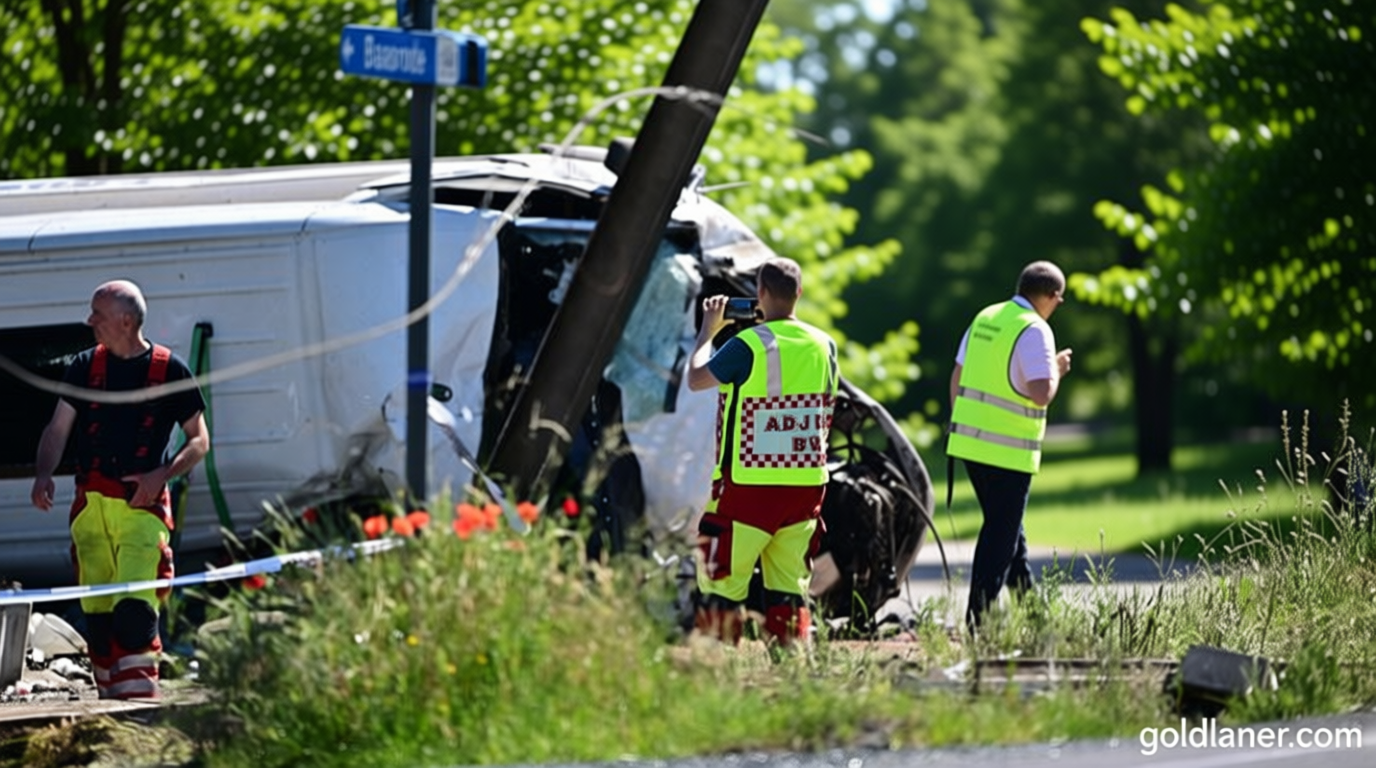
Photographs from the crash site revealed the minibus overturned on its side, lying partially on the railway tracks. The vehicle’s exterior was extensively damaged, with shattered windows and a crumpled frame indicating the force of the impact. Witnesses described the moment as chaotic, with the train emerging from the collision with minimal structural damage. No passengers on board the train were reported injured, though the minibus was left in a severe state of disrepair.
Victims and Their Backgrounds
Public Prosecution Service spokesperson Lisa De Wilde confirmed the fatalities: two students aged 12 and 15, a school attendant, and the bus driver, who was 49 years old. Five additional children sustained serious injuries during the incident and were hospitalized in stable condition. The victims included students from a nearby special education school, which authorities cited as the origin of the minibus. The school’s name was not immediately disclosed, but local media highlighted the tragic nature of the event, emphasizing the vulnerability of the young passengers involved.
Investigation and Initial Findings
Belgian officials launched an investigation into the accident, assigning a traffic expert and a forensic laboratory to the scene. The inquiry is still in its early stages, but key details have been established. Thomas Baeken, a representative of the Belgian rail track operator Infrabel, stated that the barriers at the level crossing were down, and the red warning signal was active at the time of the collision. “Footage shows that the barriers were in the closed position, and the traffic lights were red,” Baeken told Flemish public news channel VRT. “We do not know how the accident could have happened.”
“The barriers were down and the red warning signal was operating at the time of the collision,” Thomas Baeken of Infrabel stated. “We do not know how the accident could have happened.”
Despite the barriers being closed, the train driver applied the emergency brake before the impact. However, the train could not be stopped in time, leading to the collision. The driver, who had no prior convictions, tested negative for drugs and alcohol, according to authorities. This finding suggests the accident may have been caused by a combination of factors rather than a single mistake.
Statements from Officials
In the aftermath of the crash, Belgian Prime Minister Bart De Wever expressed his condolences on X, describing the incident as “horrific” and acknowledging the emotional toll on the families involved. “I was deeply moved by the tragedy in Buggenhout,” he wrote, adding his thoughts to the affected households. Similarly, Flemish Education Minister Zuhal Demir shared her sorrow, calling the news “heartbreaking” before thanking emergency personnel for their rapid response.
“What heartbreaking news from Buggenhout,” Demir wrote. “My thoughts are with the families affected.”
European Commission President Ursula von der Leyen also voiced her sympathy, stating she was “heartbroken” to learn of the accident. “My deepest condolences go out to the victims’ families and their loved ones,” she said in a statement. The international response underscored the gravity of the incident, highlighting the need for a thorough examination of safety protocols at the level crossing.
Focus on Safety Protocols
Authorities are now scrutinizing the safety measures in place at the time of the collision. While the barriers were confirmed to be closed and the warning signal functioning, questions remain about why the minibus proceeded through the crossing. Police spokesperson An Berger noted that it is too early to determine whether human error, mechanical failure, or other factors contributed to the accident. “It’s too early to say anything,” Berger said, emphasizing the need for further analysis.
The investigation will explore the sequence of events leading up to the collision. Key factors under review include the condition of the barriers, the visibility of the train and minibus, and the reaction times of both drivers. Infrabel, which operates the rail network, has stated that the barriers were functioning as expected, but their exact position at the moment of impact is yet to be confirmed. The crash has raised concerns about the safety of level crossings, particularly those near educational institutions.
Community and Family Impact
The collision has left a profound impact on the local community and the families of the victims. The special education school where the students were traveling is now in the spotlight, with questions about how the minibus reached the crossing despite the active warning system. Parents and teachers have expressed shock and grief, while emergency services have been praised for their quick actions in the early hours of Tuesday. The school’s name and the specific route taken by the minibus are still being verified, but the tragedy has sparked a conversation about transportation safety in Belgium.
Future Steps and Preventive Measures
As the investigation continues, officials are considering what steps can be taken to prevent similar incidents. The local government has already announced plans to review the safety procedures at the level crossing, including the possibility of upgrading the warning system. “We are committed to understanding why this happened and ensuring it doesn’t occur again,” a government representative said in a statement. The forensic analysis of the minibus and train will provide critical insights into the accident’s cause.
Meanwhile, the families of the victims are receiving support from local authorities and community members. The school has also announced plans to hold a memorial for the affected students, with plans to involve parents and teachers in the event. The tragedy has reminded the public of the importance of vigilance at level crossings, especially during peak hours when school buses are most active.
With the investigation ongoing, the focus remains on uncovering the truth behind the collision. The combination of mechanical systems and human oversight at level crossings will be central to the analysis. As the community processes this loss, the hope is that the findings will lead to improved safety measures, protecting future students and passengers. The incident serves as a somber reminder of the risks associated with daily commutes, particularly in areas where rail and road networks intersect.
Belgium’s transport infrastructure, which plays a vital role in connecting towns and cities, is now under closer examination. The Buggenhout level crossing, where the collision occurred, is one of several points where trains and vehicles share the same path. Authorities are working to determine whether the accident was an isolated incident or part of a larger pattern. The findings will be crucial in shaping policies and updates to ensure the safety of all road and rail users.
The event has also drawn attention to the responsibilities of both drivers and the systems they rely on. While the train driver followed protocol by applying the emergency brake, the minibus driver’s actions remain under review. The bus driver, who had no prior convictions, is expected to be the subject of an autopsy to determine the cause of death. These details will be key in the ongoing investigation, shedding light on whether the accident was preventable.
As the days pass, the families of the victims will continue to seek answers, while the broader community reflects on the importance of preventive measures. The collaboration between transportation experts and local officials aims to provide clarity and reassurance that such tragedies will not be repeated. The Buggenhout collision has become a pivotal moment in Belgium’s efforts to enhance road and rail safety, emphasizing the need for constant vigilance and innovation in transportation systems.