
Ancient DNA reveals clues about mysterious ‘Golden Man’ and rise of the Scythian elites
Ancient DNA Unveils Scythian Elite Lineage and Social Hierarchy
Ancient DNA reveals clues about mysterious – The Scythians, legendary nomadic warriors who traversed the Eurasian Steppe on horseback during the Iron Age, were known for their sophisticated society and distinct cultural practices. At the heart of their civilization was an elite class that wielded significant power, their status reflected in grand funerary rituals that often included lavish grave goods. One such figure, the enigmatic “Golden Man,” has captivated historians for decades due to the wealth of artifacts discovered in his kurgan, a burial mound excavated in 1969 in Kazakhstan. Recent genetic research has provided groundbreaking insights into how this elite hierarchy was maintained, revealing that Scythian leaders inherited their positions through familial ties, a practice that marked a shift from the more fluid social structures of the Bronze Age.
The Golden Man’s Enigmatic Identity
For years, scholars debated the gender of the Golden Man, a 4th-century BCE individual whose tomb was adorned with over 4,000 gold ornaments, iron weapons, and bronze items. Despite the name, the youth’s biological sex remained uncertain, with some theories suggesting a male identity and others proposing a female one. A new study, published in *Science Advances*, used advanced DNA analysis to resolve this mystery, uncovering evidence that points to a male lineage. By examining genetic markers across the individual’s genome, researchers filled in gaps in the data, confirming that the Golden Man belonged to a southern Scythian subgroup known as the Saka. This discovery not only clarifies his identity but also highlights the interconnectedness of Scythian elites across vast distances.
“This paper does a fantastic job of integrating genetic, archaeological, and textual findings to support their interpretations of lineage-based status,” said Alicia R. Ventresca-Miller, an associate professor of anthropology at the University of Michigan and an associate curator of archaeological sciences at the university’s Museum of Anthropological Archaeology. She was not involved in the study but praised its comprehensive approach. “An elite system that is lineage-based is a very important finding, as wealth was passed down across generations,” Ventresca-Miller told CNN in an email. “And now, the researchers found, so was social status and power.”
Genetic Links Across Scythian Elites
Researchers analyzed DNA from 85 individuals, including 38 from elite burials and 47 from non-elite graves, to trace relationships within Scythian society. The study found that the genetic profiles of upper-class individuals shared distinct similarities, indicating a hereditary system that was not present in earlier Bronze Age communities. These genetic markers, known as runs of homozygosity, reveal common ancestry among elites, even those from separate burial sites spread across the region. Such connections suggest that Scythian power was concentrated within families, reinforcing a structured social hierarchy that evolved over time. This finding challenges the earlier assumption that Scythian society was purely meritocratic, instead highlighting the role of kinship in determining influence.
The research also uncovered how genetic diversity changed during the Iron Age. While Bronze Age populations exhibited a broader range of genetic backgrounds, Iron Age elites displayed a more homogenous genetic makeup. This trend implies that elite families may have intermarried or formed exclusive networks, limiting genetic mixing and strengthening their collective dominance. The study’s authors noted that these genetic subgroups could have played a key role in preserving cultural continuity despite the region’s dynamic interactions with neighboring peoples.
The Architecture of Elite Burial Practices
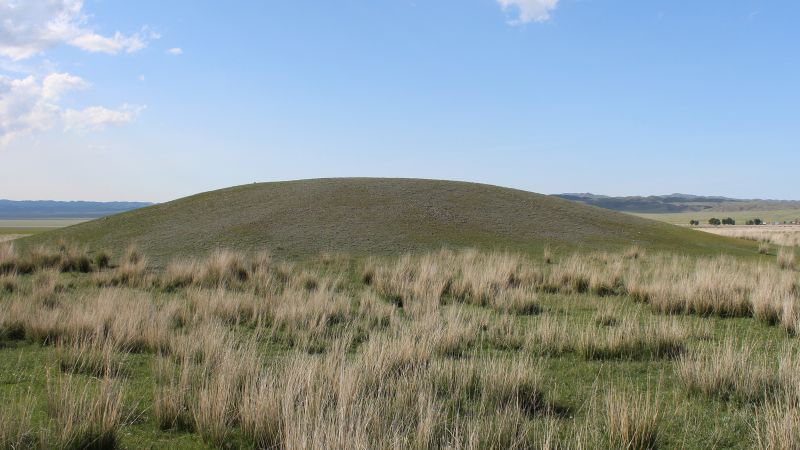
Scythian kurgans, or burial mounds, were monumental structures that symbolized the status of their occupants. These towering tombs, some reaching 49 feet in height and spanning over 345 feet in diameter, were designed to house the remains of elite individuals along with their personal belongings. The presence of mummification and postmortem trepanation—drilling a hole in the skull to remove the brain—further emphasized the Scythians’ commitment to preserving their leaders’ bodies. According to Ainash Childebayeva, senior author of the study and an assistant professor at the University of Texas at Austin, these practices were likely necessary due to the time required to prepare elaborate burials. “It would make sense if one had to build a mound to bury this individual, or if they had to be transported to a specific location where they would be laid to rest,” she explained to CNN.
The design of elite kurgans often included corridors, catacombs, and side chambers, which may have served as spaces for displaying artifacts or housing relatives. In one remarkable case, the remains of an elite man and his grandchildren were found in kurgans located over 60 miles apart. This spatial separation, combined with the shared social status, intrigued scientists as a potential indicator of dynastic rule. The youngest grandchild, buried at just one year old in an elite tomb, underscored the idea that leadership was not merely a personal achievement but a family inheritance. “To me, that was also a sign that this status was hereditary,” Childebayeva remarked.
Implications for Scythian Society and History
The study’s findings have reshaped our understanding of Scythian social organization. By linking elites through genetic evidence, researchers have demonstrated that the rise of powerful lineages was a deliberate process, supported by cultural practices and architectural choices. The preservation of bodies through mummification and trepanation, for instance, may have been a way to honor familial bonds and ensure the elite’s legacy endured. These insights also provide a framework for interpreting other Scythian archaeological sites, offering a clearer picture of how status was transmitted across generations.
Further analysis of Scythian DNA has revealed patterns of migration and cultural exchange that enriched their society. While the elites maintained a distinct genetic identity, non-elite populations showed greater diversity, reflecting the Scythians’ mobile lifestyle and interactions with other groups. This contrast suggests that while the upper class consolidated power through inheritance, the broader population remained more fluid in its composition. The study’s authors argue that such genetic homogeneity among elites could have facilitated the creation of a unified ruling class, even as the Scythians expanded their territory across Eurasia.
Archaeologists have long speculated about the Scythians’ social dynamics, but the integration of genetic data has provided concrete evidence of their hierarchical structure. The Golden Man’s tomb, with its wealth of gold and bronze items, stands as a testament to the elite’s material abundance and their ability to command resources. However, the discovery that these individuals were genetically related to one another adds a new dimension to their story, revealing a system where power was both inherited and perpetuated. This dual inheritance of wealth and status likely solidified the elites’ control over the Scythian polity, ensuring their dominance for centuries.
The research also opens new avenues for exploring the Scythians’ relationship with neighboring cultures. While their elite class was rooted in kinship, the broader population may have drawn from diverse genetic backgrounds, indicating a complex interplay between tradition and external influence. By examining the genetic makeup of both elites and commoners, scientists can now better trace the movements of Scythian groups and their interactions with other civilizations, such as the Persians and Greeks. This interdisciplinary approach—combining DNA analysis with archaeological and textual evidence—has set a new standard for studying ancient societies, offering a more nuanced understanding of their social and political systems.
In conclusion, the genetic analysis of Scythian remains has transformed our view of their civilization, revealing that hereditary status was a cornerstone of their elite structure. The Golden Man’s tomb, once a symbol of individual glory, now serves as a focal point for understanding the broader mechanisms that shaped Scythian society. As researchers continue to uncover more genetic data, they may further illuminate the Scythians’ role in the history of Eurasian cultures, bridging the gap between ancient traditions and modern scientific inquiry.
