
A submersible ride revealed a vast whale graveyard. And it holds more than just bones
A Submersible Discovery Unveils a Massive Whale Graveyard in the Depths
A submersible ride revealed a vast – In a groundbreaking expedition to the southeastern Indian Ocean, researchers uncovered one of the largest and deepest whale graveyards on Earth. This remote site, located in the Diamantina Zone, contains hundreds of fossilized remains, including evidence of a species never before documented. The discovery, reported in the journal *Nature*, sheds new light on the long-standing mystery of how whale carcasses sustain life in the ocean’s most extreme environments.
Unearthing a Deep-Sea Necropolis
The graveyard spans an area of approximately 746 miles (1,200 kilometers) in length, with whale bones scattered across the seafloor at depths reaching 15,000 to 23,000 feet (5,000 to 7,000 meters). What makes this site extraordinary is its age—fossil remains there date back at least 5 million years, indicating that the accumulation of whale skeletons has persisted for an immense stretch of time. Alongside ancient bones, scientists observed modern carcasses, some still bearing scavengers, suggesting a continuous cycle of life and death in this region.
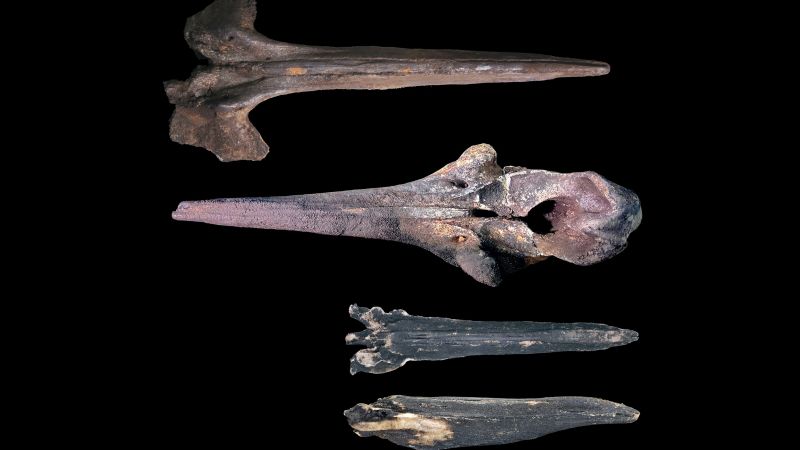
Beaked whales dominate the fossil record at the site, their elongated, dolphin-like snouts distinguishing them from other cetaceans. These deep-diving mammals rarely surface, making them elusive to observers. As a result, their behavior and life patterns remain poorly understood. The presence of both fossilized and fresh remains implies that the Diamantina Zone has served as a natural trap for these creatures for millennia, drawing them to the seafloor in a seemingly unbroken sequence.
“Until now, whale falls were mostly based on large cetacean carcasses, mostly baleen whales,” said Olivier Lambert, a vertebrate paleontologist at the Royal Belgian Institute of Natural Sciences in Brussels. “Here the authors show that beaked whale carcasses can play a similar role in some specific deep oceanic regions.”
Whale falls—dead whales that sink to the ocean floor—serve as vital ecosystems for deep-sea life. Scavengers such as bone-eating worms, brittle stars, and chemosynthetic bivalves thrive on the remains, breaking down the carcass and recycling nutrients in the abyss. The study’s authors noted that many of these species may yet be classified, highlighting the site’s potential for new scientific revelations.
The Science Behind the Graveyard
The Diamantina Fracture Zone, where the graveyard lies, is a geological feature formed between 30 and 40 million years ago during the separation of the Australian and Antarctic landmasses. This tectonic activity created deep trenches and ridges, which likely contributed to the site’s role as a sink for whale remains. The combination of depth, currents, and sedimentation has preserved the bones in remarkable detail, offering a window into the evolutionary history of these marine giants.
Researchers from the Global Hadal Trench Exploration Program, an international collaboration, used the submersible *Fendouzhe* (“Striver” in Chinese) to explore the area. This vehicle, which previously reached the Challenger Deep in the Mariana Trench in 2020, enabled the team to capture detailed imagery and collect samples from the seafloor. During 32 dives between February and March 2023, they documented 485 whale-fossil deposits and five modern whale falls, underscoring the site’s ongoing ecological significance.
“Although this is a truly massive whale graveyard, reaching it is extremely difficult due to the great depth,” said Peng Zhou, a co-lead author of the study and researcher at the Institute of Deep-Sea Science and Engineering in Beijing. “When we first observed this site, it came as a complete surprise to everyone. And then we saw the little head.”
One of the most striking findings was the density of the fossils, with some sections holding roughly 760 remains per square kilometer—far exceeding previous records. Based on these observations, the team estimates over 10 million whale skeletons lie within the trench. Zhou also noted that additional bones may be buried beneath sediments, suggesting the actual number could be even higher. The continuous deposition of remains indicates a stable process of whale carcasses sinking and being preserved over millions of years.
Implications for Deep-Sea Ecology
While the existence of whale graveyards isn’t entirely unexpected, the scale of this discovery is unprecedented. The Diamantina Zone’s unique conditions—likely a convergence of ocean currents and geological features—have created a hotspot for whale remains. This has allowed researchers to study the long-term ecological impact of these carcasses, which support entire communities of organisms in the absence of sunlight.
Whale falls act as underwater oases, providing sustenance for species adapted to chemosynthesis, a process by which organisms convert chemicals into energy. The presence of such diverse life forms near the site suggests that the graveyard may function as a microhabitat for deep-sea biodiversity. Lambert emphasized that this discovery challenges previous assumptions about the role of beaked whales in sustaining these ecosystems, opening new avenues for research on deep-sea life cycles.
Interestingly, the graveyard’s location aligns with regions known to host numerous beaked whale populations. Fossilized skulls of these whales have been found in nearby areas, such as off the coasts of Iberia, South Africa, and the Kerguelen Islands, often snagged by trawlers or long-line fishing vessels. The Diamantina Zone, however, offers a more concentrated and preserved record of these creatures, providing insights into their historical distribution and survival strategies.
Despite its remoteness, the graveyard’s importance is undeniable. The expedition’s findings not only confirm the long-standing presence of whale remains but also reveal the dynamic interactions between marine life and geological processes. As Zhou explained, the site’s discovery underscores the need for continued exploration of Earth’s deepest regions, where hidden ecosystems may hold answers to broader questions about biodiversity and evolution.
A Legacy in the Deep
This vast necropolis, with its layered history of whale deaths, represents a natural archive of marine life over millions of years. The intermingling of ancient and modern remains highlights the resilience of the ocean’s ecosystems and the enduring role of whales in shaping them. For scientists, the Diamantina Zone is more than a graveyard—it’s a testament to the interconnectedness of life in the deep sea, where even the most elusive creatures leave their mark on the seafloor.
The discovery also raises questions about the future of these habitats. As human activity intensifies in deep-sea regions, the preservation of such sites could be threatened. Protecting the Diamantina Zone and similar areas may be crucial for studying the hidden biodiversity that depends on the natural recycling of whale remains. For now, the graveyard stands as a remarkable example of nature’s ability to sustain life in the darkest, most inhospitable corners of the planet.
