
The new tastemakers are cutlery designers
The new tastemakers are cutlery designers
The new tastemakers are cutlery designers – Dung Ngo, a design writer and collector, has amassed over 10,000 pieces of cutlery. His journey began 25 years ago, when he reached the age of 30 and realized that the utensils he purchased after college from Target no longer reflected his evolving identity. In a vintage shop, he stumbled upon a 40-piece set he adored for $400, and spent a week combing through old design journals until he pinpointed it: Composition, a masterpiece by the celebrated Finnish designer Tapio Wirkkala. Today, a complete Wirkkala set can command prices exceeding $3,600, a testament to its enduring appeal.
That finding ignited a passion for Ngo, who began acquiring iconic cutlery pieces from eBay and antique stores. He sought out designs that matched faded photographs from 1940s, 1950s, and 1960s design magazines, driven by a desire to connect with the past. “I became hooked,” he later reflected. “Cutlery is among the most intimate objects in daily life.” His obsession culminated in a groundbreaking project: a 600-page book titled Knife Fork Spoon: Modernist Cutlery 1900–2025, set to release in August. The book is paired with an exhibition at the Denver Art Museum, featuring over 150 designs organized chronologically around themes such as airlines, children, and travel.
While the book and exhibition trace 125 years of flatware evolution, Ngo believes the narrative is incomplete. “There is also a future to this category,” he said, adding, “maybe I can actually participate in that future in a real, physical way, rather than just writing about it.” This sentiment underscores his broader vision to bridge the gap between tradition and innovation. As editor in chief of the architecture and design journal AUGUST, Ngo has always been attuned to the intersection of art and function. But his latest work takes this idea further, challenging the status quo of cutlery design.
His research revealed a structural issue: modern cutlery has remained largely unchanged for 150 years. “We start with a flat sheet of metal, then you bend it,” he explained. “It can get quite three-dimensional, but never highly sculptural.” This lack of transformation in form is paired with a decline in artisanal craftsmanship. During a visit to Solingen, Germany’s historic hub for cutlery makers, Ngo discovered that only a few manufacturers remained. A trip to Sheffield, England—known as the “Steel City” for its industrial legacy—confirmed the same pattern. “It’s nearly all gone,” he said, noting the emotional weight of this observation. “That was heartbreaking.”
Looking ahead, Ngo found inspiration in a 3D-printed metal set he included in his book, created by architect Greg Lynn for Alessi in 2007. At the time, it was a bold experiment costing $10,000 to $20,000 per set, with only a limited number produced. “I called Greg and said, ‘Can I take your design and put it back into production?’ He said, ‘Absolutely. Now is the time—twenty years later is perfect,’” Ngo recalled. This idea led him to collaborate with eleven international artists, each tasked with reimagining cutlery through a unique lens.
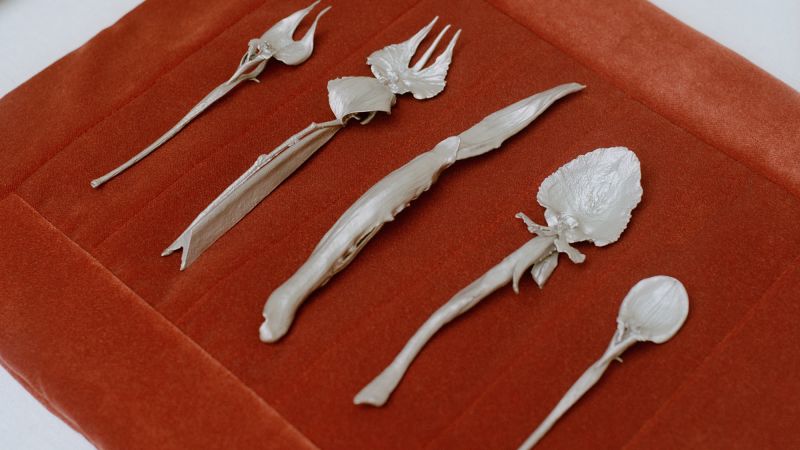
Three guiding principles were outlined for the project: personal expression, cultural relevance, and the use of 3D printing on sintered steel. The latter technique, which involves compressing steel powder into a solid form, allows for intricate shapes previously unattainable through traditional methods. Functionality was secondary, as Ngo emphasized, “You can buy that stuff from anywhere for fifty bucks.” The result was the Knife, Fork, Spoon 3.0 exhibition, curated by Ngo and presented by the Los Angeles gallery Marta during the recent Copenhagen event.
A Legacy of Craftsmanship
Ngo’s curatorial choices highlighted the shift in focus from mere utility to artistic significance. The exhibition deliberately included female designers, a group historically underrepresented in the cutlery world. By doing so, he aimed to showcase diverse perspectives and challenge long-standing conventions. For instance, Korean designer Minjae Kim created a set that combined Western utensils with chopsticks, blending cultural traditions into a cohesive design. Nigerian designer Nifemi Marcus-Bello added a resin bowl to his collection, reflecting the ritual of hand-washing before meals in his homeland. “He explained that in Nigeria, when you go out to eat, you’re asked if you want to use a fork and spoon or eat with your hands, which is the traditional way. If you say hands, you’re brought a bowl of water to clean your hands, which is part of the ritual of dining,” Ngo shared.
One standout piece came from Polish botanical designer and artist Marcin Rusak. His work, rooted in organic forms, pushed the boundaries of the brief. “Growing up, my grandfather was a nationally famous orchid breeder. In some ways, orchids are my first learned visual language,” Rusak explained. This connection to nature inspired a cutlery set that seems to blend seamlessly with the environment, challenging the notion that utensils must be rigid or utilitarian. Rusak’s design exemplifies how modern technology can be married with cultural heritage, creating objects that are both functional and deeply symbolic.
The project also underscored the importance of innovation in a field often overlooked. By leveraging 3D printing, Ngo and his collaborators could craft utensils that defy the constraints of traditional manufacturing. This approach not only allows for artistic freedom but also addresses the problem of stagnation in flatware design. As the exhibition demonstrated, the future of cutlery lies in its ability to evolve, integrating new materials, techniques, and cultural narratives into everyday use.
The Future of Flatware
Ngo’s work is a celebration of both past and future. While the book and exhibition honor the craftsmanship of the 20th century, they also serve as a catalyst for redefining the category. The 3D-printed sets, for example, are not only visually striking but also represent a step toward sustainable and customizable production. “This is the time to bring these ideas to life,” Ngo stated, emphasizing the urgency of embracing new methods before they become obsolete.
His collaboration with artists from around the world highlights the global nature of design. From Solingen to Sheffield, and beyond, the project reflects a shared recognition of the need for reinvention. By uniting tradition with technology, Ngo has created a platform for cutlery to transcend its role as a mere tool, becoming a medium for storytelling and cultural exchange. The result is a collection that is as much about identity as it is about innovation, proving that even the smallest objects can carry profound meaning.
As the exhibition and book make their debut, Ngo’s work stands as a testament to the power of design to shape perception. His journey—from a single vintage set to a movement redefining cutlery—demonstrates how a passion for aesthetics can drive change in an unexpected field. With 10,000 pieces in his personal collection and a new generation of designs, Ngo has positioned himself at the forefront of a renaissance in flatware, one that is as much about art as it is about utility.
