
With Supreme Court ruling on birthright citizenship, here’s what to know about immigration to the US, in charts
Supreme Court Upholds Birthright Citizenship, Halting Trump’s Plan to Reshape Immigration Policy
With Supreme Court ruling on birthright – On May 15, 2025, the Supreme Court delivered a landmark decision that preserved the long-standing practice of birthright citizenship in the United States. The 6-3 ruling overturned President Donald Trump’s executive order aimed at ending automatic citizenship for children born to undocumented immigrants. This decision has sparked renewed debate over the role of immigration in shaping the nation’s demographic and economic landscape, particularly as the administration continues to push its border policies.
The Legal Battle Over Birthright Citizenship
Trump’s executive order, which sought to redefine the pathway to citizenship, faced immediate legal scrutiny. Critics argued that it violated the 14th Amendment, which guarantees birthright citizenship to anyone born on U.S. soil. The case, brought to the Supreme Court, involved judges appointed by both Democratic and Republican leaders, who collectively concluded that the policy threatened constitutional rights and federal immigration laws.
“The administration’s use of the term ‘invasion’ was deliberate, as it provides a justification for aggressive immigration enforcement strategies,” explained legal analysts, highlighting the rhetorical choices made to frame the issue as a national crisis.
Immigrant Population Growth and Economic Impact
Immigration has played a central role in the United States’ demographic expansion over the past decade. Between 2010 and 2024, the number of immigrants in the country increased steadily, reaching 50.2 million by 2024—nearly 14.8% of the total population. This growth has had measurable economic effects, with immigrants contributing significantly to the nation’s fiscal health.
In 2023 alone, immigrants generated over $652 billion in tax revenue and held $1.7 trillion in combined spending power, according to the American Immigration Council. These figures underscore the vital role immigrants play in sustaining key industries, filling labor shortages, and supporting local economies. Yet, Trump’s immigration agenda has positioned birthright citizenship as a central target for reform.
The Undocumented Population and Policy Implications
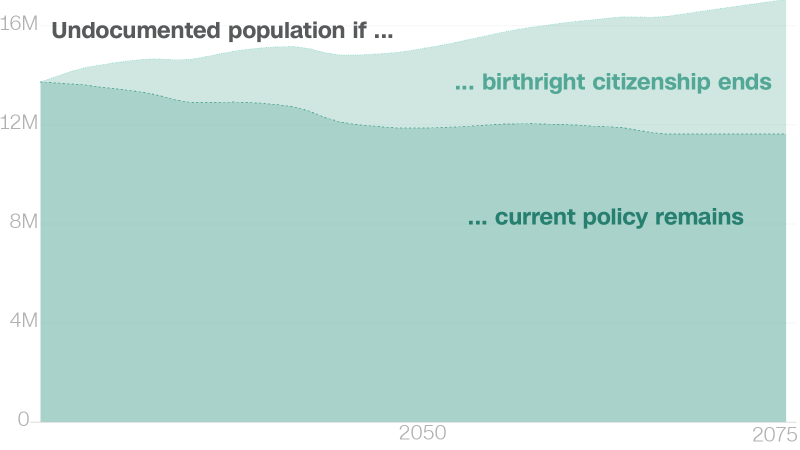
Estimates from the Migration Policy Institute indicate that over 13 million individuals live in the U.S. without legal documentation. This population has historically been a cornerstone of the American workforce, particularly in agriculture, construction, and hospitality. However, Trump’s proposal to deny citizenship to children of undocumented parents would have expanded the number of unauthorized residents, as those born to undocumented immigrants would no longer automatically gain legal status.
With the current policy unchanged, projections suggest the undocumented population will shrink over the next few decades. This trend is attributed to stricter border controls and increased deportation efforts. Yet, the Supreme Court’s intervention has delayed these changes, keeping the status quo in place and preserving the rights of over 13 million individuals.
Trump’s Immigration Agenda and Border Enforcement
Since rejoining the White House, Trump has prioritized reducing the number of undocumented immigrants. His administration launched a high-profile military operation along the Southern border, targeting asylum seekers and those crossing without authorization. Deportation efforts intensified, with over 500,000 individuals removed in 2024 alone, many of whom were linked to organized crime networks.
Trump’s policies have also extended to international partnerships, with proposals to send migrants to countries like Libya, Rwanda, and Saudi Arabia as part of a “guest worker” program. These measures reflect a broader strategy to deter unauthorized entry by linking it to economic hardship and geopolitical alliances. Despite these actions, the Supreme Court’s ruling has reaffirmed the constitutional foundation of birthright citizenship.
Geographic Distribution of Immigrants
Immigrant communities are concentrated in states across the country, with higher percentages in coastal regions and near the border. California, New Jersey, and New York—states led by Democratic governors—have been vocal in opposing Trump’s immigration policies. These states filed lawsuits against his executive order and challenged the administration’s requirement that federal grants be tied to state cooperation in immigration enforcement.
Meanwhile, states in the South and Midwest have generally supported Trump’s approach, citing concerns over border security and economic competition. The geographic divide highlights the political tensions surrounding immigration, with advocates on both sides arguing for different approaches to managing population growth and border control.
Global Origins of U.S. Immigrants
Migrants to the United States come from a wide array of countries, but Mexico remains the largest source. According to 2023 data, more than double the number of Mexican immigrants arrived compared to the combined totals of India and China. This pattern has persisted despite shifts in global migration trends, as economic opportunities and family reunification continue to draw people from Latin America and Asia.
Trump frequently described illegal immigration as an “invasion,” a term he used in executive orders and internal memos to justify his hardline stance. Legal experts note that this language serves to rally public support for measures like expedited removals and family separation policies. However, the Supreme Court’s decision has tempered these efforts, maintaining the constitutional framework that has protected birthright citizenship for over a century.
Broader Implications for U.S. Immigration Policy
The ruling has broader implications for how the U.S. manages its immigration system. By upholding birthright citizenship, the court has ensured that the 14th Amendment remains a shield for millions of children born to undocumented parents. This decision also signals a potential shift in the legal battle over immigration, as challenges to other Trump-era policies, such as the use of wartime authority for deportations and a data-sharing agreement with the IRS, continue to unfold.
While the immediate impact of the ruling is to preserve the status quo, it leaves room for future policy changes. The Supreme Court’s decision has been praised by immigration advocates who argue that it safeguards the rights of children born in the U.S. and maintains the country’s tradition of granting citizenship to those who arrive on American soil. However, critics remain concerned about the long-term consequences of the administration’s focus on reducing the number of undocumented residents.
As the debate over immigration continues, the role of birthright citizenship remains a focal point. The ruling reaffirms that this constitutional provision is a key component of the U.S. identity, even as political leaders seek to reshape its implications. With the policy intact, the country’s immigrant population will continue to grow, influencing its economic and social fabric for years to come.
