
Trump’s red card call stirs political storm around World Cup
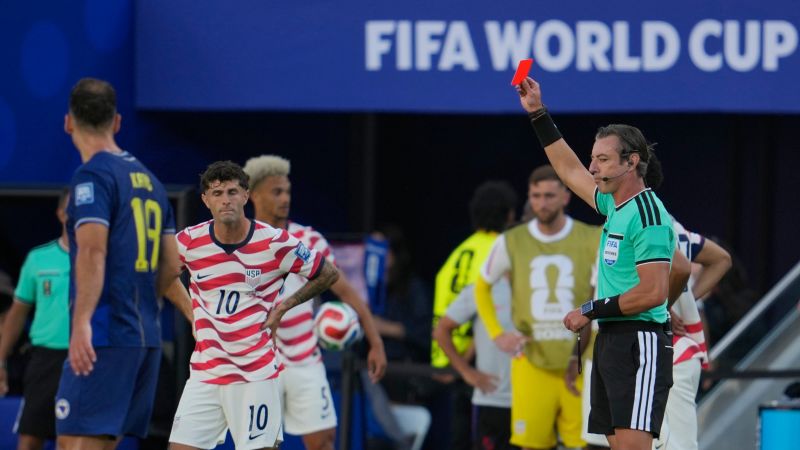
Trump’s Red Card Call Sparks Global Soccer Controversy
Trump s red card call stirs – For nearly a month, the World Cup had largely operated outside the shadow of Donald Trump’s influence in the United States during the 2026 tournament. But the political winds shifted dramatically when the president, leveraging his platform, intervened in a pivotal decision involving U.S. star player Folarin Balogun. Despite being shown a red card in the previous match and receiving a one-game ban, Balogun will now take part in the crucial knockout clash against Belgium on Monday. This unexpected reversal has ignited debates about the role of politics in football governance and the integrity of the competition.
A Presidential Appeal and FIFA’s Response
Trump’s involvement in the matter reached a new peak on Sunday, when he took to Truth Social to praise FIFA for reversing what he called a “great injustice.” The post, which included the president’s full name in all caps, underscored his enthusiasm for the decision. “Thank you to FIFA for doing what was right,” he wrote, “and reversing a great injustice! President DONALD J. TRUMP.” The statement marked a triumphant moment for the president, who has often used the World Cup as a stage to assert his influence.
On Monday, Trump further fueled the discussion by confirming he had personally contacted FIFA President Gianni Infantino to request a review of Balogun’s suspension. “I didn’t say, ‘You have to do this,’” he explained during a press conference in the Oval Office, emphasizing that his call was more of an inquiry than an ultimatum. Trump also claimed he believed Balogun’s action did not constitute a foul, a stance that has drawn both support and criticism from soccer fans and analysts.
“I didn’t say, ‘You have to do this,’” Trump said in the Oval Office, adding that he didn’t think Balogun’s offense was even a foul.
His intervention has raised eyebrows globally, as it transforms a routine soccer decision into a political spectacle. The Belgian Football Federation, which had previously supported Balogun’s suspension, now faces scrutiny for its decision to challenge the player’s inclusion in the match. The federation’s actions have sparked speculation about the extent of Trump’s sway over FIFA, particularly given the close relationship between the president and the organization’s leadership.
Referee’s Call and the Debate Over Fair Play
The controversy centers on a controversial incident during the U.S. team’s victory over Bosnia and Herzegovina last week. Balogun was initially sent off for a challenge that, under slow-motion review, appeared to involve a heavy tackle on Bosnian defender Tarik Muharemović. While the referee initially ruled it a serious foul, FIFA later overturned the decision, citing a reevaluation of the video evidence.
Supporters of Balogun argue that the video assistant referee system, which has become a cornerstone of modern football, may have been overly strict in this case. They claim the tackle, while aggressive, was not intentional and did not warrant a red card. “Clashes between players often look worse in slow motion,” one fan noted. “Balogun’s action was a split-second decision, and the system may have misinterpreted it.”
However, critics maintain that FIFA’s reversal was justified, given the clarity of the video review. The incident has reignited discussions about the balance between fairness and the potential for political influence in high-stakes matches. “This isn’t just about a single game,” said a sports analyst. “It’s about how decisions at the World Cup are being shaped by figures beyond the field.”
Global Reactions and Concerns Over Integrity
UEFA, the governing body of European soccer, voiced its concerns about the incident, calling it a threat to the tournament’s reputation. In a statement, the organization criticized FIFA for allowing a suspension to be reversed without sufficient transparency. “When the certainty of rules is no longer guaranteed by its guardians, the integrity of the game is at stake,” UEFA said. “This undermines the credibility of a competition that should be judged purely on the field.”
The Belgian Football Federation also joined the fray, accusing FIFA of lacking clarity in its decision-making process. “The pregame machinations contravened FIFA’s regulations and prejudiced fair play,” a federation spokesperson said. While the federation initially supported Balogun’s suspension, it now questions whether the decision was made in the best interest of the sport. “We act to defend football in general,” the coach added. “It defends its integrity. It defends its ethics.”
The incident has cast a shadow over the World Cup, a tournament that has traditionally been a unifying event for fans worldwide. While U.S. supporters may remain indifferent to the political aspects, the global community is more divided. The match against Belgium on Monday has become a focal point for discussions about the intersection of politics and sports, with many fearing that the controversy could tarnish the event’s legacy.
A New Era of Political Influence in Soccer?
Although Trump’s involvement may not have directly altered the outcome, the mere perception of his influence has sparked questions about the independence of FIFA. “It doesn’t necessarily matter whether Trump’s actions were decisive,” said a sports journalist. “What matters is the impression they create, and that risks souring global perceptions of the World Cup.”
Historically, the World Cup has seen its share of controversies, from Diego Maradona’s “hand of God” goal in 1986 to Zinedine Zidane’s infamous headbutt in the 2006 final. Yet, these incidents were largely attributed to the nature of the game itself, not political interference. Balogun’s case, however, is unique in its timing and the involvement of a U.S. president. “There’s no known precedent for a political leader pressuring FIFA over a player’s eligibility in such a critical match,” said a FIFA representative. “This sets a new precedent for how decisions are made in high-profile tournaments.”
As the World Cup progresses, the Balogun incident will likely remain a talking point. While the U.S. team’s performance on Monday may overshadow the controversy, a victory could still be viewed with skepticism by international fans. “Even if the Americans win, the asterisk may linger,” said a commentator. “The question will be: Was the red card a fair call, or was it a political move?”
For now, the World Cup continues its journey, but the stage is set for a deeper examination of the relationship between politics and sports. Trump’s call to Infantino has not only influenced a single match but has also sparked a broader conversation about the role of leadership in shaping the rules and outcomes of one of the world’s most prestigious sporting events. As the tournament unfolds, the balance between fairness and influence will be under closer scrutiny than ever before.
