
Venezuelans search for a future as well as survivors after twin quakes pile disaster on years of crisis
Venezuela’s Crisis Deepens as Twin Earthquakes Wreak Destruction
Venezuelans search for a future as well – Amid a backdrop of economic turmoil and political instability, Venezuelans are now confronting a new catastrophe: a pair of catastrophic earthquakes that struck the capital city of Caracas within seconds of each other. The disasters, measuring 7.2 and 7.5 on the Richter scale, have left more than 1,400 confirmed dead and thousands missing, intensifying the nation’s struggles. For many, the tremors have not only shaken the ground but also raised a haunting question—will Venezuela rise from the rubble, or has the damage become irreparable?
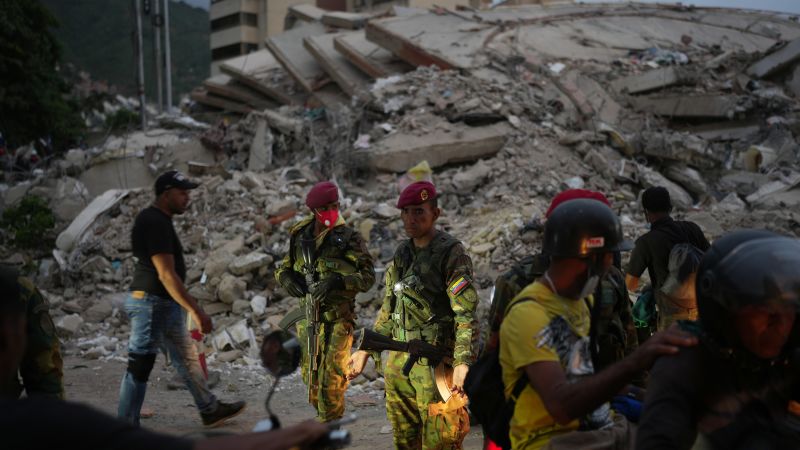
Rescue operations continue in the shadow of collapsed buildings and scattered debris, with neighbors and volunteers working tirelessly to uncover survivors. Yet the path to recovery feels arduous, as decades of mismanagement have weakened the country’s infrastructure and response capabilities. “We’ve been through a lot, but this is something else,” said Neida Pernilla, a resident of Caracas who narrowly escaped destruction. Her apartment, which was reduced to rubble, is a symbol of the widespread devastation. Pernilla, however, expresses gratitude for her survival, emphasizing the need for collective resilience in the face of adversity.
“I think we have to learn from everything we’re going through. That life is fleeting — just a moment. We have to thank God, the Virgin Mary, whatever we have faith in, for the fact that we’re alive, and we need to be more human, more cooperative, more humble.”
The earthquakes have struck across all social strata, from affluent districts to impoverished neighborhoods. La Guaira, a key port city, has become a focal point of the crisis, with residents scrambling for essential supplies as food and clean water shortages worsen. The city, located just 20 miles from Caracas, has been cut off by collapsed roads and damaged bridges, leaving families to fend for themselves. “It’s been us, the families, trying to dig through debris to find our relatives,” said Mileidy Duque, 43, who lost her mother, brother, daughter, and son-in-law in the disaster.
Duque’s family resided in the Luisa Caceres de Arismendi building, a government housing project inaugurated by ousted President Nicolás Maduro in 2015. The structure, meant to provide stability, now lies in ruins. “This situation is so sad, not just for me, but for all of Venezuela. I have no words to explain how it feels to fear that your family is trapped in there,” she told CNN. Her words reflect the emotional weight of the crisis, as the search for missing loved ones continues across the country.
Across the city, the aftermath of the twin quakes has left communities in disarray. In the upper-middle-class Palos Grandes neighborhood, Susana Henríquez stands behind yellow tape, gazing at the remnants of the Petunia residential complex. Two towers, once towering symbols of safety, now lie in splinters. “We want to trust that our neighbors in the Petunia I will be rescued alive,” Henríquez said, her voice trembling with grief. The tragedy has turned her into a symbol of hope and despair, as she clings to the possibility that those still missing might be found.
For residents like Henríquez, the earthquakes have compounded the challenges of a nation already teetering on the edge of collapse. Economic mismanagement has led to soaring inflation, with basic goods often priced higher than a worker’s daily earnings. A repressive government has further exacerbated the crisis, driving millions to seek refuge abroad in search of stability. “I have so many friends there,” Henríquez said, fighting back tears. “They’re gone, and I don’t know if they’ll ever be found.”
The quakes have also reignited memories of past disasters. In 1999, La Guaira suffered massive landslides after torrential rain, claiming an estimated 15,000 lives according to researchers at the Central University of Venezuela. “This was much worse than the mudslides,” said Lindomar Milla, whose sister and brother-in-law perished in the Playa Los Cocos neighborhood. “So many people are still looking for their loved ones. There are people who traveled to La Guaira and found buildings that no longer exist.”
As the 72-hour golden window for rescue efforts passes, the urgency of the situation grows. Hundreds of aftershocks have continued to rattle the region, adding to the anxiety of those still trapped beneath the rubble. Moments of joy and relief burst through the despair when survivors are pulled from the debris, yet these are often overshadowed by the grief of families waiting for news. “I’ve been feeling so much pain and uncertainty,” Henríquez said, her gaze fixed on the ruins. “Every day feels heavier than the last.”
Survivors describe a landscape transformed by the earthquakes. In the northern regions, where the quakes caused the most damage, the streets are littered with broken concrete and collapsed structures. “The city is in pieces,” said Milla, who sat outside the morgue in Caracas, where the remains of his family were displayed. “People are still coming to find what they can, even though it’s hard to believe they’ll ever get back what was lost.”
The humanitarian crisis, already severe, has deepened with the earthquakes. With power outages and communication networks disrupted, the search for survivors relies heavily on local efforts. “It’s been a race against time,” said a volunteer rescuer, who spoke of the exhaustion and hope that define the current moment. “We’ve lost sleep, but we keep going because we know someone might still be alive.”
As the days pass, the tropical heat intensifies the struggle for survival. In impacted areas, many have resorted to wearing face masks to avoid the stench of decay. “It’s not just the buildings that collapsed—it’s our sense of normalcy,” said Henríquez. “We’re used to scarcity, but this is different. This is a whole new kind of suffering.”
The twin quakes have become a stark reminder of the fragility of Venezuela’s progress. While the government has offered reassurances, its ability to provide immediate aid remains limited. “We’re not alone,” said Acting President Delcy Rodríguez, addressing the nation. But for many, the words feel hollow in the face of overwhelming loss. The disaster has laid bare the cracks in the country’s foundation, and whether Venezuela can mend them remains uncertain. For now, the focus is on the people—those who survived, those who are missing, and the collective determination to keep hope alive in a broken world.
