The ‘earthquake gate’ stopping a San Andreas disaster is under its highest stress in 1,000 years

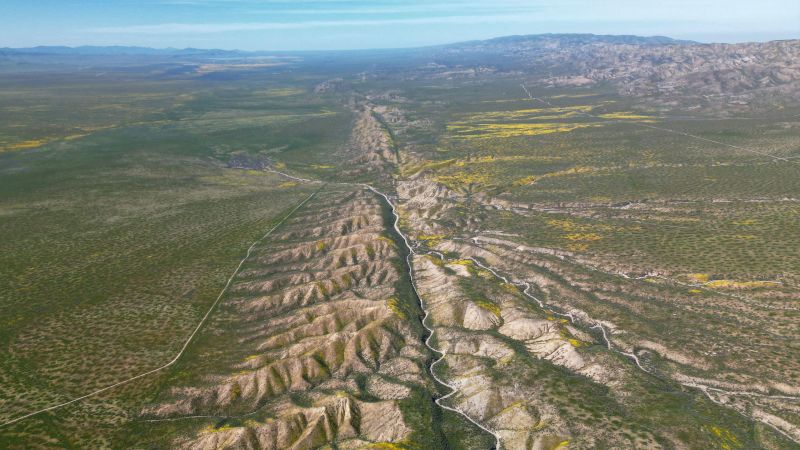
The ‘earthquake gate’ stopping a San Andreas disaster is under its highest stress in 1,000 years
The earthquake gate stopping a San Andreas – Recent findings suggest the San Andreas fault system, which threatens the heart of Southern California, is on the verge of a major rupture. Scientists have identified a critical zone near the Cajon Pass, where the fault lines meet, as a potential trigger for a widespread earthquake. This junction, dubbed the “earthquake gate,” is currently experiencing stress levels not seen in over a millennium, raising concerns about the likelihood of a catastrophic event.
A New Perspective on Seismic Risk
Historically, the San Andreas fault has been viewed as a single, dominant force. However, new research reveals a more complex dynamic. The southern segment of the fault, along with parts of the adjacent San Jacinto system, are locked in a state of heightened tension. This condition, which has persisted for more than a century, could lead to a quake of significant magnitude, potentially affecting multiple regions in a single, devastating strike.
The study, led by geophysicist Liliane Burkhard at the University of Bern, Switzerland, analyzed the past 1,000 years of seismic activity. It found that the stress buildup in these fault zones is now at its peak, creating a scenario where a rupture could spread beyond its initial point. “We talk loosely about faults being ‘overdue,’ but it’s important to see a physics-based estimate that the system is sitting at a 1,000-year high,” said Matthew Weingarten, a geologist at San Diego State University, who was not involved in the study.
The Mechanics of Tectonic Stress
Earthquakes occur when energy stored in the Earth’s crust is released suddenly. This happens as tectonic plates shift, causing friction along fault lines. When the stress between two rock masses exceeds their strength, they slip, generating seismic waves. In some areas, this slip is restricted, allowing stress to accumulate over time. The southern San Andreas and San Jacinto faults are among those currently unable to release this energy freely.
The Pacific and North American tectonic plates, which border these fault systems, have been sliding past each other at a rate of a few centimeters annually. Yet, certain segments remain locked, acting like a coiled spring that stores potential energy. Over the past century, stress has built up to dangerous levels along these fractures, increasing the probability of a major quake. Previous models estimated a 50% chance of a 6.7-magnitude or higher earthquake occurring in the region within the next few decades.
The Cajon Pass: A Critical Junction
At the heart of this risk lies the Cajon Pass, a natural corridor where the San Andreas and San Jacinto faults intersect. This area functions as a kind of “earthquake gate,” either blocking or facilitating the spread of seismic activity between the two systems. In 1812, a 7.5-magnitude earthquake known as the Wrightwood quake is believed to have crossed this pass, triggering tremors across both faults and resulting in 40 fatalities.
Today, the situation appears similar but more intense. If a rupture were to pass through the Cajon Pass, scientists predict it could extend across both fault systems, creating a cascading effect. This would mean damage could occur simultaneously in cities like San Bernardino, Riverside, and the Coachella Valley, all within a short period. “A joint rupture crossing Cajon Pass could approach around a magnitude 7.4 to 7.8 and affect a far larger area than a single-fault event,” Burkhard explained.
Stress Levels and Historical Comparisons
The research team reconstructed the last 1,000 years of seismic behavior to understand current conditions. They found that ruptures typically passed through the Cajon Pass when both sides of the junction had similar stress levels. Now, the data shows that the San Jacinto’s Bernardino segment has reached the highest stress load recorded in this timeframe—3.6 megapascals. This exceeds its previous peak from nearly 50 years ago.
Meanwhile, the Mojave South segment of the San Andreas fault recorded 2.8 megapascals, surpassing its own earlier record set a decade ago. These numbers highlight a growing imbalance, as past simulations indicated that ruptures only traveled through Cajon Pass when the stress difference between segments was minimal, around 0.3 megapascals. The current gap of 0.8 megapascals suggests the system is primed for a larger event.
“The insight isn’t that stress builds over time, which we’ve long known,” said Weingarten. “But that the balance of stress across the junction may decide whether the next earthquake stays contained or grows into a much bigger rupture.” This balance could determine whether the seismic impact remains localized or spreads across multiple fault zones, increasing the scale of destruction.
Preparing for the Worst
The findings underscore the urgency of preparedness efforts. While the study does not guarantee an earthquake, it highlights the conditions that could lead to one. The Cajon Pass’s role as a critical transmission point means that even a moderate quake in one area could have far-reaching consequences. This scenario would overwhelm infrastructure, disrupt transportation networks, and endanger communities.
“The underlying message is not to panic, but to act with urgency,” Burkhard emphasized. “The data shows we are at a tipping point. If the stress continues to accumulate, the likelihood of a major rupture grows significantly.” The research team’s simulations suggest that the current stress configuration could lead to a quake that affects a broader region than previously anticipated. This would require coordinated emergency responses and long-term planning to mitigate the impact.
As the tectonic plates keep moving, the risk of a major earthquake remains a pressing concern. The San Andreas fault, which has shaped the geography and history of California, is now under unprecedented strain. Scientists urge policymakers, urban planners, and residents to take these findings seriously. With the potential for a large-scale event looming, the focus must shift from speculation to action, ensuring that Southern California is ready for the next big shake.
“We talk loosely about faults being ‘overdue,’ but it’s important to see a physics-based estimate that the system is sitting at a 1,000-year high,” said Matthew Weingarten, a geologist at San Diego State University, who was not involved in the study.
“In terms of severity, a joint rupture crossing Cajon Pass could approach around a magnitude 7.4 to 7.8 and affect a far larger area than a single-fault event,” said Liliane Burkhard, the study’s lead author and geophysicist at the University of Bern, Switzerland.
The research highlights how the interaction between fault systems can amplify seismic risk. As stress continues to build, the potential for a widespread disaster increases. This is a wake-up call for those who live in the shadow of the San Andreas fault, reminding them that the Earth’s movements are as unpredictable as they are powerful. By understanding these dynamics, experts hope to provide better guidance for risk mitigation and disaster response.