
Marilyn Monroe through the female gaze
Marilyn Monroe through the female gaze
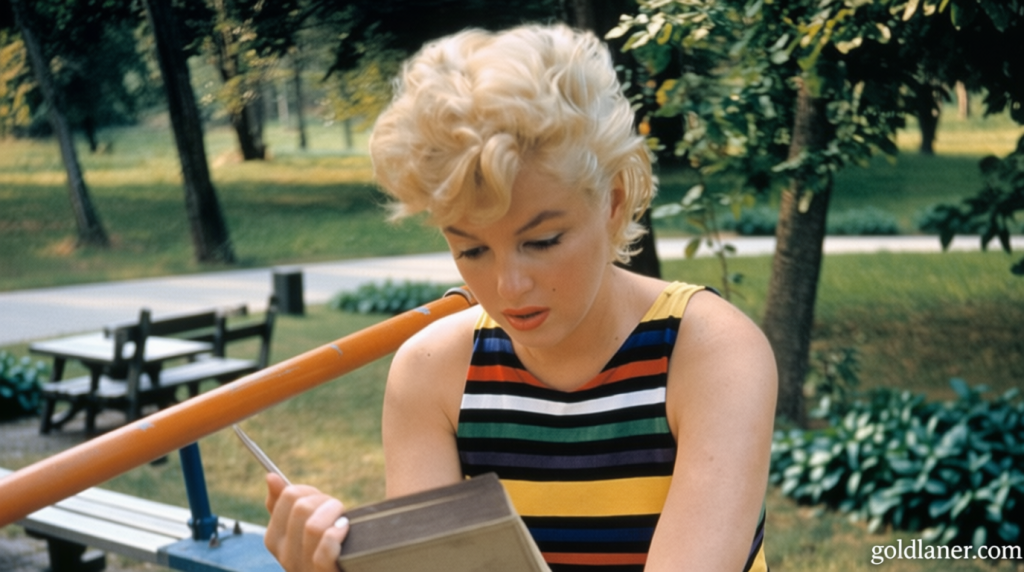
Marilyn Monroe through the female gaze – At first glance, the image appears unassuming: a woman seated on playground equipment, her attention fixed on a book. Yet this photograph, taken in 1955 by American photojournalist Eve Arnold, holds layers of meaning. The studio makeup and lighting are absent, as are her shoes, leaving her exposed limbs bathed in a summery glow. The scene is playful, with Monroe wearing a vibrant romper in a children’s setting, but it also carries a quiet seriousness. In her arms rests James Joyce’s Ulysses, a famously challenging novel, suggesting a depth of engagement far beyond the surface. This image, part of a new exhibition at the National Portrait Gallery in London, captures a pivotal moment in Marilyn Monroe’s life—a rare glimpse of her intellectual side, unmediated by the Hollywood machine that often dictated her public persona.
A Portrait of Agency
The exhibition, which opens on Thursday, centers on Monroe’s ability to shape her own image. It traces her journey from the early pinups of Norma Jeane, the All-American girl who would have celebrated her 100th birthday this month, to her final photoshoot on Santa Monica’s beach, taken weeks before her death in 1962 at age 36. Arnold’s photograph, however, stands apart for its subtle defiance of stereotypes. It portrays Monroe not as the quintessential sex symbol but as a woman immersed in literature, challenging the narrow narratives that often defined her career.
Reading Beyond the Surface
Monroe’s dedication to reading was well-documented, but this image offers a unique testament to her passion. Her personal library, according to her grandson Michael Arnold, who passed away in 2012, contained over 400 books, ranging from poetry to plays and dense works like Ulysses. The photo, Michael explains, was not a staged prop but a spontaneous moment. “Eve was just setting up her cameras, and she saw that Monroe got it out and was reading it, waiting for her to get ready,” he recalls. This detail transforms the image into a symbol of Monroe’s desire to break free from the “dumb blonde” archetype, revealing her as a multifaceted individual.
“With her choice to be seen reading the end of Ulysses, Monroe was clearly making a knowing point,” wrote feminist art historian Griselda Pollock in her 2016 essay on the photograph. “It was an identification perhaps at so many levels with the words, the spoken words of an uneducated woman, allowed to have an inner and a sexual life, and to have the final say.”
The photo’s significance is further amplified by its alignment with the novel’s themes. Monroe’s position on the last pages of Ulysses mirrors the protagonist Molly Bloom’s exploration of female sexuality through a stream of consciousness. This connection suggests Monroe’s deliberate choice to align herself with the novel’s subversive portrayal of women’s agency, using the photograph as a visual statement.
Control and Creativity
Monroe’s influence over her still images was a source of pride, as opposed to the constraints of her film roles. Georgia Atienza, assistant curator of the exhibition, notes that the actress often exercised veto power over her photographs, scrutinizing contact sheets and occasionally marking unwanted images with a hairpin. “There’s this very conscious idea from her of controlling her image and getting out there the ones she was really happy with,” Atienza says. This control allowed Monroe to curate her legacy, ensuring her portraits reflected her aspirations rather than the expectations imposed by the industry.
A Bond Beyond Hollywood
The collaboration between Monroe and Arnold began years before this iconic shot. In 1952, Arnold had captured Marlene Dietrich in a natural, unposed manner—a style that resonated with Monroe. At a party, she approached Arnold, asking, “If you can do that well with Marlene, can you imagine what you can do with me?” This exchange marked the start of a partnership that would span a decade, culminating in emotionally charged sessions like those for The Misfits in 1960. During this time, Monroe’s marriage to Arthur Miller was in turmoil, and Arnold’s presence provided a stabilizing force.
Arnold, who considered herself a serious photojournalist, was initially hesitant to work with a Hollywood star. Yet Monroe’s magnetic presence drew her back repeatedly. The two shared a mutual understanding of the industry’s pressures, forging a creative bond that allowed Monroe to explore her identity beyond the screen. “We learned to play together and kind of break the rules,” Michael Arnold adds, reflecting on their dynamic. This partnership became a space where Monroe could express herself authentically, even in the face of a world that often reduced her to a symbol.
The Power of a Single Frame
What makes this photograph enduring is its ability to encapsulate Monroe’s complexity in a single moment. It captures the paradox of her public image and private interests, the playfulness of her youth and the gravity of her ambitions. The absence of studio constraints—no makeup, no shoes, no props—underscores her willingness to strip away artifice. Arnold’s lens, as the exhibition highlights, reveals a Monroe who was both vulnerable and empowered, a woman who used photography to assert her narrative.
Monroe’s decision to read Ulysses in this setting was not accidental. The novel’s modernist style and focus on inner thought align with her evolving identity. By choosing to be seen in this moment, she challenged the notion that intelligence and femininity were mutually exclusive. The photo becomes a testament to her agency, a visual act of defiance that transcends the era in which it was taken.
In the broader context of the exhibition, Arnold’s image is a microcosm of Monroe’s larger story. It invites viewers to reconsider the ways in which women are portrayed in media, offering a glimpse into the mind of a star who sought to redefine her legacy. As the National Portrait Gallery’s display suggests, this photograph is not just a record of Monroe’s life but a powerful statement about the intersection of art, identity, and the female gaze. Through Arnold’s work, Monroe’s journey from a blonde bombshell to a woman of substance is laid bare, inviting a deeper appreciation for the layers of meaning hidden within her iconic image.
