Ukraine targets St. Petersburg as ‘Putin’s Davos’ gets underway

Ukraine Targets St. Petersburg as ‘Putin’s Davos’ Gets Underway
Ukraine targets St Petersburg as Putin – As the St. Petersburg International Economic Forum commenced, Ukraine launched a coordinated drone attack on the Russian city, signaling a deliberate effort to disrupt the event dubbed ‘Putin’s Davos.’ The strikes, which targeted key infrastructure in St. Petersburg, underscored the ongoing conflict’s reach beyond traditional frontlines. Regional officials confirmed that hundreds of drones were intercepted and neutralized over Moscow and surrounding areas late Tuesday, with the attacks intensifying as the forum drew global leaders to showcase Russia’s economic ambitions. The event, held annually in the city, has become a pivotal stage for Putin to project stability and progress amid the war in Ukraine.
The Strategic Significance of ‘Putin’s Davos’
The St. Petersburg International Economic Forum, held at the height of the war, serves as a critical platform for Russia to highlight its economic resilience and political authority. Hosting thousands of international delegates, including corporate executives, policymakers, and investors, the forum aims to reinforce Moscow’s position as a global economic leader. However, Ukraine’s drone strikes during the event disrupted this narrative, casting doubt on Russia’s ability to maintain control over its territories. Analysts noted that the timing of the attacks was deliberate, targeting the city’s symbolic and strategic value as a hub for energy trade and political discourse.
The Russian Ministry of Defense reported that over 350 Ukrainian drones were intercepted across the Leningrad region, Moscow, and Novgorod. While the majority were shot down by air defenses, some managed to breach the city’s outskirts, striking districts in St. Petersburg. Governor Aleksandr Beglov confirmed that three areas were hit, resulting in casualties and damage to infrastructure such as power grids and communication hubs. This marked a significant escalation, as the attacks demonstrated Ukraine’s capability to strike deep into Russian territory, challenging the notion that the frontlines were the only battleground.
Impact on Critical Infrastructure and Energy Supply
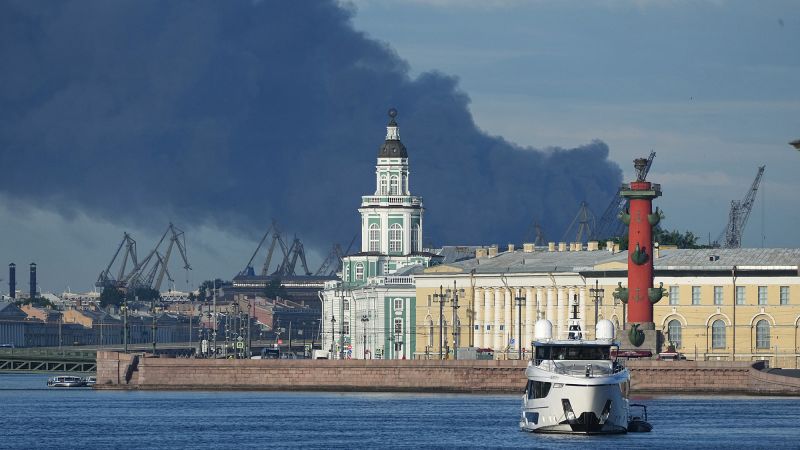
Among the primary targets was the St. Petersburg oil terminal, a vital transshipment point for Russian fuel exports. Ukrainian forces emphasized that the facility was a key node in Russia’s logistics network, and its destruction could impact energy distribution to Europe. The terminal’s location near the city’s industrial zones made it a strategic choice, with explosions and fires visible in footage released by Kyiv. This attack aligns with Ukraine’s broader strategy to cripple Russia’s energy infrastructure, a move that has already disrupted fuel supplies in multiple regions.
Ukraine’s focus on long-range strikes has intensified in recent months, with dozens of aerial operations launched to bypass frontline defenses. The May attack on Moscow, the largest such operation in over a year, set a precedent for targeting cities hosting high-profile events. This pattern suggests that Ukraine’s military strategy is evolving to include not only battlefield objectives but also symbolic strikes aimed at weakening Russia’s international standing. Zelensky’s repeated assertions that these attacks are part of a plan to “bring peace closer” have framed the operations as both tactical and psychological.
“Ukraine’s plan for long-range strikes is being carried out exactly as needed to bring peace closer,” said Ukrainian President Volodymr Zelensky. He highlighted that the St. Petersburg oil terminal was a primary target, with footage showing intense blasts and smoke rising from the site. The attack, he claimed, would “disrupt Russian logistics and fuel exports, creating pressure on the war effort.” Zelensky’s remarks were echoed by military officials, who stressed the importance of targeting infrastructure that supports Russia’s economy and military operations.
Casualties and Regional Reactions
While the exact number of casualties remains under investigation, initial reports indicated that the attacks caused significant disruptions in St. Petersburg. In Smolensk, a western Russian city near the Belarus border, two firefighters were killed while extinguishing a fire sparked by debris from a downed drone. Governor Vasiliy Anokhin noted that additional injuries were reported, with two more firefighters and a civilian sustaining minor harm. These incidents reflect the expanding reach of Ukrainian aerial campaigns, which now target not only military installations but also civilian infrastructure in regions previously deemed safe.
The attacks have prompted swift responses from Russian authorities, with officials condemning Ukraine’s actions as “reckless aggression” against a peaceful gathering. Putin’s presence at the forum has been a central point of contention, as the strikes aimed to undermine his image as a strong leader. Meanwhile, international reactions have been mixed, with some nations expressing concern over the escalation, while others have supported Ukraine’s efforts to weaken Russia’s economic footing. The incident has also raised questions about the safety of high-profile events in conflict zones and the potential for further disruptions in the future.
As the forum continues, the psychological and economic impact of the drone strikes is expected to linger. The targeting of St. Petersburg, a city symbolizing Russia’s economic power, has sent a clear message to Putin and global audiences. With the attacks demonstrating Ukraine’s advanced capabilities, the conflict’s dynamics are shifting toward a more aggressive phase. The next steps will likely depend on Russia’s ability to respond and Ukraine’s capacity to sustain its aerial operations, setting the stage for an even more intense showdown in the months ahead.