John Roberts draws a line with Trump — over history

Daftar Isi
Roberts Breaks Ranks Over White House Ballroom, Citing Century-Old Architectural Values
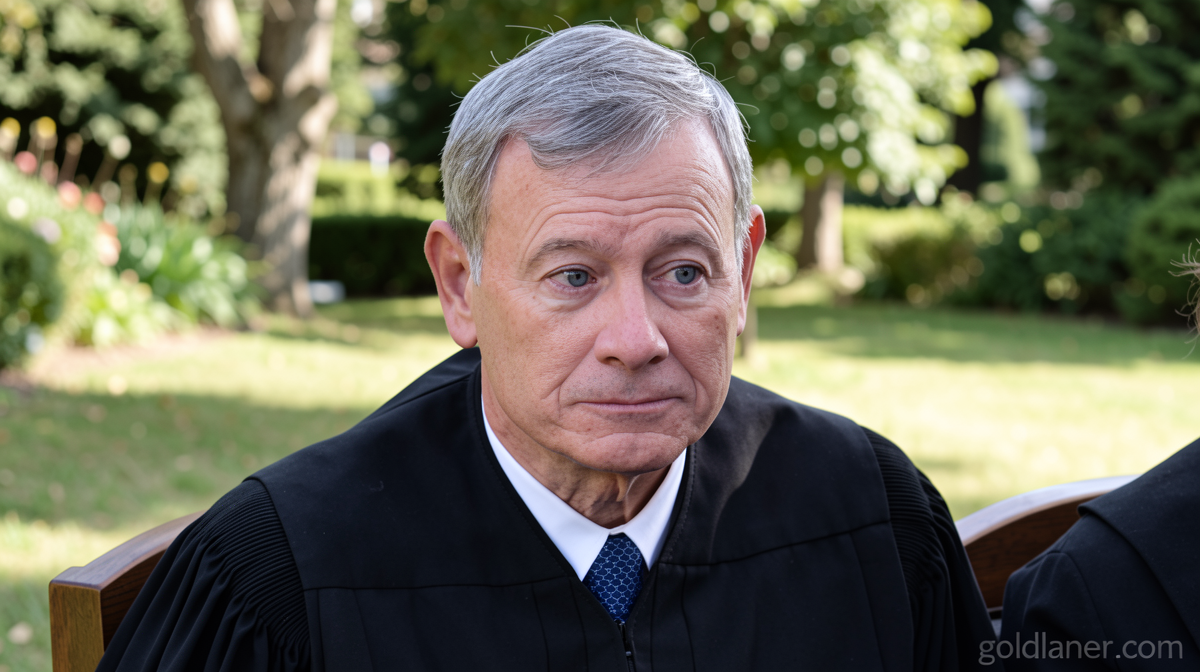
Goldlaner.com – For most of Donald Trump’s second term, Chief Justice John Roberts has moved in lockstep with the president, signing off on sweeping expansions of executive power that would have been unthinkable a decade earlier. On Monday, however, the nation’s top jurist stepped out of formation. In a six-page dissenting statement, Roberts separated himself from the president and from four fellow conservative justices to object to the massive ballroom project reshaping the White House’s East Wing — a rare and pointed act of institutional pushback from a man who has, by his own record, become one of Trump’s most reliable judicial allies.
A Dissent Rooted in Stone and Memory
The chief justice’s objection was not framed in partisan terms. Instead, Roberts reached for the language of preservation, history, and civic symbolism. He invoked Theodore Roosevelt’s 1902 remarks to Congress, in which the former president thanked lawmakers for funding the East and West wing additions while praising “the stately simplicity” of the original structure and urging that such edifices be kept as “historic monuments which keep alive our sense of continuing with the Nation’s past.”
Roberts, who has told audiences on multiple occasions that he once contemplated a doctoral program in history at Harvard before ultimately choosing law, wove that Roosevelt passage into a broader meditation on what Washington’s built environment means to the republic. He then turned to Winston Churchill, lifting a line from the British leader’s 1943 wartime address:
“We shape our buildings, and afterwards our buildings shape us.”
To that Churchill passage, Roberts appended his own admonition:
“All the more reason to ensure that those responsible follow the rules in deciding what to tear down and what to build up at the People’s House.”
The rhetorical register was unmistakably Roberts: measured, historically literate, and steeped in reverence for institutional continuity. The chief justice, who frequently displays pride in the Supreme Court’s neoclassical colonnade, extended that same aesthetic deference to the White House itself — a structure completed in 1800, more than a century before the Court secured its own dedicated building in 1935.
The Legal Question: Who Controls the East Wing?
The dispute reached the Supreme Court on an emergency docket. The National Trust for Historic Preservation had filed suit, arguing that demolishing the East Wing and erecting a 90,000-square-foot ballroom and associated security structure required explicit congressional authorization under the White House Preservation Act. Lower federal courts had preliminarily agreed with the Trust, finding that the organization possessed standing because it had demonstrated a concrete, particularized injury. Central to that finding was the testimony of Alison Hoagland, an architectural historian and longtime Trust leader, who described how the planned demolition impaired her personal enjoyment of the White House as a historic landmark.
The majority, however, rejected that theory of injury. Writing per curiam — the Latin designation for an unsigned, unanimous-style opinion typically reserved for expedited appeals — the justices held that “mere offense, disagreement, or distaste does not qualify as a concrete and particularized injury” sufficient to confer standing. With that threshold cleared, the Court allowed the president to proceed with construction that had been underway for nearly a year and was, by Monday, nearing completion.
What the Dissent Reveals About Roberts’ Record
The vote itself was costless to Trump: five conservative colleagues formed a majority, and the ballroom will be built. Yet the dissent adds a complicating layer to Roberts’ legacy as he navigates what has become a docket dominated by Trump administration challenges. Earlier this term, the chief justice had authored or joined opinions granting the president immunity from criminal prosecution (2024) and affirming his authority to remove heads of independent agencies (June 2026). Those rulings represented extraordinary expansions of executive prerogative, and Roberts signed each without visible reservation.
Still, the record is not uniformly deferential. Last session, Roberts voted against two of the administration’s most aggressive moves: the imposition of sweeping tariffs on foreign goods without congressional approval, and an attempt to curtail birthright citizenship — the centuries-old constitutional practice guaranteeing American citizenship to any child born on U.S. soil. Monday’s ballroom dissent, then, fits a pattern of selective resistance: Roberts will defend the president’s agenda in most arenas but will draw a line where he perceives a collision with institutional norms, historical continuity, or the rule of procedure.
The Smithsonian Thread and Washington’s Transformation
Roberts’ position also intersects with his largely ceremonial role as chancellor of the Smithsonian Institution, a title that attaches automatically to the chief justiceship. In that capacity he has presided over board meetings while watching the Trump administration pursue an ongoing effort to reshape the nation’s major public museums. The ballroom case sits within a wider program of physical transformation: Trump has moved to inscribe his name on the John F. Kennedy Center for the Performing Arts and to construct a 250-foot triumphal arch at the traffic circle between the Arlington National Cemetery entrance and the Lincoln Memorial.
Whether Roberts’ dissent will alter the trajectory of any of those projects is unclear. The ballroom, at minimum, will be finished. What the statement does accomplish is something subtler: it places the chief justice’s name beside a century of presidential and congressional language about what the White House is supposed to represent — not a personal monument, but a shared civic symbol whose alteration, Roberts argued, demands procedural discipline and historical restraint.
Related Reading
Frequently Asked Questions
What is John Roberts draws a line?
John Roberts draws a line is the main topic of this guide. The article explains the context, practical details, and next steps readers should understand.
Why does John Roberts draws a line matter?
John Roberts draws a line matters because readers are looking for a useful answer, not just a short summary. Good content should match search intent and help them decide what to do next.