
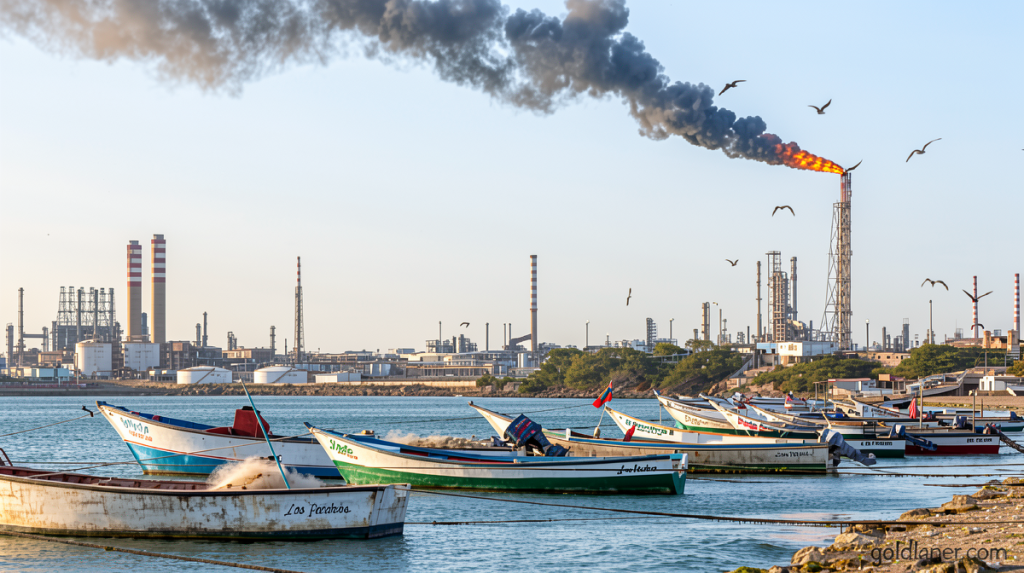
Venezuela’s Oil Windfall and the SPR Dilemma: Why a Historic Deal May Not Fix America’s Energy Shortfall
Goldlaner.com – The United States Strategic Petroleum Reserve sits at its most depleted level since November 1982, a fact that has made the emergency stockpile a recurring talking point in Washington energy circles. With the administration having drawn down 130 million barrels from the 172-million-barrel authorized capacity to stabilize supply during the Iran conflict, pressure to refill the caverns has intensified. President Donald Trump’s recently detailed arrangement with Venezuela — granting the United States a controlling interest across 17 oil fields holding roughly 65 billion barrels of proven reserves, more than twice what America itself banks — was pitched as a direct answer to that shortfall. Yet the mechanics of how Venezuelan crude would actually flow into the SPR reveal a fundamental mismatch that makes near-term replenishment unlikely.
The Architecture of the Deal
Announced by the White House on Monday and branded by officials as the “biggest oil deal in world history,” the arrangement channels investment through a little-known Pentagon unit called the Office of Strategic Capital. That office will acquire up to a 35 percent equity position in a holding company that controls North American Blue Energy Partners, or NABEP, the second-largest privately owned oil producer operating inside Venezuela. NABEP has committed, per White House disclosures, to pouring $100 billion into new extraction and transport infrastructure across its concession fields.
Beyond the equity slice, the State Department holds a contractual right to purchase 20 percent of every barrel NABEP produces, priced at the cost of production rather than market value. It also carries a right of first refusal on the remaining output. Taken together, the Trump administration frames the combined position as a 55 percent stake in the new joint venture — a majority that would give Washington direct influence over production scheduling, export routing, and reinvestment decisions.
The Betancourt Question
NABEP is controlled by the family of Alejandro Betancourt López, a UK-based international businessman whose track record has drawn scrutiny. Spanish authorities opened an investigation into fraud and money-laundering allegations tied to his operations; the probe has not yet produced charges. A parallel inquiry in Switzerland was closed without prosecution. A spokesperson for NABEP declined to comment when reached for clarification. The White House has stated that NABEP will operate under US law and that the government retains veto power over any board-level appointment, a governance safeguard intended to insulate the venture from the kind of opacity that has historically surrounded Venezuelan energy concessions.
Why Heavy Crude Does Not Fit the SPR
The central technical obstacle is straightforward: the SPR was engineered to store light sour and light sweet grades of crude. Venezuelan output is overwhelmingly heavy, high-sulfur oil. A 2016 long-term strategic review conducted by the Department of Energy concluded that hardening the underground caverns to accommodate heavy crude would impose costs that exceed the strategic benefit, while introducing substantial operational complications in retrieval and blending. The department determined that the existing inventory of lighter grades is adequate for crisis response and that adding heavy oil — even blended with lighter streams — would generate persistent handling problems over the coming years.
“Even if blended with lighter oil, it would still cause problems in the years ahead,” noted Matt Smith, director of commodity research at Kpler.
In other words, the barrels Trump’s deal would unlock are the wrong kind of fuel for the tanks America already has. Until the SPR undergoes a physical redesign — a project measured in decades and tens of billions of dollars — Venezuelan crude cannot simply be pumped into the caverns and counted toward the authorized ceiling.
Production Realities: Reserves Versus Output
Venezuela holds 303 billion barrels of proven reserves, the largest inventory on Earth. Reserves, however, are a geological accounting figure, not a production schedule. Current exports stand at approximately 1.2 million barrels per day, an increase of roughly 150,000 barrels per day from the start of the year, according to Luisa Palacios, former chair of Citgo and current managing director of Columbia University’s Center on Global Energy Policy. That figure remains well below the 3.5 million barrels per day the country was producing before the socialist-era nationalization of the late 1990s dismantled much of the upstream infrastructure.
Palacios emphasizes that the dilapidated state of Venezuela’s pipelines, separators, and processing facilities demands sustained capital injection over many years before output can approach historical peaks. The $100 billion NABEP investment, while substantial, must be deployed incrementally; no single fiscal quarter will convert dormant fields into flowing barrels at scale.
Long-Term Value for Gulf Refiners
The deal’s more defensible rationale lies not in SPR replenishment but in securing a reliable feedstock for the Gulf Coast refining complex. American refineries along the Texas and Louisiana coasts were purpose-built to process heavy, sour crude — the very grade Venezuela produces. That crude is essential for manufacturing asphalt, industrial lubricants, and efficient diesel and jet-fuel blends. Venezuela already ranks as the second-largest source of imported oil to the United States, trailing only Canada, and a stable, US-governed supply channel would reduce exposure to OPEC+ quota swings and shipping disruptions.
For those refineries, the public-private partnership could represent a structural de-risking of feedstock supply over a ten- to twenty-year horizon. For the SPR, however, the arithmetic does not close. The barrels that matter for emergency response are light grades, and Venezuela’s geology does not hand them over in meaningful volume. Until that gap is bridged — through domestic shale production, allied-supply agreements, or a redesign of the caverns themselves — the Venezuelan windfall remains a long-term energy-security asset rather than a near-term solution to America’s depleted emergency stockpile.
Related Reading
Frequently Asked Questions
What is Why Venezuela probably won t solve?
Why Venezuela probably won t solve is the main topic of this guide. The article explains the context, practical details, and next steps readers should understand.
Why does Why Venezuela probably won t solve matter?
Why Venezuela probably won t solve matters because readers are looking for a useful answer, not just a short summary. Good content should match search intent and help them decide what to do next.