
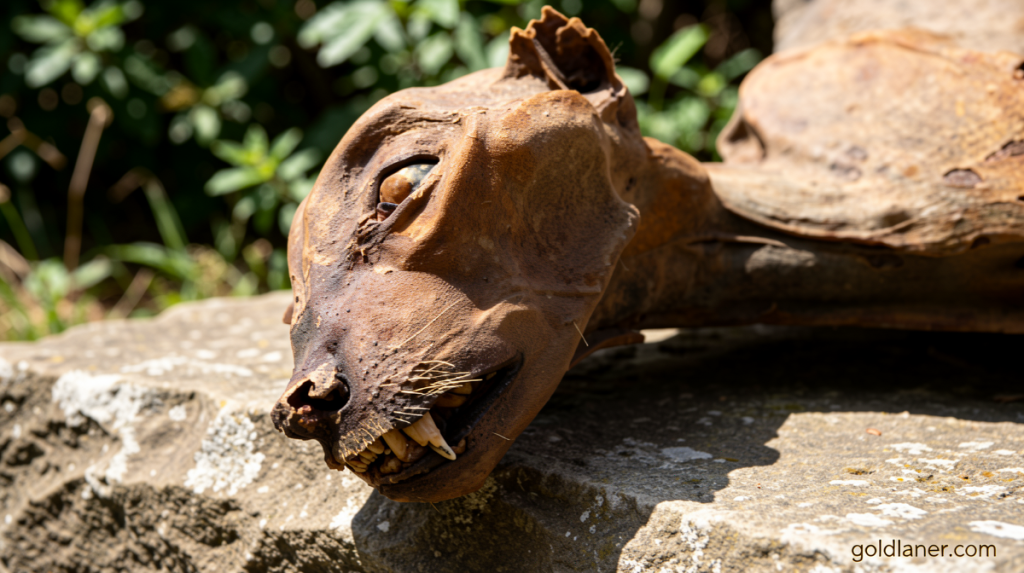
Seven Ancient Cheetah Mummies Found in Saudi Caves Rewrite the Peninsula’s Wildlife History
Goldlaner.com – In the hyper-arid limestone caves scattered near Arar, a city in Saudi Arabia’s northern reaches, researchers stumbled upon a cache that no one had anticipated: seven cheetahs preserved by nature itself, their soft tissue and skeletal structures remarkably intact after centuries or even millennia of desiccation. The discovery, made during systematic wildlife surveys conducted in 2022 and 2023 by teams affiliated with the National Center for Wildlife, shattered a long-held assumption about which cheetah lineages ever set paw on Arabian soil.
A Genetic Surprise Hidden in Ancient Tissue
For decades, the prevailing view held that only the Asiatic cheetah — formally designated Acinonyx jubatus venaticus — had ever occupied Saudi Arabia. That subspecies is now critically endangered, clinging to existence in a small wild population within Iran. Across the broader Arabian Peninsula, cheetahs were declared locally extinct during the 1970s, and the species’ current global range covers a mere 9 percent of its historic territory spanning Africa and parts of Asia.
Yet when scientists extracted complete genome sequences from three of the seven mummified individuals — a first for naturally mummified cheetahs or any large feline — the results upended the single-subspecies narrative. Two of the oldest specimens proved genetically closer to Acinonyx jubatus hecki, the Northwest African cheetah. The finding, published in January in the journal Communications Earth & Environment, confirms that at least two distinct cheetah subspecies once roamed the peninsula simultaneously or sequentially across millennia.
“It was highly surprising,” said Ahmed Al Boug, ecologist researcher and deputy CEO of the National Center for Wildlife in Saudi Arabia, and the study’s lead author. “This finding represents the first documented case of natural mummification in cheetahs, and first physical evidence that cheetah subspecies occurred in the Arabian Peninsula.”
“Moreover, cave use by cheetahs is extremely atypical behavior, making both the discovery itself and the context in which it occurred entirely unexpected,” Al Boug added in an email.
Why the Caves? Why the Mummification?
The team is still probing the question of why these cats entered and occupied cave systems — behavior wholly outside the species’ typical open-terrain ecology. Al Boug and colleagues have ruled out simple accident or terminal isolation as explanations. What is clear, however, is that the caves’ hyper-arid microclimate acted as a natural desiccation chamber, halting decomposition and preserving muscle, skin, and bone in a state rarely seen outside deliberate human embalming.
Alongside the seven mummies, surveyors catalogued skeletal fragments belonging to 54 additional cats within the same cave complexes. Five of those remains were radiocarbon-dated; the oldest dates to roughly 4,000 years before present. The two mummies subjected to full genomic analysis span a window of approximately 130 to 1,870 years ago, placing their deaths squarely within the era of expanding human settlement and pastoral pressure across northern Arabia.
Conservation Implications and a New IVF Milestone
The genetic clarity now available carries direct practical weight for reintroduction planning. Knowing precisely which lineages once thrived in the peninsula allows conservationists to select ecologically appropriate source animals rather than importing cheetahs from unrelated populations. The discovery also supplies tangible proof that cheetahs succeeded in the region’s harsh environment for thousands of years — evidence that the landscape can support them again.
That hope has been reinforced by a parallel breakthrough: two cheetah cubs were recently born via in-vitro fertilization, marking the first successful IVF births for the species. Combined with the genomic data from the mummies, the technique opens a pathway to bolstering small wild populations without removing individuals from already fragile groups.
“This discovery is significant in that it represents the easternmost record of an African cheetah subspecies and demonstrates that northern Saudi Arabia was occupied by multiple cheetah lineages over millennia,” Al Boug stated. “Together, these findings refine our understanding of cheetah landscape use, clarify timelines of regional extirpation, and improve resolution on the subspecies historically present in this region.”
An Outside Voice on the Findings
Adrian Tordiffe, a veterinary wildlife specialist based in India and a lecturer at South Africa’s University of Pretoria — who was not involved in the study — called the dating results particularly arresting. That some of the cheetah remains were only about a century old means these cats persisted in Saudi Arabia far more recently than the public had realized.
“Even more striking is that the remains show different subspecies of cheetahs lived there at different times,” Tordiffe said in an email. “This tells us the Arabian Peninsula was once an important natural bridge for cheetahs, not an ecological dead end.”
Tordiffe emphasized that the discovery hands conservationists a concrete, species-level blueprint for what once inhabited the area in a not-so-distant past, enabling reintroduction programs to target ecologically matched animals rather than importing cheetahs from entirely different evolutionary lineages.
What Comes Next
Al Boug and his team intend to extend genomic and morphological analysis to the remaining mummies and the 54 skeletal fragments, potentially identifying subspecies affiliations across the full temporal span of the cave deposits. Each additional sample narrows the picture of how cheetah populations shifted, contracted, and ultimately vanished from the peninsula — a story that, until now, existed only in fragmentary historical accounts and the absence of living animals.
The Arabian oryx’s celebrated recovery from near-extinction in the same region offers a cautionary-optimistic parallel: a species once written off can return if the ecological and genetic groundwork is properly understood. For the cheetah, the mummies in those northern caves now supply exactly that groundwork — written not in ink, but in four billion years of inherited code, preserved by sand and silence.
Related Reading
Frequently Asked Questions
What is Scientists extracted DNA from mummified cheetah?
Scientists extracted DNA from mummified cheetah is the main topic of this guide. The article explains the context, practical details, and next steps readers should understand.
Why does Scientists extracted DNA from mummified cheetah matter?
Scientists extracted DNA from mummified cheetah matters because readers are looking for a useful answer, not just a short summary. Good content should match search intent and help them decide what to do next.