
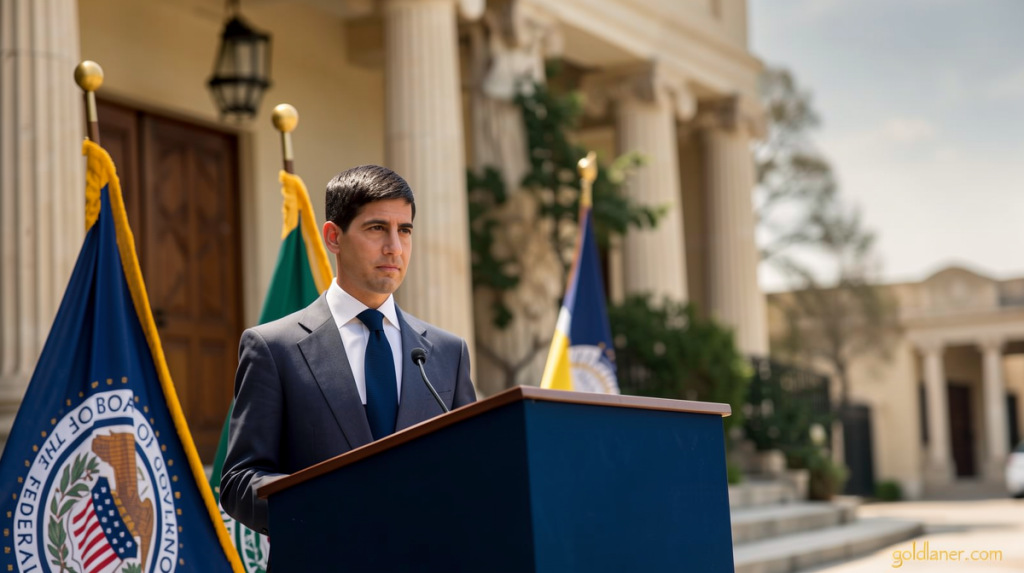
Warsh’s Jackson Hole Test: Markets Demand Answers on Inflation, Chairman May Stay Silent
Goldlaner.com – The question hanging over global financial markets this week is deceptively simple: will the Federal Reserve’s new chairman finally tell investors how he thinks? Kevin Warsh, who assumed the Fed chair three months ago, arrives Friday at the Jackson Hole symposium in Wyoming carrying a mandate that his predecessors treated as routine — and a reputation for opacity that has rattled bond traders.
The annual gathering, hosted by the Federal Reserve Bank of Kansas City, draws central bankers, finance ministers, and policymakers from dozens of nations to a mountain town in Wyoming. For over twenty years, the sitting Fed chair has used the keynote slot to telegraph the direction of monetary policy. Warsh, by every available indication, intends to shatter that convention.
A Chairman Who Will Not Tip His Hand
Since taking office, Warsh has withdrawn the incremental signals — the carefully calibrated phrases, the conditional language, the subtle shifts in tone — that Wall Street has long relied upon to anticipate rate decisions. His silence has coincided with a troubling uptick in inflation, fueled by tariff impositions, ongoing geopolitical conflict, and an unprecedented wave of corporate spending on artificial-intelligence infrastructure. Several members of his own policy committee are now pressing for the first rate increase since July 2023.
The market reaction to his last public appearance was instructive. Following a post-meeting press conference last month in which Warsh offered no commentary whatsoever on the trajectory of borrowing costs, long-term Treasury yields jumped sharply. Traders interpreted the silence as a warning: the Fed may not move aggressively enough to bring stubbornly elevated price growth back toward target.
“I don’t expect any signals to come out of Kevin Warsh’s Jackson Hole speech,” said Jan Groen, chief US economist at Societe Generale. “And if I’m right, I think the market is not going to like it.”
The Missing Reaction Function
At the heart of the investor frustration lies a concept Warsh has repeatedly declined to articulate: his “reaction function.” The term, as the Brookings Institution outlined in a recent analysis, refers to a central bank’s explanation of what indicators it monitors, how it interprets economic data, how it balances competing risks, and what specific developments would alter its policy judgment. It is distinct from “forward guidance,” which projects a more explicit path for rates under a baseline economic scenario.
Warsh has turned down every reporter’s attempt to pin him down on the subject. At a July gathering in Sintra, Portugal, he argued that the bond market does not need such a framework, claiming it is capable of “actually understanding quite well” without one. That characterization has drawn sharp pushback from fixed-income professionals.
“The bond market is really looking to the Fed for clues on their reaction function,” said Ian Kresnak, senior investment strategist at Vanguard. “What’s driving a lot of the volatility in the rates market is uncertainty around how the Fed is going to respond to inflation.”
A CNBC survey conducted this week of 31 economists, strategists, and investors found that 80 percent of respondents believed Warsh should lay out his economic reasoning in substantially greater detail. The Jackson Hole platform, analysts at financial firm Glenmede noted in an August 24 research memo, represents his most natural venue to do exactly that. They added that disclosing his reaction function “could reduce some of the uncertainty driving recent volatility in bond markets.”
Why the Silence Costs the Treasury
The stakes extend beyond abstract market anxiety. Rising government deficits and a swelling supply of corporate debt have already pushed bond yields higher over recent months. Every basis point of additional yield translates directly into larger interest outlays for the federal government, compounding a debt load that now exceeds $40 trillion. Prolonged ambiguity about the Fed’s next move keeps that premium elevated, raising the cost of servicing the nation’s obligations precisely when fiscal pressures are already acute.
What the September Meeting Hints At
Investors are pricing in a roughly 34 percent probability that the Fed will hike rates at its September 15–16 meeting, per CME FedWatch data. The odds climb meaningfully for subsequent sessions through year-end. The question is no longer whether inflation will cool on its own; it is whether Warsh will act before the damage compounds.
“It’s a close call whether or not they hike at all this year,” said Jim Caron, chief investment officer of portfolio solutions at Morgan Stanley Wealth Management.
If Warsh walks into the Jackson Hole auditorium and delivers a speech that says nothing about rates, nothing about his reaction function, and nothing about the conditions under which he would tighten policy, the market will read that silence as confirmation of a deeper problem: that the new chair intends to govern by surprise. For a central bank whose credibility rests on predictable, rule-based conduct, that choice carries costs no amount of mountain scenery can offset.
Related Reading
Frequently Asked Questions
What is Fed Chairman Kevin Warsh faces pressure?
Fed Chairman Kevin Warsh faces pressure is the main topic of this guide. The article explains the context, practical details, and next steps readers should understand.
Why does Fed Chairman Kevin Warsh faces pressure matter?
Fed Chairman Kevin Warsh faces pressure matters because readers are looking for a useful answer, not just a short summary. Good content should match search intent and help them decide what to do next.