
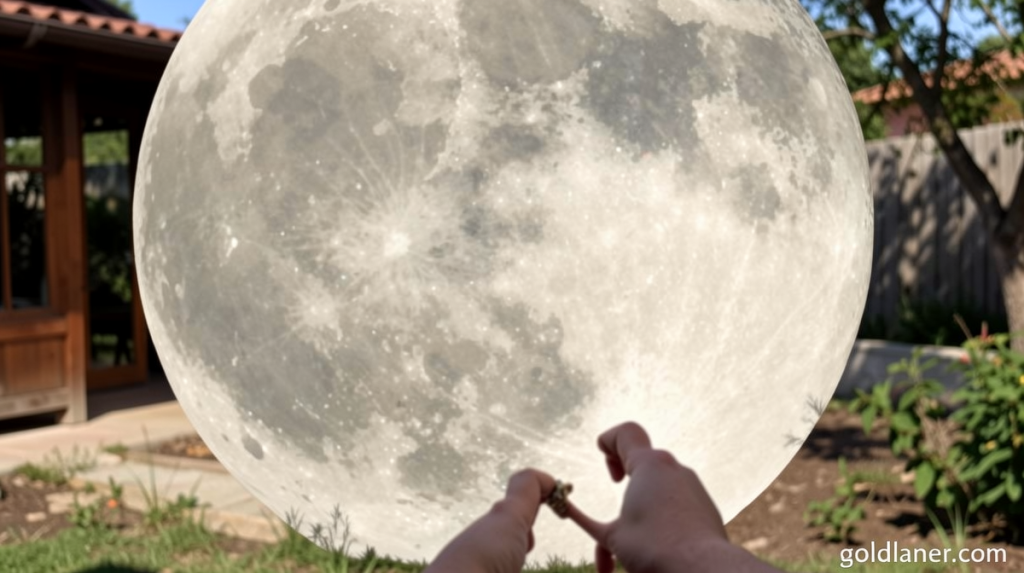
Earth’s Shadow Will Swallow Nearly All of August’s Full Moon in a Rare Near-Total Eclipse
Goldlaner.com – On the night of Thursday into Friday, August 28–29, 2026, the full moon will slide almost entirely into Earth’s umbral shadow, producing what skywatchers across the Americas will experience as one of the most dramatic partial lunar eclipses in recent memory. With 96 percent of the lunar disk expected to pass behind the planet’s dark core shadow, the event sits just a sliver short of totality — close enough that the remaining illuminated crescent will be barely perceptible to the naked eye.
The alignment works because the sun, Earth, and moon fall into a near-perfect straight line, with our planet positioned squarely between the two. Only during a full moon can this geometry occur, which is why every lunar eclipse coincides with the brightest phase of the monthly cycle. In this particular configuration, the moon’s orbit tilts just enough that a thin sliver escapes the umbra, preventing a true total eclipse while still delivering a spectacle that rivals one.
Timing and Where to Watch
The eclipse sequence opens at 10:34 p.m. Eastern Time on Thursday, August 28, as the first bite of shadow touches the lunar limb. Maximum obscuration arrives at 12:13 a.m. ET Friday, when the shadow reaches its deepest penetration across the disk. The moon’s own peak fullness — the moment it appears roundest and brightest in the sky — follows five minutes later at 12:18 a.m. ET, meaning the two events overlap almost exactly.
Because the phenomenon unfolds during evening and overnight hours, observers throughout North America and South America will have clear access to most or all of the event. No special equipment is required; unlike solar eclipses, which demand protective filters, a lunar eclipse is perfectly safe to observe with the unaided eye. Binoculars or a small telescope can add texture detail to the shadow’s edge, but they are optional rather than essential.
The Color Question: How Red Will the Moon Turn?
During deeper eclipses, the moon often takes on a coppery or crimson glow. The physics behind this is atmospheric refraction: shorter wavelengths of sunlight (violet, blue) scatter away as they pass through Earth’s atmosphere, while longer wavelengths (red, orange) thread through and illuminate the shadowed disk. Enthusiasts have long called this effect a “blood moon.”
For this near-total event, predicting the exact hue is genuinely difficult. Noah Petro, who leads the Planetary Geology, Geophysics and Geochemistry Lab at NASA’s Goddard Space Flight Center in Greenbelt, Maryland, told reporters in an email that the outcome is
“hard to predict.”
He added his best expectation for the visual result:
“I would expect the side of the Moon furthest from the lit area might take on a darker hue with some red to it.”
Atmospheric conditions on the day — volcanic aerosols, cloud cover over the terminator, seasonal dust loading — all shift the balance of wavelengths that reach the lunar surface, making each eclipse’s coloration unique.
A Possible Aurora Bonus
The National Weather Service’s Space Weather Prediction Center has flagged a chance that solar-wind activity late Thursday night could trigger geomagnetic storms. While the forecast does not anticipate severe-level disturbances, moderate conditions could push auroral displays into visibility from northern U.S. states, potentially layering green and violet curtains above the eclipsed moon for viewers at higher latitudes.
Getting the Best View
Petro’s practical advice centers on one variable: ambient light. Streetlamps, porch lights, and even distant urban glow will wash out the subtle shading of the partially shadowed disk. He recommends seeking
“a nearby park or any kind of open space that you can go to have an unobstructed view of the night sky.”
Pamela Gay, a senior scientist at the Planetary Science Institute, frames the evening as a broader invitation to slow down and look up. Her suggestion for maximizing the experience:
“Set yourself up a hammock, pull out a pair of binoculars, go out and enjoy the entire experience.”
Why It’s Called the Sturgeon Moon
The August full moon carries the name “sturgeon moon” in traditions of Algonquin-speaking peoples and other Indigenous nations around the Great Lakes. Lake sturgeon runs peaked around this time of year, making the fish a critical seasonal food source, and the moon’s name memorializes that harvest window. Other Indigenous communities apply entirely different labels to the same celestial event: the Assiniboine of the Northern Great Plains call it the black cherries moon, while Eastern Woodlands nations refer to it as the green corn moon, reflecting their own agricultural and foraging calendars.
Where This Fits in the Year’s Eclipse Calendar
The number of lunar eclipses in any given year fluctuates. Most years deliver two, but the count can swing. Gay noted the variability plainly:
“Some years, we actually get three.”
“Some years, we unfortunately get zero.”
In a typical year, though, “there’s two good opportunities” for the sun, moon, and Earth to align closely enough for an eclipse, she explained. The first such event of 2026 arrived in March as a total lunar eclipse, best observed from Australia and surrounding Pacific regions. This August partial is the year’s second.
Four additional full moons remain in 2026. Notably, the November and December full moons will coincide with perigee — the point in the moon’s elliptical orbit nearest Earth — producing supermoons that appear noticeably larger and brighter than average. Those events, while not eclipses, will offer their own visual drama for the remainder of the year.
For those who missed the August alignment, the next lunar eclipse of 2027 has already been flagged by astronomers as a particularly favorable event worth planning around. Until then, the night sky still holds plenty of spectacle: meteor showers, planetary oppositions, and the quiet geometry of the moon’s monthly phases.
Related Reading
Frequently Asked Questions
What is Catch the full moon as it slips?
Catch the full moon as it slips is the main topic of this guide. The article explains the context, practical details, and next steps readers should understand.
Why does Catch the full moon as it slips matter?
Catch the full moon as it slips matters because readers are looking for a useful answer, not just a short summary. Good content should match search intent and help them decide what to do next.