
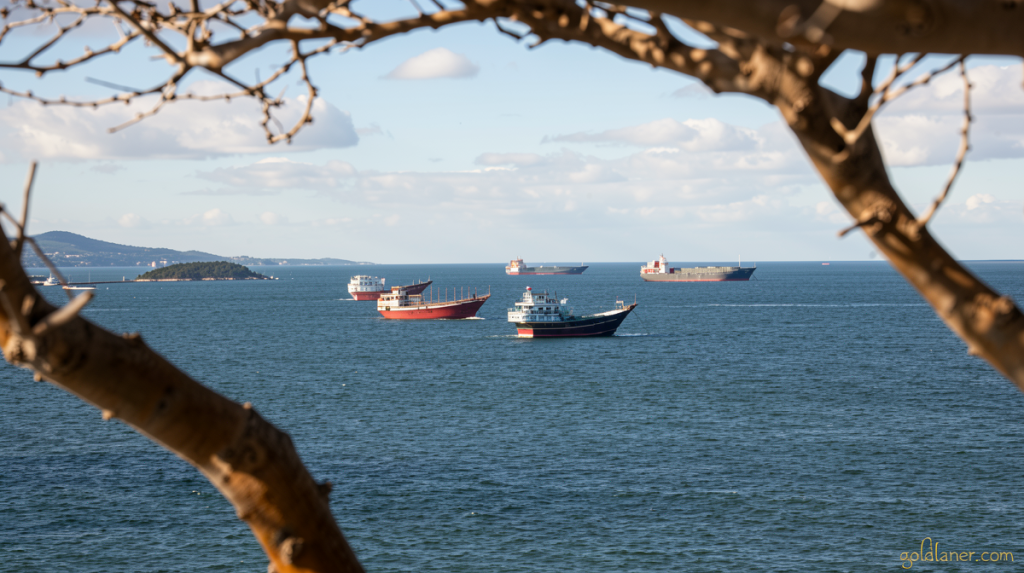
Strait of Hormuz: Iran’s Grip on the World’s Most Critical Oil Chokepoint Is Slipping
Goldlaner.com – For months, the question dominating energy markets and geopolitical strategy has been simple: who actually commands the Strait of Hormuz? Both Tehran and Washington have staked competing claims of dominance over the narrow waterway that funnels roughly a fifth of global petroleum consumption. The fog of competing rhetoric has muddied the picture for analysts, traders, and policymakers alike. Yet the operational reality emerging over the past fortnight points in one direction — and it is not Tehran’s.
Shipping telemetry now indicates that more than 80 percent of liquid cargo moving through the strait in the last two weeks has either followed the Omani corridor — a shipping lane authorized by the United Nations that Iran has consistently rejected — or traveled as so-called “dark” transits, vessels with transponders switched off that almost certainly took the same southern path. The data comes from Kpler, a maritime analytics firm that fuses AIS transponder signals with satellite imagery to reconstruct vessel movements.
The Toll Question and the Expiring MoU
Iran’s preferred method of asserting authority over the waterway has been to levy transit fees on passing tankers, a practice it employed during the spring. With the Memorandum of Understanding between Washington and Tehran set to expire this week, Tehran theoretically regains the legal cover to resume toll collection. In practice, that has not happened. The dramatic collapse of traffic along Iran’s favored northern corridor — the route skirting the north coast of Oman — has stripped the country of the leverage it once wielded to extract payments from shipowners.
“Iran’s request to collect tolls is something that most Middle East folks don’t want to do and haven’t been doing,” said Dan Pickering, founder and chief investment officer at Pickering Energy Partners. “So the Oman route absolutely makes the most sense.”
Shipowners, faced with dozens of vessels already struck by Iranian attacks while attempting the northern passage, have largely opted to sail the southern corridor under the implicit guarantee of United States naval escort. The risk calculus has shifted decisively.
VLCCs, Dark Transits, and the Limits of Tracking
A further layer of complexity has emerged from the Gulf’s major producers. Kuwait, Saudi Arabia, and the United Arab Emirates have chartered Very Large Crude Carriers — the largest class of oil tanker in commercial service — to push cargoes out of the Persian Gulf through the strait, then offload the crude onto customer-owned tankers waiting in the Gulf of Oman, beyond the range of Iranian fire. Andy Lipow, president of Lipow Oil Associates, confirmed the arrangement.
To minimize their exposure to Iranian strikes, these VLCCs have switched off their AIS transponders, sometimes for stretches lasting weeks. The resulting “dark traffic” has evaded conventional tracking services, including Kpler’s standard feeds. Satellite passes can still detect some of these vessels, but the gaps in coverage make precise flow accounting difficult. The United States, however, maintains a substantial naval presence in and around the strait and claims visual and sensor coverage of every vessel transiting the waterway.
Oil Flow Numbers and the Gap Between Rhetoric and Reality
Energy Secretary Chris Wright stated last week that combined oil transits through the strait plus rerouted volumes around the waterway averaged approximately 15 million barrels per day over a recent seven-day window. That figure sits considerably closer to the roughly 20-million-barrel-per-day pre-war baseline than most conventional estimates had suggested during the conflict’s earlier phases.
The number prompted President Donald Trump to declare on Monday that the United States exercises “total control over the strait” — a formulation he has repeated with regularity throughout the campaign. Yet the persistence of Iranian attacks on shipping, coupled with oil flows still meaningfully below pre-war levels, complicates any straightforward reading of that claim. Full control implies the absence of coercion; the continued need for naval escort and the willingness of shipowners to go dark suggest otherwise.
“If their goal is to be ‘in charge,’ then I’d say they were never completely in control to start with,” Pickering observed. “It feels like their goal is deterrence, in order to be validated as in-control. I think they are still deterring.”
Still, if tanker volumes are genuinely approaching the levels Washington describes, then Iran’s capacity to deter or dictate terms of passage has eroded substantially compared with one or two months ago, when virtually no traffic used the Omani corridor at all.
Oman–Iran Talks and the Unresolved Endgame
Adding another variable to an already volatile equation, Oman and Iran are reportedly conducting bilateral discussions aimed at restoring freedom of navigation through the strait — talks conducted without United States participation, a fact that has drawn sharp criticism from the Trump administration. The practical implications for oil traffic, toll regimes, and long-term control of the waterway remain unclear.
“I would take all the information and headlines ‘under advisement,'” Lipow cautioned. “But it is fair to say that Iran has partially lost control of the strait.”
For energy markets, the takeaway is neither total American dominance nor continued Iranian veto power, but something more ambiguous: a contested chokepoint where the balance of coercion is tilting, slowly and unevenly, away from Tehran. The strait’s strategic weight — roughly 20 million barrels per day of crude and refined products passing through before the war — ensures that every shift in its operational control reverberates through global pricing, insurance premiums, and supply-chain planning. Until the Oman–Iran talks produce a durable framework, and until pre-war flow levels are fully restored, the Strait of Hormuz will remain the single most consequential unresolved question in the Iran conflict.
Related Reading
Frequently Asked Questions
What is Iran has lost significant control?
Iran has lost significant control is the main topic of this guide. The article explains the context, practical details, and next steps readers should understand.
Why does Iran has lost significant control matter?
Iran has lost significant control matters because readers are looking for a useful answer, not just a short summary. Good content should match search intent and help them decide what to do next.