
Massive blasts in Moscow shatter even Putin’s protective shell
Massive blasts in Moscow shatter even Putin’s protective shell
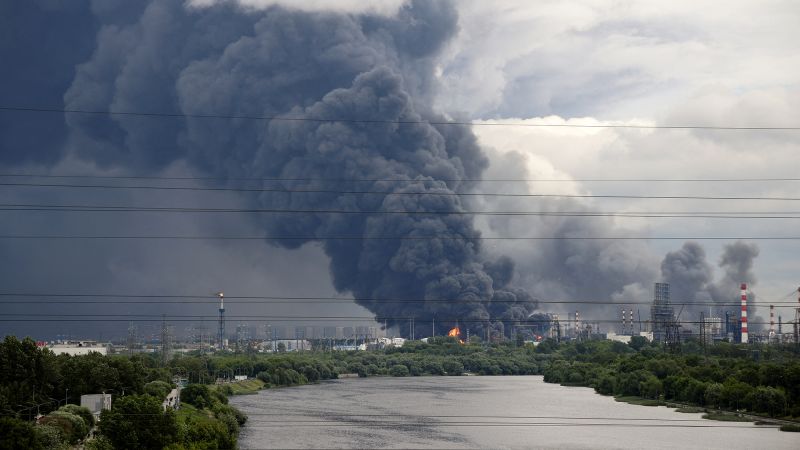
Massive blasts in Moscow shatter even – The recent devastation in Moscow’s skyline has pierced the veil of isolation that Russian President Vladimir Putin has maintained throughout his invasion of Ukraine. Reports indicate that powerful explosions, likely caused by Ukrainian drone strikes, have rattled the capital, forcing even the most fortified elements of the Kremlin’s defense strategy into the spotlight. These attacks, occurring just 10 miles from the heart of Russian government, have been described as a stark reminder of the war’s reach and its ability to disrupt even the most secure areas. The damage has not only impacted infrastructure but has also raised questions about the resilience of Putin’s leadership in the face of mounting pressure.
Thursday’s strikes marked a pivotal moment in the conflict. Videos shared by Russians on social media revealed a series of dramatic scenes: a refinery roof blown off, multiple fires raging across the city, and thick black smoke billowing over the capital. These images, captured by citizens rather than state-controlled media, underscore a shift in the narrative. For years, Moscow’s population has been shielded from the full extent of the war’s impact by a carefully curated information campaign. However, the recent events have exposed cracks in that facade, with citizens now witnessing the consequences of Ukrainian attacks in real time.
The attacks have sparked discussions about the effectiveness of Russia’s air defenses. Traditionally seen as a robust system, Moscow’s defenses appear vulnerable to the growing arsenal of Ukrainian drones. These unmanned aircraft, once used to target Ukrainian territory, now pose a significant threat to Russian soil. Analysts note that the drones’ affordability and adaptability have allowed Ukraine to conduct sustained operations, challenging the notion that Russia’s military superiority is unshakable. The strikes on refineries, in particular, have raised concerns about energy supply disruptions, potentially leading to fuel shortages and long lines at gas stations—a scenario that could deepen public unrest.
President Volodymyr Zelensky has framed the attacks as a calculated response to Russia’s relentless bombardment. In a
statement following the strikes, he said: “These attacks are a direct retaliation for the continuous assaults on our cities and the suffering of our people.” The Ukrainian leader’s remarks highlight a strategic shift, emphasizing not just defense but a proactive approach to counter Russian advances. Zelensky’s confidence appears bolstered by the G7 summit in Evian, where President Donald Trump’s mixed signals—both apathy and support for Ukraine—provided a glimmer of hope. Trump’s endorsement of Ukraine’s capacity to mass-produce Western weapons, however, remains ambiguous, leaving room for interpretation about the true extent of American commitment to the conflict.
The European Union has also signaled its willingness to engage, with Italian Prime Minister Giorgia Meloni suggesting that a “middle power” could act as a bridge for renewed negotiations. In a statement released 11 days prior to the Moscow strikes, the UK, France, and Germany reiterated their position on a potential ceasefire, a stance that has long been a sticking point for Moscow. Despite the setbacks, there is still optimism that Putin may reconsider his approach, particularly as the war has entered a prolonged stalemate. His recent comments hint at a possible pivot, stating that a peace deal and the capture of Donbas are “not mutually exclusive” ideas, though the meaning remains unclear.
The war’s toll on Russia’s economy and society has grown increasingly evident. With over half a million Russians reportedly killed, the human and financial costs have forced a reevaluation of the conflict’s viability. The blackened rain that fell on Moscow’s streets after the blasts symbolizes the irreversible damage to both the environment and the public’s perception of the war’s outcome. While the Kremlin has sought to downplay these developments, the sheer scale of the destruction has left little room for denial.
Since a small drone struck the Kremlin in May 2023, Moscow has become a frequent target of Ukrainian operations. The attack on Victory Day, a pivotal date for Russian morale, saw the parade scaled back significantly, signaling the war’s impact on national pride. The recent barrage of videos—showcasing drones descending in waves over burning buildings—has created a stark contrast to the controlled media environment that once dominated the narrative. This shift in information flow suggests that Moscow’s efforts to manage public sentiment have weakened, allowing dissent to spread more freely.
Despite the pressure, Putin’s leadership remains intact, though his options have narrowed. The destruction in Moscow has forced him to confront the reality that the war may not be as easily won as he once believed. His response to the attacks—suggesting further retaliation rather than diplomacy—reveals a reluctance to acknowledge the need for a strategic adjustment. Yet, the growing unrest in the capital and the visible damage to key infrastructure may compel him to take a different path.
For Ukraine, the attacks on Moscow represent a turning point. The successful use of drones to target Russian oil facilities has demonstrated the country’s ability to adapt and innovate. This capability, combined with the support from Western allies, positions Ukraine as a formidable player in the conflict. The country’s ability to mass-produce weapons under license, as hinted by Zelensky, underscores a broader strategy of leveraging both domestic and international resources to sustain its war effort. This development also signals that Ukraine is no longer just a defensive force but a proactive one, capable of striking deep into Russian territory.
The implications of the Moscow strikes extend beyond the immediate damage. They have reignited debates about the future of the war and the potential for a negotiated settlement. While Putin continues to insist on the necessity of capturing Donbas, the visible toll on the capital has made it harder to ignore the possibility of a more sustainable peace. The European Union, with its consistent push for a ceasefire, remains a key player in this process, even as Russia resists. The coming weeks will likely determine whether Putin can maintain his grip on the narrative or if the war’s realities will force him into a new era of diplomacy.
