
July 4, 1776: The day Thomas Jefferson went shopping
July 4, 1776: The day Thomas Jefferson went shopping
July 4 1776 – On the morning of July 4, 1776, in the heart of Philadelphia, the weather was unusually tranquil. A gentle breeze carried the scent of the Delaware River, and the sun rose without the usual intensity of summer heat. Yet, this seemingly ordinary day would later be immortalized as the birth of a nation. What makes it remarkable, however, is not the historical events that unfolded but the fact that Thomas Jefferson, the principal author of the Declaration of Independence, spent part of his time engaged in an activity that might seem trivial by comparison: shopping.
A Day of Contrasts: Weather and History
The temperature that day fluctuated gradually, beginning at a cool 68 degrees as dawn approached. By 9 a.m., it had risen to 72.25 degrees, and by noon, the air warmed to a comfortable 76 degrees. As evening settled, the heat slightly eased to 73.5 degrees. These precise measurements, recorded by Jefferson himself, offer a fascinating glimpse into the man behind the revolutionary document. Though the Continental Congress was finalizing the Declaration’s text and declaring the United States free from British rule, Jefferson’s attention seemed to be focused on the weather rather than the weighty political decisions.
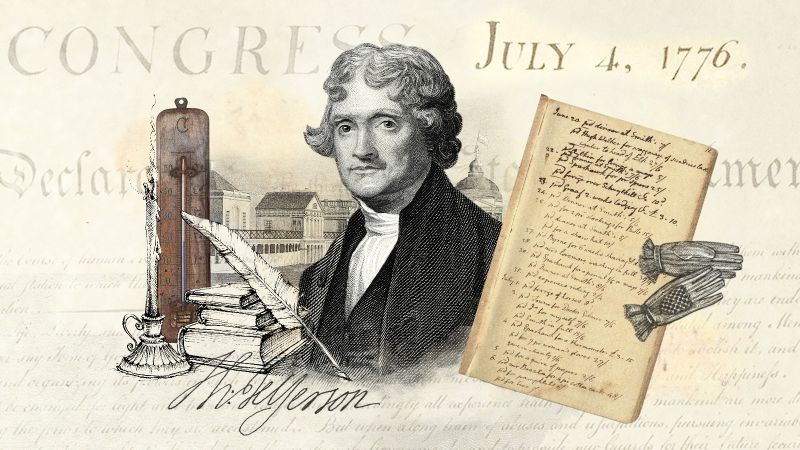
Jefferson’s meticulous habit of logging daily observations extended beyond politics. His personal expenditure records, kept in careful memorandum books, document a range of purchases, from books to goods. On July 4, he spent three pounds and 15 shillings on a thermometer from John Sparhawk, an apothecary and bookseller on Second Street. This detail, though minor, underscores a broader pattern of Jefferson’s life: his ability to balance grand ideological missions with the practicalities of everyday existence.
The Unlikely Significance of a Shopping Day
While the nation’s fate was being sealed, Jefferson’s actions on this specific day reveal a unique perspective on leadership. The declaration of independence was the culmination of months of debate, with the final version of the document approved by Congress on July 2. By July 4, the hard work of drafting and refining the text had largely been completed, allowing for a more relaxed atmosphere. Yet, Jefferson’s decision to visit Sparhawk’s shop suggests that even in moments of historical importance, routine tasks remained essential.
Jefferson’s shopping spree included not only the thermometer but also seven pairs of women’s gloves for 17 shillings. These purchases, while modest in cost, hint at the domestic responsibilities that accompanied his political duties. Scholars have noted that such activities might indicate a lighter workload for Jefferson compared to his contemporaries, such as John Adams, who was deeply involved in the Congress’s most critical decisions. “The fact that he could manage errands on the same day as the Declaration’s adoption might mean he wasn’t on as many committees as others,” said Cara Rogers Stevens, a Jeffersonian historian at Ashland University. “It’s possible he had a more flexible schedule.”
Jefferson’s meticulous record-keeping also included a small charitable contribution: one shilling and six pence. This act of generosity, alongside his shopping, paints a picture of a man who was both analytical and grounded in the mundane. “It’s a reminder that even during the most pivotal times in history, individuals must attend to daily tasks,” remarked Andrew Davenport, vice president of research at Monticello, Jefferson’s estate. “The fabric of civic life isn’t just grand gestures—it’s the sum of everyday decisions.”
Revisiting the Timeline: July 4 vs. July 2
The formal decision to sever ties with Britain was made on July 2, when the Continental Congress approved Richard Henry Lee’s resolution for independence. John Adams, in a letter to his wife Abigail dated July 3, predicted that this date would become a celebrated milestone. “The Second Day of July 1776, will be the most memorable Epocha, in the History of America,” Adams wrote. “It ought to be commemorated, as the Day of Deliverance by solemn Acts of Devotion to God Almighty.”
However, the actual adoption of the Declaration occurred on July 4, which, as Davenport pointed out, was “a mundane day, except it’s a revolutionary one.” The shift from July 2 to July 4 as the iconic date for independence highlights how historical narratives can evolve. The final document, penned by Jefferson and revised by others, was likely approved and ordered for printing in the morning of July 4. This means that the day was more about finalizing the text than its initial drafting, a detail that adds nuance to its perceived significance.
Jefferson’s role in the process was pivotal. He had arrived in Philadelphia in May 1776 for the Second Continental Congress, where he was joined by Robert Hemmings, an enslaved teenager who assisted with his daily needs. On June 11, the Congress appointed a five-member committee to draft the Declaration, with Jefferson as its primary author. McClure noted that Jefferson worked on the draft amidst other obligations, submitting it to Congress by June 28. By July 4, the document was in the final stages, allowing for a more streamlined day of approval.
A Legacy of Balance and Routine
While the Declaration of Independence is often seen as the climactic event of the American Revolution, Jefferson’s actions on July 4 challenge that perception. His ability to maintain a detailed record of the weather and personal expenses, even on a day of monumental importance, suggests that the revolutionaries were not entirely consumed by their political mission. They also had to manage the logistics of governance, from procuring supplies to caring for household matters.
Jefferson’s thermometer purchase, in particular, offers a symbolic connection between science and revolution. The instrument, which measured the day’s temperature shifts, was a tool of precision in a time when the nation’s future was being decided by words and ideals. This duality—of measuring physical conditions and shaping a new political order—highlights Jefferson’s multifaceted role as both a leader and an observer of the world around him.
As historians continue to explore the nuances of this period, Jefferson’s shopping day serves as a reminder that the creation of a nation was not a singular, dramatic event but a series of interconnected decisions. From the meticulous recording of weather data to the careful management of personal expenditures, every action contributed to the broader narrative of independence. The July 4, 1776, that Jefferson experienced was not just a day of rebellion—it was a day of routine, purpose, and quiet determination. In this way, the story of the Declaration is as much about the everyday as it is about the extraordinary.
