
Iran sends a defiant message to Trump with colossal funeral for slain Supreme Leader Ali Khamenei
Iran Sends a Defiant Message to Trump with Colossal Funeral for Slain Supreme Leader Ali Khamenei
The Spectacle of Mourning
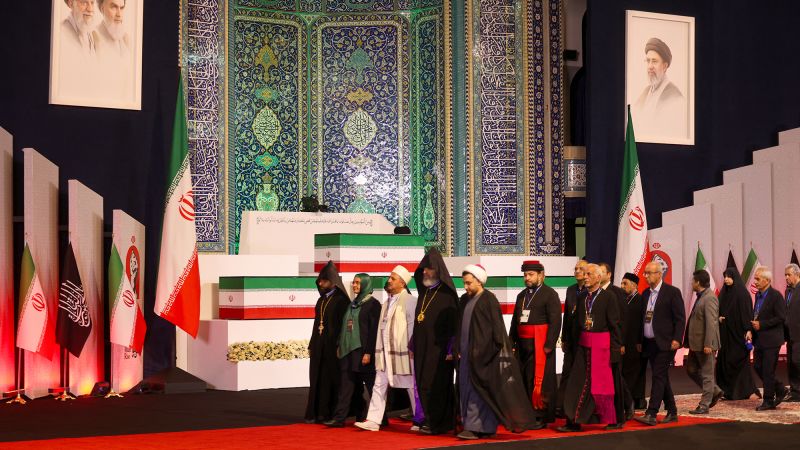
Iran sends a defiant message to Trump – Nearly four months after his assassination, Supreme Leader Ali Khamenei’s funeral has become a grand event spanning multiple cities in Iran and Iraq, drawing millions of participants. The weeklong ceremony, marked by intense emotional displays and religious rituals, coincides with the 250th anniversary of the United States’ Independence Day, a timing that underscores the symbolic contrast between Iran’s grief and America’s historical celebration. Despite the ongoing conflict with the U.S. and Israel, which has imposed significant economic strain and military losses, Tehran has orchestrated an elaborate tribute to Khamenei, emphasizing the regime’s endurance and resilience.
The funeral’s scale is unprecedented, with authorities mobilizing vast resources to ensure its success. Government officials, university students, labor unions, firefighters, soldiers, and aid workers have all been deployed to manage the logistics of the event. Religious mourning groups, often organized to amplify communal sentiment, play a central role in guiding attendees through the rituals. The plan includes displaying Khamenei’s body in a prominent location for two days, a practice that will draw crowds to both Iranian cities and Iraqi holy sites, where Shiite Muslims form a majority.
The event’s timing is no accident. Khamenei’s body will lie in state on July 4, the day the U.S. celebrates its independence, while another key segment of the procession aligns with a major Shiite observance honoring the death of Imam Hussein, a revered religious figure. This overlap is deliberate, as the Islamic month of Muharram—a time of profound mourning in Shia tradition—serves as a backdrop for the funeral. The choice of dates aims to juxtapose Iran’s national sorrow with American festivity, reinforcing the narrative of defiance against Western powers.
A Defiant Legacy
Khamenei’s leadership, spanning 37 years, was characterized by unwavering resistance to Western influence. His assassination on February 28, the opening day of the U.S.-Israeli war on Iran, transformed him into a martyr in the eyes of many supporters. The funeral, therefore, is not just a farewell but a public demonstration of the regime’s ability to sustain its identity despite external pressures. For Iranian citizens, the ceremony symbolizes unity and shared purpose, even as it highlights the personal sacrifices of the leader.
“The assassination has made Khamenei far more powerful symbolically in death than he was in life,” said Sina Toossi, a senior nonresident fellow at the Center of International Policy, in a statement to CNN. “Khamenei is now being framed as a martyred religious authority, akin to revered Shia saints whose worldview was vindicated by the manner of their deaths.” This perspective resonates deeply within Iran’s cultural and religious fabric, where martyrdom is often associated with divine favor and moral strength. The funeral’s emphasis on these themes is intended to galvanize the population and reaffirm the regime’s ideological foundation.
Despite the war’s toll on Iran’s economy and military capabilities, the state has invested heavily in the funeral’s production. Tribute songs, documentaries, and mass media campaigns have dominated coverage for over a decade, overshadowing earlier discussions about U.S.-Iran negotiations. This shift reflects a strategic focus on domestic morale, positioning Khamenei as a unifying figure against perceived global threats. The ceremony also marks the debut of Mojtaba Khamenei, his son and the new Supreme Leader, who has remained in the shadows since the attack that claimed his father’s life.
Historical Precedents and Symbolic Significance
The funeral’s scale echoes past moments of national mourning in Iran. The only comparable events were the 1989 funeral of Ayatollah Ruhollah Khomeini, the founder of the Islamic Republic, and the 2020 memorial for Quds Force commander Qassem Soleimani. Both ceremonies were marked by intense public participation and, in some cases, chaotic scenes, including crowd crushes. However, the current event is distinct in its coordination with the U.S. Independence Day, a detail that adds layers of political and cultural meaning.
Khamenei’s body will be displayed in the same location where his predecessor, Ayatollah Khomeini, was laid to rest. This spatial continuity reinforces the idea that the leader’s legacy is interwoven with the nation’s history. The choice of Muharram, the first month of the Islamic calendar, further deepens the symbolism. For Shiite Muslims, this month is traditionally associated with mourning the martyrdom of Imam Hussein, who was killed in a battle against the Umayyad caliphate. By aligning the funeral with these ancient traditions, Iran seeks to legitimize Khamenei’s role as a modern-day martyr, drawing parallels between historical struggles and contemporary geopolitical tensions.
“We must rise and raise the cry for the nation’s blood to the world so that the world knows that the honorable and noble nation of Iran does not remain silent in the face of oppression… and will not let go of the blood of its Imam (Khamenei),” wrote Mohammad Bagher Ghalibaf, the influential parliamentary speaker, in a message published by state media. Ghalibaf, who is leading Iran’s diplomatic efforts with the U.S., framed the funeral as a declaration of the regime’s unyielding spirit. His words reflect a broader sentiment that Khamenei’s death is not an end but a catalyst for renewed determination.
The ceremony’s impact extends beyond Iran’s borders. International observers note that the event serves as a reminder of the enduring influence of religious symbolism in shaping political narratives. While the U.S. and Israel may view the funeral as a testament to Iran’s perseverance, Tehran sees it as a triumph of ideological strength. The logistical coordination, including the transport of Khamenei’s body and the management of millions of mourners, underscores the government’s commitment to maintaining this image of resilience.
For many Iranians, the funeral is a moment of catharsis, a chance to honor a leader who symbolized the country’s resistance against foreign domination. Yet, it also highlights the personal toll of the conflict, with Khamenei’s assassination having ignited some of the fiercest anti-regime protests in recent history. Despite the brutality of these demonstrations, the regime’s hardline elements have gained strength, leveraging the leader’s martyrdom to consolidate power.
The funeral, while a display of unity, also serves as a platform for the new Supreme Leader, Mojtaba Khamenei, to step into the public eye. His presence at the event is a strategic move to legitimize his leadership and signal continuity with his father’s legacy. As the ceremony unfolds, it becomes clear that Iran is not only commemorating a fallen leader but redefining its narrative in the face of ongoing challenges. The message is unequivocal: even in death, Khamenei’s influence endures, and the nation’s resolve remains unshaken.
“The assassination has made Khamenei far more powerful symbolically in death than he was in life,” said Sina Toossi, a senior nonresident fellow at the Center of International Policy, in a statement to CNN. “Khamenei is now being framed as a martyred religious authority, akin to revered Shia saints whose worldview was vindicated by the manner of their deaths.”
As the funeral progresses, it becomes a microcosm of Iran’s broader strategy: to transform loss into legacy, and to use the moment to assert its place on the global stage. The overlap with American Independence Day is not merely coincidental—it is a calculated act of defiance, challenging the narrative of Western dominance while celebrating the nation’s own sacrifices. In this way, the funeral is both a mourning ritual and a political statement, reinforcing the idea that Iran’s struggle is as much about identity as it is about ideology.
The event also highlights the role of media in shaping public perception. For weeks, Iranian outlets have been emphasizing Khamenei’s life and contributions, downplaying earlier diplomatic efforts. This focus on martyrdom and national pride is a masterstroke in rallying support, as it positions the leader as a unifying force against external enemies. The logistics of the funeral, from transportation to crowd control, reflect the regime’s ability to organize on a massive scale, even in the face of global scrutiny.
As the days of the funeral pass, the spectacle will likely become a defining moment in the narrative of the U.S.-Iran conflict. While the war has taken a heavy toll, the ceremony ensures that Khamenei’s memory remains a powerful symbol of resistance. For the international community, it is a reminder of the deep cultural roots that continue to shape Iran’s political landscape. And for the Iranian people, it is a chance to reaffirm their commitment to a leader who, even in death, embodies the nation’s spirit.
