
Bodies lie unclaimed and rats run rampant as months on Gaza’s ceasefire remains unfulfilled
Bodies Lie Unclaimed and Rats Run Rampant as Months on Gaza’s Ceasefire Remains Unfulfilled
A Child’s Dream Amidst Ruin
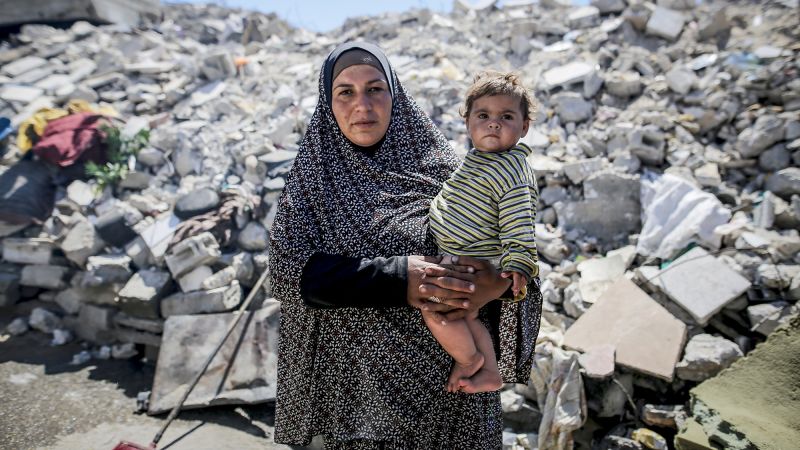
Bodies lie unclaimed and rats run rampant – Fourteen-year-old Karam, a displaced resident of Deir al-Balah in central Gaza, clutches a blue, yellow, and white football as he navigates a dusty path through the remnants of his community. “My dream was to become a footballer,” he says, recounting how he once played with friends in the streets. “Life before the war was beautiful. But now, there is no life,” he tells CNN. The once vibrant landscape of Gaza, with its deep blue sea and sprawling horizons, has been reduced to a haunting scene of burned fields, scorched orchards, and rubble-strewn neighborhoods. Despite promises of peace, the reality for many remains one of quiet despair.
“You can be bombed anytime in any place,” says Sally Saleh, an aid worker displaced in Deir al-Balah. “There is no actual ceasefire here.”
The Ceasefire Agreement and Its Unfulfilled Promises
After two years of relentless bombing and siege in Gaza, Israel and Hamas inked a two-phase agreement last fall. This pact, signed following the October 7, 2023 attacks in Israel, aimed to establish a lasting peace by envisioning the eventual withdrawal of Israeli forces, Hamas’s full disarmament, the deployment of an international security force, and the formation of a new Palestinian governance body. However, progress has been slow, and the agreement has yet to deliver the stability it promised.
Since the deal was signed on October 11, the Palestinian Ministry of Health reported at least 1,059 fatalities and 3,429 injuries in Gaza due to Israeli attacks. The toll has been particularly devastating for children, with one Palestinian child reportedly killed in Gaza every day on average, according to a CNN analysis of health records. Meanwhile, the Board of Peace, established to advance the ceasefire plan, claimed in Cyprus that recent meetings had been “highly productive.” Yet, the path to peace remains uncertain, with no clear timeline for implementing key elements of the agreement.
A Dire Existence in the Ashes
Months after the deal, the situation in Gaza continues to deteriorate. Nikolay Mladenov, a former UN official tasked with overseeing the agreement, warned in May that the “dangerous status quo” threatens to become the new normal. Without significant progress, Gazans remain trapped in a cycle of violence, with no respite from the war’s relentless impact. Displacement has become widespread, with over 1.9 million people—nearly the entire population—forced from their homes, many multiple times.
Living conditions have worsened, with many settling in poorly ventilated, makeshift tents. These shelters, often built from scavenged materials, have become breeding grounds for health crises. In its latest report, the UN noted that ectoparasitic infections, such as those caused by parasites burrowing into the skin, have spread across more than 80% of displacement areas. Rats, cockroaches, and weasels now roam freely, tearing through tents, gnawing on food supplies, and even biting children and infants in their sleep.
“We have spoken to parents whose children have been bitten by rats, who are terrified that it will happen again,” says Sally Saleh, the head of emergency operations for the UK-based NGO Medical Aid for Palestinians (MAP).
Survival in the Shadows of War
Residents describe a daily struggle to survive amid the chaos. “The brutality of war has not ended; it has just taken a different form,” says Saleh, emphasizing the persistent threat of violence. Many now rely on limited resources, with some even resorting to hanging food containers on the ceilings of their tents to keep them out of reach from rodents. The UN has raised concerns about the spread of disease, citing soil and water contamination as a growing problem due to insufficient sanitation facilities.
Hosni Nadeem Mohanna, a spokesperson for Gaza’s water municipality, highlights the challenges of maintaining basic hygiene. “Residents have dug makeshift cesspits as latrine stocks dwindle, leading to severe soil and water pollution,” he explains. The lack of infrastructure has exacerbated the humanitarian crisis, with long-term homelessness compounding the suffering of those already displaced. For families in Deir al-Balah, the once-familiar streets now echo with the sounds of despair and the cries of children.
Israel’s Occupation and Hamas’s Resilience
While the ceasefire deal was meant to ease tensions, Israel has intensified its control over Gaza. The military has expanded its presence beyond the “yellow line”—a reference to the boundary agreed upon in the agreement—continuing to target Hamas members and their supporters. Israeli Prime Minister Benjamin Netanyahu recently stated that his government had ordered forces to seize control of 70% of the enclave, hinting that the occupation could grow even further.
Hamas, meanwhile, has regrouped and maintained its grip on the remaining areas. The group has refused to disarm, citing the need for security guarantees. Its continued influence has kept the conflict alive, even as the ceasefire agreement was meant to provide a pause. The result is a fragile truce that feels more like a temporary reprieve than a lasting solution. For many, the promise of peace has been overshadowed by the harsh realities of daily life.
A Call for Action and Accountability
Amid the growing humanitarian crisis, international actors have faced criticism. The UN recently accused Israel of committing genocide in Gaza by deliberately targeting children, a claim the government dismissed as “a political blood libel disguised as a UN document.” Yet, the evidence of civilian casualties and the worsening conditions in Gaza speak for themselves. Diplomats may refer to “peace,” but for those on the ground, the word feels distant and unattainable.
As the months pass, the people of Gaza remain trapped in a landscape of destruction. Their hopes for a better future are dimmed by the slow pace of progress and the encroaching shadow of war. The agreement, once seen as a beacon of hope, now appears to be a testament to the challenges of achieving lasting peace in a region where trust is hard to rebuild. For Karam and millions like him, the dream of a safe and stable life continues to fade, replaced by the stark reality of a ceasefire that has not ceased.
