
A man was jailed for murder. 15 years after his death, he will get a retrial
A Life Sentence, A 15-Year Pursuit: Japan Grants Posthumous Retrial for Murder Convict
A man was jailed for murder 15 – In a recent development, a Japanese court has agreed to a retrial for Hiromu Sakahara, a man who spent over 24 years behind bars for a murder conviction before passing away in 2011. The decision, which marks the first time a posthumous retrial has been granted in Japan, has brought his family together around his grave, where they now reflect on the long journey to clear his name. Sakahara’s case has become a symbol of the country’s justice system, highlighting the challenges faced by those seeking to overturn convictions after decades of detention.
The Weight of a Life Sentence
Sakahara was sentenced to life imprisonment in 1984 for the killing of a store manager in the small town of Hino, located roughly an hour east of Kyoto. His death in 2011 came after a confession he claimed was coerced during interrogation, which formed the basis of his conviction. Now, nearly 15 years after his passing, his family is set to see the justice system revisit his case, a process that has been both emotionally taxing and legally complex.
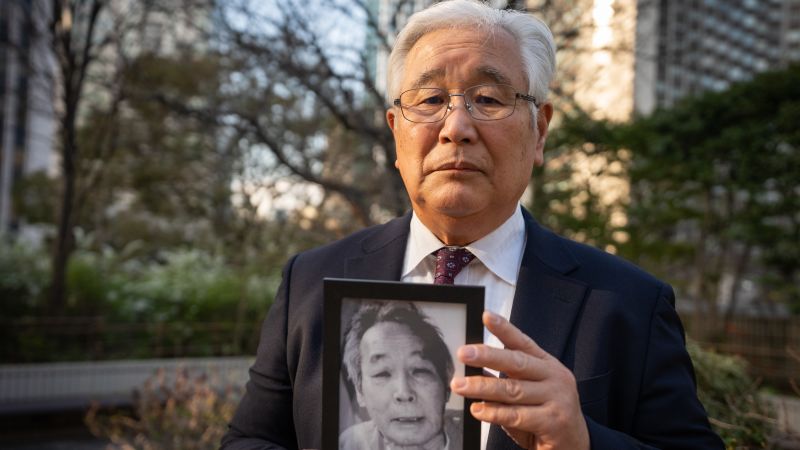
“I regret that we could not save my father from prison,” said Koji Sakahara, his son, in a statement to CNN. “While I am happy about the decision to grant a retrial, it’s still incredibly painful.” Koji, who is now 64 and has graying hair from years of advocacy, recounted the enduring struggle to prove his father’s innocence. His family’s efforts have not only spanned decades but have also become a catalyst for broader discussions about Japan’s judicial procedures.
Japan’s “Hostage Justice” System
Japan’s legal framework is often criticized for its “hostage justice” model, a term describing how suspects can be detained for questioning for extended periods without legal representation. This practice, which can last far beyond the standard detention limits seen in other nations, has led to a conviction rate exceeding 99%. Human rights groups argue that such a high rate increases the likelihood of innocent individuals being incarcerated for crimes they did not commit.
The retrial of Sakahara is seen as a rare opportunity to challenge this system. His case, which took 15 years to reach the posthumous stage, has underscored the need for reforms to expedite the redress process. Legal experts suggest that delays like these can erode public trust in the fairness of the system, particularly when evidence is later found to be questionable.
A Family’s Unyielding Campaign
Sakahara’s journey began in 2001 when his family first requested a retrial. Despite his death a decade later, they did not relent, continuing their fight through appeals and legal arguments. The process was not without resistance—prosecutors at all three levels of the court repeatedly contested the family’s claims, prolonging the case and deepening the emotional toll on the Sakahara household.
“You can’t give up in a place like this,” Koji’s mother once told his father during visits to the prison. “You’ve got to keep fighting.” The family’s persistence was fueled by the belief that the truth would eventually prevail, even as Sakahara’s health deteriorated over the years. In 2011, he contracted pneumonia and succumbed to it after two decades of imprisonment, leaving his family to carry the burden of his legacy.
Koji’s recollection of the moment his father’s life ended is poignant: “His sister told him, ‘You don’t have to fight anymore. It’s okay to let go. You’ve worked so hard until now.’” The family’s efforts, however, have not been without challenges. Despite their dedication, the stigma of being associated with a criminal has lingered, with Koji’s mother once receiving harassing calls from strangers who mocked her as a “murderer’s relative.”
Reforms and the Road Ahead
The Sakahara case has inspired a proposed legislative change that could make it more difficult for prosecutors to appeal retrial decisions. This bill, if passed, would reduce the time it takes for cases like Sakahara’s to be reviewed, potentially preventing similar delays in the future. However, officials within Japan’s Justice Department have raised concerns, arguing that the amendment might compromise the finality of convictions.
Prime Minister Sanae Takaichi, a right-wing leader who admires Britain’s Margaret Thatcher, has endorsed the legislation, emphasizing the importance of timely justice. “It is unacceptable for innocent people to be punished,” she stated in a recent parliamentary address. “If a final judgment convicts an innocent person, that individual must be promptly exonerated.” Her support signals a growing recognition of the need for systemic improvements, even as debates over judicial autonomy continue.
The Crime That Changed a Life
Sakahara’s story began in December 1984, when a local liquor store manager vanished from her home in Hino. Three months later, her body was discovered in a nearby field, sparking a murder investigation. At the time, Sakahara was a regular customer at the store, which initially made him a suspect. However, his wife had provided evidence suggesting he was elsewhere that night, leading to his temporary release.
Three years later, police returned to question Sakahara again. After a day of intense interrogation, he confessed to the crime, claiming he had been beaten and kicked by officers. “He told me he was coerced into admitting guilt,” Koji explained, recounting the emotional impact of his father’s testimony. The confession, combined with his ability to guide investigators to the body and the stolen safe, led to his conviction. Yet, Sakahara maintained his innocence throughout the trial.
His son’s account of the confession adds a human dimension to the legal battle. “He never came home again,” Koji said, reflecting on the moment his father was taken away after the interrogation. The family’s determination to challenge the verdict was further strengthened by the discovery of negative film in the evidence files, which their lawyer argued could show that police had subtly directed Sakahara to the crime scene. This new evidence has now become central to the retrial, offering hope that the truth might finally emerge.
A Legacy of Advocacy
With the posthumous retrial set to begin, the Sakahara family’s efforts have taken on new significance. Their case has not only brought attention to Japan’s judicial practices but also inspired a movement for reform. As Koji noted, “People viewed us as a family of a criminal,” highlighting the societal challenges faced by those defending an accused individual. Yet, their perseverance has sparked a broader conversation about fairness and the importance of due process in criminal justice.
The retrial represents a milestone in Japan’s legal history, demonstrating that even after a person’s death, their story can continue to shape the system. While Sakahara’s fate remains uncertain, the case has already prompted changes in how retrials are handled. For his family, the decision is a small victory, a step toward redemption in a system that once seemed unyielding. As the trial unfolds, their legacy serves as a reminder of the power of perseverance in the pursuit of justice.
“This isn’t just about my father,” Koji said in a recent interview. “It’s about every person who has fought for their right to be heard, even when the odds were stacked against them.” His words echo the broader sentiment of those who have endured long trials, hoping for a chance to prove their innocence and reclaim their dignity. With the retrial underway, the Sakahara family’s story may finally find the closure it has long sought.
