
The underground tunnel village where Vietnamese people lived for years to hide from war
Vịnh Mốc’s Underground Tunnel Village: A Hidden Refuge from the Vietnam War
The underground tunnel village where Vietnamese – Nestled near the coast of Quảng Trị province, Vịnh Mốc now appears as a quiet fishing village, its markets and street vendors offering a glimpse of normalcy. Yet beneath the surface lies a remarkable legacy—a vast tunnel network that once sheltered hundreds of residents during the Vietnam War. This underground sanctuary, known as the tunnel village where, became a symbol of resilience and ingenuity, allowing families to endure years of relentless bombing and conflict.
The Birth of a Subterranean Sanctuary
Before the war, Vịnh Mốc thrived as a peaceful coastal settlement, its landscape dotted with golden sands and rice fields. The tranquility was shattered in 1954 when the Geneva Accords divided Vietnam, creating the Demilitarized Zone (DMZ) along the Bến Hải River. By 1965, the village was strategically located near critical supply routes for North Vietnamese forces, making it a prime target for U.S. and South Vietnamese military operations. Over eight years, nearly 9,000 tons of explosives were dropped on the area, forcing locals to seek refuge below ground.
Residents, facing constant aerial assaults, turned to subterranean living as a survival strategy. While the concept of tunnels was not unfamiliar, the scale of Vịnh Mốc’s system was extraordinary. Local leaders, including Trần Nam Trung of the South Vietnam Communist Party, envisioned a network that could house families and support military logistics. Inspired by the Củ Chi tunnels, the design of Vịnh Mốc’s underground village focused on creating a functional and spacious refuge, distinct from the cramped crawlways of its southern counterpart.
Engineering a Self-Sufficient Underground World
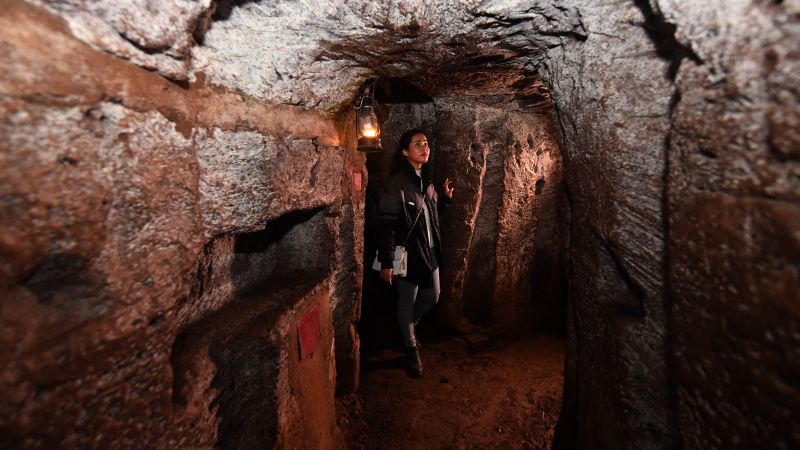
The construction of the tunnel village began in 1965, led by border police commander Lê Xuân Vy. Spanning over a mile, the system featured three levels, reaching depths of 50 to 75 feet. Unlike the narrow, labyrinthine Củ Chi tunnels, Vịnh Mốc’s design prioritized accessibility and comfort, with wide corridors for movement and communal rooms for daily activities. Walls were carved to accommodate sleeping quarters, and wells were strategically placed to provide fresh water, ensuring the village could sustain life underground.
One of the most impressive aspects of the tunnels was their ventilation system. Opposite exits allowed for cross-ventilation, reducing humidity and stale air. The entrances were also carefully positioned to enable discreet supply lines to Cồn Cỏ Island, a crucial hub for food and fuel during the war. “The tunnels were more than shelter—they were lifelines,” says Văn Ngọc Vũ of Annam Tour. “Every detail was crafted to maintain survival in a hostile world.”
Life in the Shadows of War
Living underground demanded a shift in daily routines. Families shared tight spaces, with cooking and eating concentrated in communal areas. The sight of red plastic chairs and Coca-Cola fridges on the surface today feels almost otherworldly, a reminder of the stark contrast between the past and present. Yet, despite the cramped conditions, the tunnel village where became a home where traditions endured, and children played under flickering lanterns.
Residents adapted to the challenges of subterranean life, creating a society that functioned despite the constant threat of bombs. The cool, damp air of the tunnels offered relief from the tropical heat, while the darkness provided a sense of security. “It was a complete transformation of life,” explains Tran My Hoa of Connect Travel. “The sun was replaced by lanterns, and the rhythm of daily chores shifted underground.” The tunnels not only protected them from violence but also became a testament to human perseverance.
A Lasting Legacy of Resistance
Today, the tunnel village where stands as a historical site, drawing visitors who marvel at its scale and complexity. The system’s design showcased the ability of communities to innovate in the face of adversity, blending military strategy with civilian needs. Visitors can walk through the tunnels, imagining the lives of those who once called this hidden world their home. The site remains a powerful reminder of how people can create safety and stability in even the most dangerous circumstances.
