Trump’s stunt on the housing bill seems like a very bad idea

The Housing Bill Stunt: A Political Misstep
Trump s stunt on the housing – President Donald Trump has long been known for his unpredictable approach to legislation. Throughout his tenure, he has often introduced last-minute surprises that have left congressional leaders scrambling to respond—particularly when it comes to proposals within his own party. Yet, the maneuver he executed on Wednesday morning stands out as one of his most questionable moves. By abruptly canceling his planned signing of a housing affordability bill, Trump disrupted a process that had already secured broad support across both chambers of Congress. This bipartisan agreement, which had been passed with overwhelming majorities, now hung in the balance as Trump demanded additional concessions: the passage of the “SAVE America Act” before he would commit to finalizing the housing legislation.
A Political Misstep
Trump’s decision to withhold his signature on the housing bill created a ripple effect, undermining the momentum that had been building for weeks. The bill, which aimed to address rising housing costs and improve affordability, was widely praised for its potential to benefit millions of Americans. However, Trump’s sudden shift turned the situation into a high-stakes negotiation. By tying the housing bill to the “SAVE America Act,” he effectively held the former hostage, using it as leverage for a separate proposal. This tactic, while common in political strategy, appears increasingly risky as the November elections draw closer.
“One of the most significant pieces of housing affordability legislation in American history,”
declared Karoline Leavitt, the White House press secretary, just a day before Trump’s reversal. Her statement highlighted the importance of the bill, which had already garnered bipartisan backing. Yet, Trump’s political adviser for the midterms had earlier called the legislation a “signature commitment,” signaling his belief in its value. Now, that support seemed to evaporate, as he pivoted to demand a new piece of legislation that has yet to gain traction.
Republicans who had previously championed the housing bill now found themselves in a difficult position. While some argued that the “SAVE America Act” was worth the gamble, others questioned whether the trade-off was justified. The act, which includes provisions requiring proof of citizenship for voter registration, has been framed as a necessary step to combat election fraud. However, the urgency of the housing issue suggests that Trump’s demand may have been more about political posturing than substantive policy.
The Economic Downturn
Trump’s decision to delay the housing bill signing comes at a time when the American public is deeply concerned about economic stability. Inflation, affordability, and the overall state of the economy have become central issues in the presidential race, with voters increasingly holding the administration accountable for its performance. Recent polling reveals that Trump’s disapproval ratings on these matters have surged, reaching alarming levels. For instance, a Fox News poll reported 68% of respondents disapprove of his handling of the economy, while CBS News and AP-NORC each recorded 66% and 66%, respectively.
On inflation, the numbers are even more stark. CBS polling indicated that 73% of Americans disapprove of Trump’s approach, with Strength in Numbers-Verasight and Reuters-Ipsos reporting 71% and 69% disapproval, respectively. These figures highlight a growing perception that Trump has not only failed to address the root causes of the economic crisis but has also made it worse. Unlike previous challenges, this one is not just about policy; it’s about accountability. Voters are no longer content with vague promises or passive leadership. They are demanding concrete action—and they are increasingly critical of Trump’s performance.
Historically, such high disapproval rates are rare. Typically, only about 30% of Americans agree on major issues, but Trump’s numbers suggest a deeper rift. The economic situation has become a defining issue for many, with public sentiment shifting rapidly. A CBS poll conducted just before the Iran war in February found that 75% of respondents believed the Trump administration had not done enough to lower prices. A month later, that number had dropped slightly to 65%, but the message remained clear: the administration is perceived as neglecting the problem, and now, after the war, it is seen as actively worsening it.
The SAVE America Act’s Ambiguity
While the “SAVE America Act” may be important to some Republicans, its appeal to the general public remains uncertain. The legislation’s primary goal is to tighten voting rules by requiring proof of citizenship for registration, but it also includes other provisions that have yet to be fully detailed. Critics argue that the act could inadvertently restrict access to the ballot for eligible voters, particularly in communities where registration barriers are already significant. Yet, Trump and his allies insist that the measure is a critical tool in safeguarding democratic integrity.
Despite these claims, the American people are not clamoring for the “SAVE America Act.” A March CBS poll showed that 66% of respondents supported requiring proof of citizenship for voter registration, but the same survey revealed only 28% approval for the legislation in its current form. This discrepancy underscores the challenge Trump faces: while the act may align with his base’s priorities, it struggles to resonate with the broader electorate. The housing bill, by contrast, was a clear win for the majority of Americans, regardless of party affiliation.
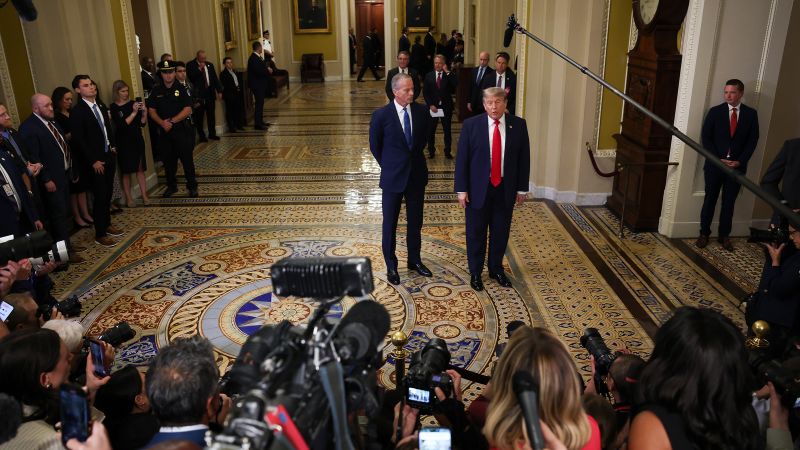
Trump’s handling of the situation has also been criticized for its lack of foresight. He pulled back from signing the housing bill just as a press conference was underway, where prominent Republicans had already praised its benefits. This abrupt reversal sent a confusing message to the public, reinforcing perceptions that Trump is more interested in personal gain than in addressing pressing concerns. His indifference to affordability issues has been evident for months, with him dismissing the problem as a “hoax” and prioritizing other topics at rallies.
By linking the housing bill to the “SAVE America Act,” Trump has risked deepening the public’s distrust. The move appears to prioritize short-term political leverage over long-term economic stability, which is already a major liability for his re-election campaign. With voters increasingly focused on economic conditions, the timing of this maneuver could not be more precarious. As the nation grapples with rising costs and uncertainty, Trump’s refusal to act decisively on the housing bill may be seen as a further sign of his detachment from the issues that matter most to the average American.
Ultimately, Trump’s latest strategy highlights the tension between his political ambitions and the reality of public sentiment. While some Republicans may see the “SAVE America Act” as a worthwhile trade-off, the broader implications of his actions suggest a more damaging outcome. By holding the housing bill hostage, he has not only delayed progress on a key issue but also reinforced his image as a leader who prioritizes theatrics over tangible solutions. This could have lasting consequences, especially in a race where economic concerns are front and center.