
Trump will present the World Cup trophy. It could be VERY awkward
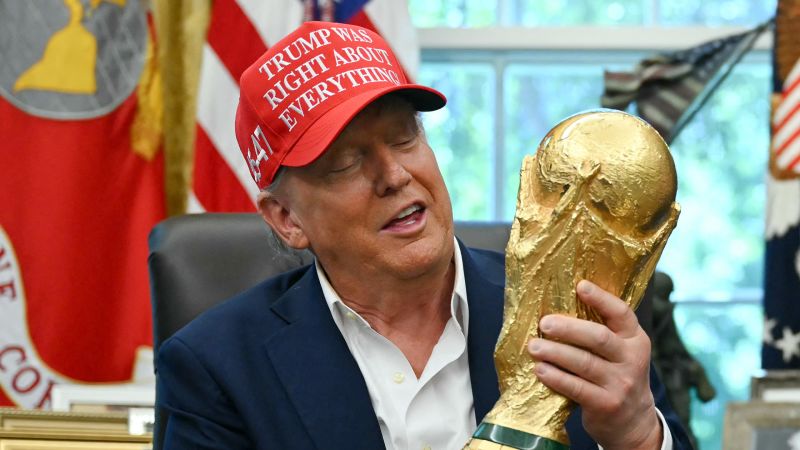
Trump to Present World Cup Trophy: A Potential Political Minefield
Trump will present the World Cup trophy – On July 19, US President Donald Trump will take center stage in New Jersey as he presents the World Cup trophy to the victorious team. This event, while seemingly celebratory, carries the potential for a significant political moment, as Trump’s recent actions and rhetoric could cast a shadow over the ceremony. The ceremony’s atmosphere may become tense, given the leader’s controversial stance on immigration, foreign policy, and his tendency to provoke nations with sharp criticisms.
America First and Global Tensions
Trump’s foreign policy has consistently emphasized a “America First” agenda, often clashing with international alliances and relationships. During the tournament, he has engaged in direct conflict with one nation and launched verbal attacks on numerous others. His rhetoric has targeted leaders and populations, including accusations against countries for not aligning with his goals. For instance, he imposed steep tariffs on Brazil to penalize opposition to his ally, former President Jair Bolsonaro, who is currently serving a 27-year sentence for orchestrating an attempted coup. These economic measures reflect a strategy of using trade as a political tool, even as global tensions rise.
His interactions with NATO have also raised eyebrows. Trump’s unpredictable approach to the alliance has left Western Europe, the heart of the soccer world, feeling uneasy. He once derided Brussels, the headquarters of NATO, as a “hell hole,” and dismissed Norway’s contributions by calling it a “joke” after the nation failed to award him the Nobel Peace Prize. Despite these remarks, FIFA has offered Trump a separate recognition, underscoring the diplomatic nuances of his role.
The US Team and Immigrant Roots
Meanwhile, the US Men’s National Team has been making headlines for its strong performance in the group stage, challenging assumptions about the country’s soccer capabilities. The team’s top scorer, Folarin Balogun, has become a symbol of the intersection between American identity and global heritage. Born in the UK, Balogun’s Nigerian mother was seven months pregnant when she could no longer leave New York, highlighting the complex journeys of many players. His eligibility to represent the US is rooted in the 14th Amendment, which guarantees birthright citizenship, but Trump’s allies are now pushing to question this right in a potential legal challenge.
If the US secures victory, it will be in part due to the contributions of players with immigrant backgrounds, a fact that could draw attention during the trophy presentation. Trump’s policies, which have often targeted immigrants, may create a moment of irony as he honors a team built on diverse roots. The Supreme Court, currently dominated by conservative justices, is poised to decide whether Trump can legally undermine the 14th Amendment’s protections, a decision that could reshape the nation’s approach to citizenship and immigration.
Global Rhetoric and Political Maneuvering
Trump’s international engagements have been marked by both alliances and adversarial actions. He has extended support to Argentina by offering a financial bailout to his friend, President Javier Milei, a move that has bolstered the far-right leader’s campaign. In contrast, he imposed a 40% tariff on Brazil, a clear message to the country’s leadership. Mexico and Canada, fellow host nations, have also faced his ire through economic pressures and the threat of a border wall, which he has repeatedly touted as a solution to immigration concerns.
His comments during the tournament have echoed past controversies. In the Oval Office, he accused South Africa’s president of committing “genocide” against White farmers, a statement that has drawn criticism from both domestic and international observers. Simultaneously, Trump has sought to align with far-right groups in Europe, including in the UK, where his endorsement of a political movement contributed to the downfall of the current prime minister. This shift reflects a broader strategy of leveraging global events to advance domestic policies, such as his recent push to deport Haitians with temporary legal status, a move that has been framed as a continuation of his “America First” ideology.
Trump’s approach to the World Cup also mirrors his domestic initiatives. He has made a notable remark about the political instability in Ghana, where the US appears to be reversing its stance on local anti-LGBTQ+ laws. While the Biden administration opposed these laws, Trump’s silence on the issue has sparked debate about his priorities. This pattern of selective engagement is evident in his relationship with South America, where he has sought to influence elections in countries like Colombia, endorsing the far-right opposition party that leads the first count in a tight runoff.
Consequences of Rhetoric and Diplomacy
The World Cup trophy presentation is set against a backdrop of Trump’s evolving global strategy. His recent actions have not only impacted the nations he directly targets but also influenced the broader political landscape. For example, his criticism of Iran during the tournament has not deterred the country from advancing in the competition, despite facing additional restrictions. Trump’s declaration of the Iran conflict as a “war” has drawn reactions from Spain, which he labeled a “horror show” for its resistance to the campaign. These exchanges underscore the high stakes of international diplomacy under his leadership.
Even within the context of sports, Trump’s rhetoric has shown no signs of restraint. He once joked about Pearl Harbor when welcoming Japan’s new leader, a gesture that blended historical reference with a touch of humor. However, this moment contrasts with his harsh criticisms of Haiti, where he referred to the nation as a “shithole country” during his first term and repeated the label during the 2024 presidential campaign. The Trump administration has also spread a false narrative about Haitian asylum seekers, claiming they eat the pets of Ohioans—a claim that has fueled anti-immigrant sentiment.
As the World Cup approaches its final stages, the tension between Trump’s diplomatic actions and his domestic policies will be on full display. The Supreme Court’s decision on the 14th Amendment could have far-reaching implications, affecting not just the US team’s players but also the broader discourse on immigration. Whether the trophy presentation becomes a celebration or a spectacle of awkwardness remains to be seen, but one thing is certain: Trump’s influence extends beyond the political arena, shaping perceptions even in moments of international camaraderie.
Leaders from France and Germany have frequently found themselves in delicate positions, striving to maintain a balance between appeasing Trump and supporting their own national interests. Their efforts to placate the president have been overshadowed by his alliances with far-right factions in Europe, a move that has further complicated the global political landscape. As the World Cup nears its conclusion, the stage is set for a unique blend of celebration, criticism, and the enduring impact of Trump’s global strategies.
Legacy of Polarizing Leadership
Trump’s tenure has been characterized by a mix of aggressive foreign policy and personal attacks on international leaders. His actions have left a lasting impression on countries he has engaged with, from Mexico to South Africa. The upcoming trophy presentation will serve as a microcosm of this complex relationship, where the US’s success in the tournament may be juxtaposed with the president’s attempts to redefine global norms. As the final match approaches, the question remains: will this moment of triumph be celebrated, or will it become another chapter in the story of Trump’s polarizing leadership?
