
They thought there was no immediate danger. Then a wall of smoke arrived
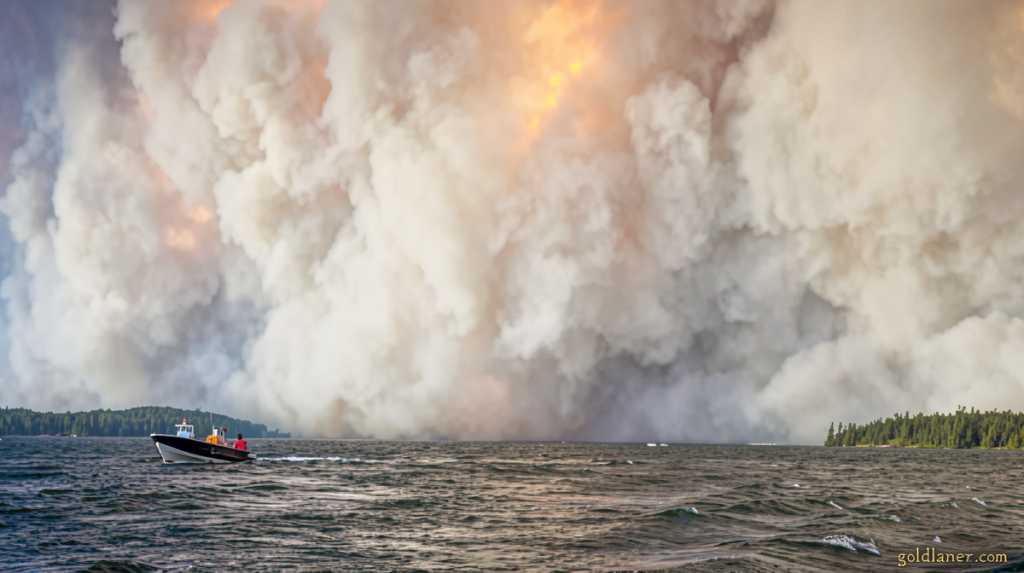
A Wall of Smoke Catches Collins First Nation Unprepared
Residents Flee as Fire Closes In
They thought there was no immediate – When Miiyah Paavola looked out from her residence in Namaygoosisagagun First Nation, located in northwestern Ontario, she witnessed something terrifying. A dense barrier of smoke dominated her view. The smoke seemed to be approaching from a distance, yet the remote Indigenous settlement received word from the Ministry of Natural Resources that Monday, July 13, that no urgent threat existed. Within just a few hours, families were scrambling to escape for their safety.
“It was all very fast-paced. There was not really much time to think about what was happening,” Paavola told CNN. Before boarding a small aluminum vessel with five companions, three dogs, and a cat, she managed to grab a damp towel. The community, alternatively called Collins First Nation, lacks road connections, relying instead on a railway and Collins Lake for access.
Paavola did not comprehend the full magnitude of the peril until her boat moved away from shore. “All you could see was orange and gray and it was very dark,” she recalled. As they traveled across the water, she gained perspective on how narrowly they had avoided disaster. “When I was going across maybe about the second island, that’s when I watched it. I could just barely see the flames reach the shoreline. And it was a very thick wall of smoke that followed it very quickly.”
“If we had waited any longer, we would have been dead.”
Boat Escape Through Rough Waters
Only twenty-five of approximately sixty community members found themselves in Collins when the blaze struck. Residents believe this fact likely preserved numerous lives. People packed into aging twelve- and fourteen-foot aluminum boats equipped with motors from decades past. Many were forced to abandon their pets during the hasty departure.
Miiyah described the journey itself as equally frightening as the approaching flames. “It was very scary,” she stated. “There were quite a few times I felt like we were about to tip.” During the roughly forty-minute crossing from northern to southern Collins Lake, strong waves battered their vessel. Shortly after departing, the boat struck a submerged rock and nearly capsized.
“It was very scary. There were quite a few times I felt like we were about to tip.”
Chief Paavola’s Agonizing Wait
Chief Helen Paavola, Miiyah’s mother, had not been in the village when the fire erupted. A fire official had informed her earlier that no immediate danger existed, claiming the smoke residents observed originated from a smoldering blaze located further away. During the evacuation, the Chief experienced moments of intense anguish as she struggled to contact community members, including her daughter and two sons.
“All I could think was … they’re gone. My children are gone. My community is gone,” she told CNN.
She expressed profound relief upon learning everyone had escaped. “There are no words to explain the relief that I felt when I knew everybody was out.” Unfortunately, her home, like every other structure in Collins First Nation, was completely consumed by the flames.
Wider Crisis and Jurisdictional Challenges
The fires that devastated Collins represent a portion of a broader wildfire emergency across Canada. As of Thursday night, the Canadian Wildland Fire Information System reported 889 active fires spreading throughout the country. Ontario alone contained 163 active wildfires according to the provincial Ministry of Natural Resources.
At a press conference alongside Ontario Premier Doug Ford, government representatives acknowledged that the fire began unusually close to Collins, providing minimal response time. Officials announced plans to examine their handling of the situation.
Linda Debassige, Grand Council Chief of the Anishinabek Nation in Ontario, reported that more than thirty homes were destroyed, along with the administration office, school, community center, storage buildings, vehicles, and essential equipment. “If they waited for an emergency response,” she explained, “we would all be on a recovery mission looking for the bodies of children, elderly people, men and women.”
The organization representing thirty-nine First Nations, including Collins, is currently covering accommodation, meals, and supplies for evacuees remaining in Thunder Bay since government assistance has not yet materialized. Debassige noted that Collins has experienced jurisdictional difficulties because it qualifies as a “near band,” a community still pursuing full federal recognition, which complicates access to government support. The settlement had faced wildfire threats merely weeks prior, yet minimal action was taken afterward to enhance protection through fire breaks or other preventive strategies.
The devastation in Collins has reignited debates regarding whether Ontario’s wildfire strategy adequately addresses increasingly intense fire seasons.
