
Trump wanted to star at the World Cup, but politics may spoil the party
Trump Wanted to Star at the World Cup, but Politics May Spoil the Party
Trump wanted to star at the World – Donald Trump, a man who has long thrived on global attention, initially believed he would miss the opportunity to shine at the 2026 World Cup finals. In 2018, when the United States secured co-hosting rights for the event, he lamented that “I won’t be here” due to presidential term limits. However, his remarkable political resurgence—becoming the second U.S. leader to win two nonconsecutive terms—has granted him additional time in the spotlight. This new chapter now sees him not only participating in the tournament but also leveraging it to reinforce his image as a world leader.
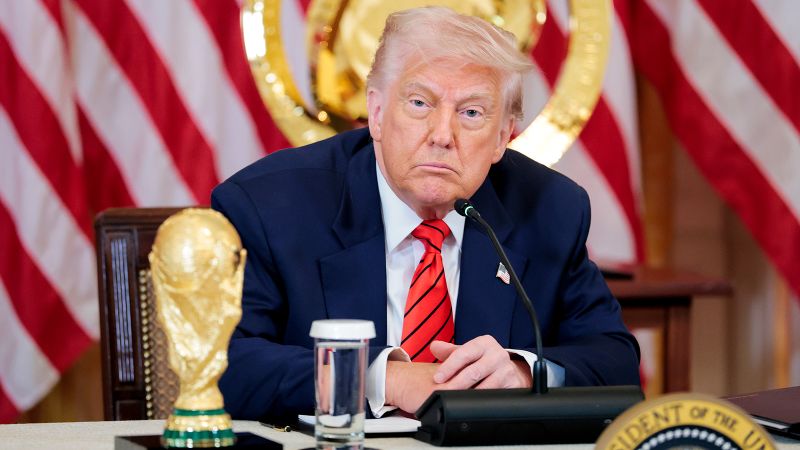
Trump’s ability to insert himself into international narratives has been a hallmark of his presidency. When he proudly showcased a gleaming replica of the World Cup trophy in the Oval Office, the golden decor served as a backdrop to his global ambitions. He welcomed FIFA president Gianni Infantino into his MAGA circle, further cementing his ties to the organization. Even his appearance at a FIFA club tournament, where he presented Chelsea with the trophy, was met with his characteristic enthusiasm, as if he had personally contributed to the team’s victory. Yet, this World Cup, set to open on Thursday, may now become a stage for showcasing the divisions his presidency has sown.
The 2026 World Cup finals arrive amid growing political tensions. While Trump might aim to use the event as a platform to reassert his global influence, critics argue that his actions have overshadowed the spirit of unity that the tournament typically embodies. His second term has been marked by sharp rhetoric and policies that have strained international relations, casting a shadow over the sport’s celebration of togetherness. The event’s timing—co-hosted with Canada and Mexico during a period of Western Hemisphere friction—adds to the complexity, as political debates threaten to dominate the narrative.
A Political Comeback and Global Staging
Trump’s 2016 election victory and subsequent return to the White House in 2024 have allowed him to maintain his presence on the world stage. This resurgence has given him the chance to reframe his image, even as his domestic popularity wanes. The World Cup, with its massive global audience, offers a prime opportunity to reconnect with international audiences. However, recent events suggest that his political maneuvering may be the main attraction, rather than the game itself.
Infantino’s decision to award Trump the FIFA Peace Prize—following his friend’s exclusion from the Nobel Peace Prize—has drawn scrutiny. The honor, given in 2025, now feels ironic in light of Trump’s military strikes against Iran, a World Cup qualifying nation. The conflict, which erupted during his second term, has raised questions about the sincerity of his commitment to peace. Critics point to the tension between his symbolic gestures and concrete actions, arguing that the prize has become a focal point for political critique.
Meanwhile, Trump’s immigration policies have sparked controversy. A respected Somali referee was denied entry to the U.S. during a pre-World Cup training camp, despite the administration’s accusation of fraud against Minnesota’s Somali community. The community has consistently denied these claims, highlighting the disconnect between policy and practice. Similarly, the Senegalese team reported undergoing rigorous security checks upon arrival, though the federation deemed the process routine. These incidents have left foreign fans questioning whether the World Cup is a celebration of inclusivity or a showcase for Trump’s hardline stance.
Divisions at Home and Abroad
As the World Cup approaches, Trump’s political influence is being tested. Domestic unpopularity has grown, with public discontent over policies that some argue alienate immigrant communities. Internationally, his confrontational approach has led to diplomatic friction, including concerns over ICE’s potential sweeps at games involving South American teams with significant U.S. followings. The administration has tried to downplay these fears, but the perception of exclusion remains.
The issue of ticket prices has also intensified debates about accessibility. With costs soaring to over $1,000 for opening matches, many fans—particularly from the Global South—face barriers to participation. This pricing model has been criticized as emblematic of broader economic disparities, where the working-class fan base of football is increasingly priced out of the action. Trump, who has often championed American exceptionalism, even expressed ambivalence about the expense, telling the New York Post, “I would certainly like to be there, but I wouldn’t pay it either, to be honest with you.” His remarks underscore the tension between his desire to be seen as a global leader and the financial realities of his supporters.
Historically, major sporting events have been entangled in political currents. The 1980 Moscow Olympics, for example, were boycotted by the U.S. over the Soviet invasion of Afghanistan. Similarly, the 2022 World Cup in Qatar faced accusations of human rights abuses, including the tragic deaths of migrant workers constructing the stadiums. The 2026 tournament, however, adds a unique layer of controversy with Trump’s active involvement. His political activism—such as demanding Greenland from Denmark—has already prompted discussions of a European boycott, further illustrating how sport can become a battleground for international disputes.
A Spectacle of Polarization
Infantino’s close alignment with Trump has drawn attention to the FIFA president’s role in mediating global tensions. His frequent appearances in Washington and Mar-a-Lago have made him a fixture in the U.S. political scene, even as he navigates the complexities of international diplomacy. The FIFA Peace Prize, awarded to Trump in 2025, contrasts with the Nobel version, which was given to a different individual. This distinction has fueled debates about the true purpose of such honors in an era of political polarization.
Trump’s global presence at the World Cup has been both a boon and a bane. While his charisma and media savvy have ensured his visibility, they have also amplified the discord his policies generate. The tournament, which should be a celebration of athletic excellence, now finds itself at the center of geopolitical narratives. His rhetoric about making the world great again has taken on a new dimension, with the World Cup serving as a stage for his broader vision of global dominance.
Despite the challenges, the 2026 World Cup remains a significant event. However, the hyper-politicization of the tournament has raised concerns about its ability to foster unity. With the spotlight on Trump, the focus may shift from the game to the political spectacle. The opening matches, while promising, are likely to be scrutinized for their symbolism as much as their sporting merit. As the world watches, the question remains: will the World Cup become a unifying force, or a reflection of the divisions Trump’s presidency has created?
“I would certainly like to be there, but I wouldn’t pay it either, to be honest with you.” – Donald Trump, New York Post
The interplay between sports and politics continues to shape global discourse. From the Moscow Olympics to the Qatar World Cup, international events have often been marred by political controversies. The 2026 tournament, co-hosted by the U.S., Canada, and Mexico, now faces its own set of challenges, with Trump’s presence acting as both a magnet and a mirror for the world’s current divisions. Whether it will succeed as a celebration of the beautiful game or a platform for political drama remains to be seen.
