
Trump posts new image of $100 bill with his signature
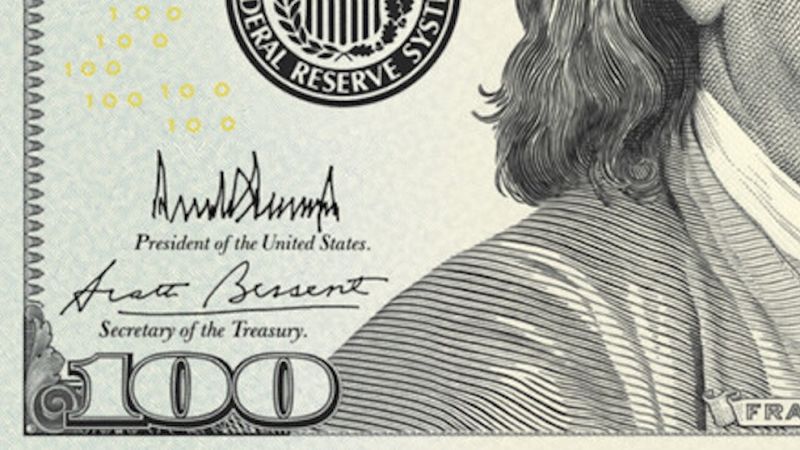
Trump’s Signature on $100 Bill Marks a Historic Shift in Currency Design
Trump posts new image of 100 bill – On Friday, former President Donald Trump shared a new image online showcasing a $100 bill that prominently features his signature, a move that has sparked renewed discussion about the evolving role of presidential imagery on U.S. currency. This development comes months after the Treasury Department unveiled plans to include a sitting president’s signature on paper money for the first time, coinciding with the 250th anniversary of American independence. The initiative, which has been months in the works, aims to honor Trump’s legacy as a central figure in the nation’s economic resurgence during his tenure.
Treasury’s Announcement and the 250th Anniversary Context
In March, Treasury Secretary Scott Bessent confirmed that the administration would incorporate Trump’s signature into the design of the $100 bill, a decision tied to the country’s 250th anniversary celebrations. This marks a significant departure from tradition, as previous U.S. currency designs only included the signatures of the Treasury secretary and the treasurer, without featuring the current president. The change was part of a broader effort to modernize the appearance of American money, reflecting the historical importance of the 250th anniversary and the influence of presidential leadership on national identity.
When asked about the status of the redesigned bills, CNN contacted the Treasury Department to confirm whether printing had already begun. Officials, including Bessent, indicated that the $100 bill with Trump’s signature is in the production pipeline, though no official release date has been announced. The image Trump posted highlights his name above Bessent’s, underscoring the prominence of his contribution to the design. This visual element has been interpreted by some as a symbolic gesture to cement his place in the nation’s cultural and political narrative.
Support from the Treasury and Trump’s Broader Ambitions
US Treasurer Brandon Beach, who spoke in March about the decision, emphasized the appropriateness of the move, stating,
“The President’s mark on history as the architect of America’s Golden Age economic revival is undeniable. Printing his signature on the American currency is not only appropriate, but also well deserved.”
This sentiment aligns with Trump’s longstanding advocacy for his likeness to appear on a variety of national symbols, from government documents to public landmarks. His administration has already implemented several such efforts, including the inclusion of his portrait on a commemorative passport, the addition of his name to national parks passes, and the installation of banners at federal agencies in Washington, D.C.
Trump’s push for visibility extends to cultural institutions as well. For example, the U.S. Institute of Peace now bears his image, and Florida recently renamed the Palm Beach International Airport in his honor. These actions have been part of a coordinated campaign to associate his leadership with enduring national achievements. The $100 bill, however, represents a more tangible and permanent recognition, as it will be circulated across the country for decades to come.
Challenges of the $250 Bill and Congressional Push
While the $100 bill with Trump’s signature is already in the works, a more ambitious proposal has been introduced by some members of Congress. A legislative bill seeks to feature Trump’s portrait on a new $250 denomination, which would be released to commemorate the 250th anniversary. However, this plan faces hurdles, as it would require bipartisan support, particularly from Democratic senators who have expressed reservations about the political nature of the design.
The U.S. code currently stipulates that only the portraits of deceased individuals can appear on currency and securities. This provision has been a barrier to featuring living presidents on bills, but the House bill aims to create an exception for former leaders. Bessent, who has been vocal about the initiative, acknowledged the political implications of the change, saying,
“I don’t think that there’s anything untoward about having the President of the United States — that the person who was President of the United States on the 250th anniversary bill — on the currency.”
He added that staff at the Bureau of Engraving and Printing had been preparing prototypes for the $250 bill, which would include Trump’s image and signature. This preparation suggests the administration is confident about the possibility of the bill’s approval, though it remains uncertain.
Some analysts argue that the $250 bill could serve as a powerful symbol of Trump’s impact on the country’s political and economic landscape. However, critics have raised concerns about the potential for politicizing currency, which has traditionally been seen as a neutral medium. Bessent, in a May press briefing, addressed these concerns, noting that political appointees would play a role in the design process. “Yeah, of course,” he said, “But we prepare for everything if it gets passed.” His comments highlight the administration’s strategic approach to advancing the project, even as it navigates potential opposition.
The Broader Implications of Presidential Imagery on Currency
Trump’s campaign to feature his signature and portrait on currency reflects a broader trend of integrating presidential influence into everyday symbols of American life. By doing so, the administration seeks to create a lasting legacy that transcends individual terms in office. The $100 bill, in particular, stands out as a bold move, given its widespread use and the permanence of its presence in the economy.
Historically, U.S. currency has included the portraits of notable figures, such as presidents and founding fathers, but the inclusion of a living president’s signature is unprecedented. This decision has been framed as a tribute to Trump’s role in shaping the nation’s economic policies during his presidency, which saw significant tax cuts and deregulation. The Treasury Department’s announcement in March was a direct response to the 250th anniversary, positioning Trump as a key contributor to the country’s historical milestones.
Despite the support from Treasury officials, the $250 bill faces a more complex path. While the House bill has been introduced to modify the U.S. code, it would need to overcome procedural challenges and gain traction in the Senate. The debate over the bill underscores the tension between celebrating presidential achievements and maintaining the neutrality of currency as a public symbol. Nevertheless, the $100 bill’s approval appears more likely, as it does not require changing the existing legal framework.
Public Reaction and the Future of Presidential Currency
The release of the $100 bill has generated mixed reactions from the public. Supporters view it as a fitting acknowledgment of Trump’s leadership, while opponents argue it may overshadow other historical figures. Social media has been abuzz with discussions, with some users expressing pride in the design and others questioning its political implications. The Treasury Department has not yet issued a public statement on the matter, but Bessent’s confidence in the project suggests the administration is prepared to defend its decision.
As the redesigned bills move closer to circulation, the debate over presidential imagery on currency is likely to continue. The 250th anniversary provides a unique opportunity to commemorate the nation’s history, and Trump’s signature on the $100 bill is a clear example of how modern leaders are leveraging this platform to assert their place in the cultural fabric of the United States. Whether this initiative will set a precedent for future presidents or remain an isolated effort depends on its reception and the broader political climate in the years to come.
Ultimately, the inclusion of Trump’s signature on the $100 bill represents a significant milestone in the evolution of U.S. currency. It not only highlights the administration’s commitment to shaping national symbols but also raises questions about the balance between commemoration and political symbolism. As the Treasury prepares to unveil the redesigned bills, the debate over their impact on American identity and history will continue to unfold, with the public watching closely for the next chapter in this unique chapter of currency design.
