
Trump foe John Bolton enters guilty plea. Here’s why his classified information case didn’t fall apart
John Bolton’s Guilty Plea in Classified Documents Case: A Victory for Federal Prosecutors
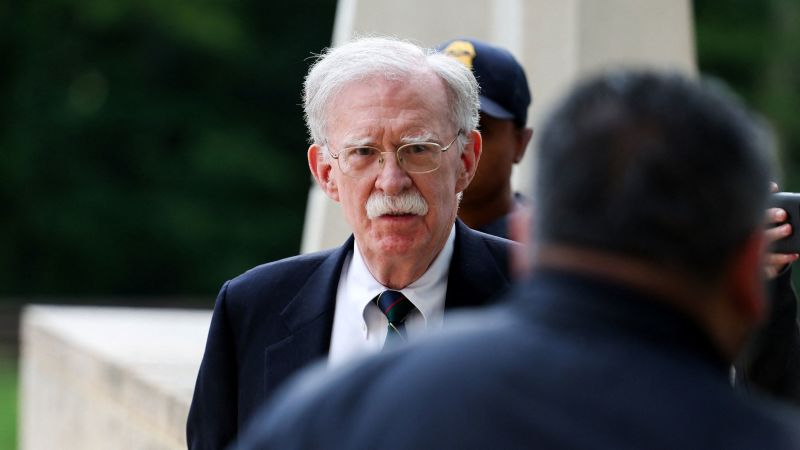
Trump foe John Bolton enters guilty – On Friday, John Bolton, the former national security adviser to President Donald Trump, entered a guilty plea in a case involving the unlawful retention of classified information. This development marks a notable success for federal prosecutors in their ongoing efforts to hold Trump’s political adversaries accountable, despite the broader challenges faced by the Justice Department in securing convictions against the president’s opponents.
The Plea and Its Legal Implications
Bolton’s admission of guilt centers on his retention of sensitive national security material, a charge that underscores the importance of safeguarding classified documents. During the court hearing, when asked directly by Judge Theodore Chuang if he was guilty, Bolton responded with a succinct yet poignant statement: “I am your honor and I’m sorry for it.” The plea agreement, which Bolton and his legal team negotiated, stipulates a maximum prison term of six years and a fine of $2.25 million. Notably, half of the fine will be paid within five days of sentencing, according to prosecutors. Additionally, Bolton will forfeit his pension, a significant financial penalty tied to his role as a high-ranking official.
While the judge acknowledged the possibility of variations in sentencing guidelines, the agreement between Bolton’s attorneys and prosecutors remains a focal point. The sentencing is set for October 28, a date that will determine the final outcome of this case. The decision to plead guilty, rather than go to trial, reflects a strategic move to avoid a more severe punishment and to streamline the legal process.
Prosecutors’ Case and National Security Concerns
“As national security adviser to the president of the United States, Mr. Bolton had access to and was responsible for safeguarding the most sensitive national defense information, including classified material,” said Maryland US Attorney Kelly Hayes following the hearing. She emphasized that Bolton was aware of the proper procedures for storing and sharing such information. “He also knew the damage to national security that could be caused by mishandling that sensitive information. Nevertheless, as Mr. Bolton just admitted, he put our nation’s security at grave risk in violation of the law,” Hayes added.
“I am required to calculate the guidelines myself,” Judge Chuang warned Bolton, highlighting the flexibility in sentencing calculations. “It may vary from the agreed guidelines between Bolton’s attorneys and prosecutors.”
The case against Bolton, which includes the sharing of classified information with his family, has been described as a single felony count. This relatively narrow charge contrasts with the broader, more complex cases against other Trump critics, such as former FBI Director James Comey. Unlike those cases, Bolton’s plea deal has maintained strong support from career prosecutors and investigators, a rarity in the context of high-profile political prosecutions.
Bolton’s Defense and Political Context
John Bolton’s lawyer, Abbe Lowell, defended the plea deal as a responsible choice. “Today, Ambassador Bolton did what real leaders do,” Lowell stated. “He took responsibility for a mistake he made, thereby saving the government resources to pursue a case that could expose additional sensitive information.” The lawyer drew a sharp contrast between Bolton’s actions and those of President Trump, who has been accused of dismissing classified information laws. “By contrast, President Trump thumbed his nose at the classified information laws, took actual classified documents to his Florida mansion, interfered with the investigation of that conduct, and has never accepted any accountability for his actions,” Lowell noted.
Bolton’s offense, according to his legal team, was limited to maintaining a diary containing classified information. His intent was to preserve historical records, whereas Trump’s retention of secrets, as described by Lowell, was motivated by self-interest. “Ambassador Bolton, whose offense was only keeping a diary which contained classified information, kept a record to preserve history, but Donald Trump kept secrets to serve himself,” the lawyer added.
Hayes’ Strategic Approach and Political Neutrality
The successful resolution of Bolton’s case is largely attributed to Maryland US Attorney Kelly Hayes, a career prosecutor known for her methodical approach. Unlike other US attorneys who have sought to draw attention to their work in the Trump administration, Hayes has maintained a low profile, allowing her to operate with greater independence. This strategy has enabled her to focus on the legal merits of the case without being swayed by political pressures.
While several US attorneys have pursued high-profile cases against Trump’s adversaries, the Bolton investigation was secured through Hayes’ steady leadership. “Everybody’s pleasantly surprised she’s still in the job,” said a source familiar with the office. “In some ways, she’s been trying to keep her head down … A lot of US attorney’s offices tried to attract attention” from the White House. Hayes’ ability to avoid political entanglements has made her approach more credible and less vulnerable to accusations of partisan bias.
Her office also faced pressure to investigate California Senator Adam Schiff, a critic of Trump who had not been charged with any crime. Assistant US attorneys considered the possibility of linking Schiff to his mortgage applications but hesitated due to the lack of clear evidence. “They looked closely at the senator’s financial records and explained their concerns to Justice Department leadership,” said another insider. Schiff has consistently denied any wrongdoing, and Hayes’ decision to focus on Bolton instead of Schiff has been seen as a calculated move to preserve the integrity of the prosecution.
The Broader Significance of the Case
Bolton’s plea deal not only highlights the consequences of mishandling classified information but also serves as a reminder of the legal risks faced by those in positions of power. The fine, which could reclaim much of the money Bolton earned from his 2020 memoir—deeply critical of Trump—adds another layer to the case’s implications. For prosecutors, it represents a rare instance where political adversaries have been brought to justice without the case collapsing under scrutiny.
The yearslong investigation into Bolton has been marked by its quiet persistence, contrasting with the more publicized efforts against other Trump figures. Hayes’ role in steering the case through its complexities has positioned her as a key figure in the Justice Department’s strategy to address national security violations. Her approach has also set a precedent for future cases, demonstrating how career prosecutors can navigate political landscapes while maintaining judicial integrity.
