
Reflecting Pool woes: Trump administration turns to hydrogen peroxide in latest bid to beat back algae
Algae Troubles in the Lincoln Memorial Reflecting Pool
Reflecting Pool woes – Just days after the Trump administration completed its over $14 million renovation of the Lincoln Memorial Reflecting Pool, the iconic water feature has become a focal point of controversy. The 300,000 square foot pool, which was refilled with 6.5 million gallons of clean water, is now facing a persistent problem that has plagued similar projects for decades: algae growth. Despite the substantial investment and the promise of a pristine, visually stunning space, the pool has already turned a murky green, raising questions about the effectiveness of the cleanup efforts.
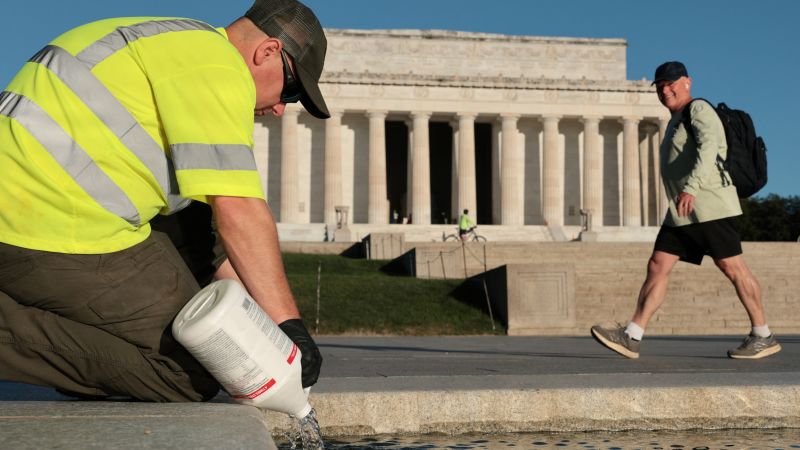
The algae issue has sparked immediate action from the administration. Crews equipped with hip-waders have been seen manually removing clumps of the green substance, while workers were dispatched on Tuesday to apply hydrogen peroxide in an attempt to combat the growth. However, the results so far have been mixed, with the pool appearing to worsen in its algae-infested state. This has led some to speculate whether the president’s vision for a revitalized, national symbol of beauty can truly be achieved.
A worker who spoke to CNN on Tuesday humorously noted the challenge of the task. “It would take an entire lifetime to clean this pool,” they said, highlighting the scale of the problem. The Department of Interior, responsible for overseeing the project, has claimed that its latest technology is making a difference. According to a spokesperson, “The ozone nanobubbler system is now operational and has successfully eliminated the algae bloom that has affected every pool reopening.” This advanced filtration system, which was installed by an Ohio-based company, is said to be a key part of the solution.
While the nanobubbler is being promoted as a cutting-edge method, hydrogen peroxide is also being used as a complementary treatment. The spokesperson emphasized that the chemical is “a milder alternative” with “no harmful side effects to marine life or the environment.” This approach has been met with cautious optimism, though its long-term efficacy remains to be seen. The Department of Interior has also clarified that the algae observed in the pool was “residual from supply lines” that had been dormant during the eight-week construction period. “It’s part of the normal startup process,” they explained, “and we are actively removing it as we speak.”
The Role of Contractors and Filtration Systems
Multiple parties involved in the project have offered their perspectives on the algae issue. Eddie Wood, a representative of Atlantic Industrial Coatings, which resurfaced the pool, stated that his company was responsible for waterproofing and tightening the structure, not water management. “My company had nothing to do with water, only water-proofing and water-tightening,” he said, adding that he is proud of the work his team contributed to the renovation.
The filtration system, a critical component of the project, was installed by Greenwater Services, an Ohio-based firm that claims to provide “the only water purification system in the world whose patented technology is backed by government and academic research.” The company’s website highlights that its solutions are designed to reduce toxins, algae, microcystins, nitrates, and phosphates from contaminated water. Despite these claims, Greenwater Services has yet to comment on the current algae situation, leaving some to question whether the technology is performing as promised.
Public records reveal that the renovation project was a collaborative effort involving various contractors and agencies. While the Department of Interior took the lead in addressing the algae problem, other stakeholders have remained silent or distanced themselves from the issue. This lack of unified communication has fueled public debate about the project’s progress and the transparency of the administration’s efforts.
Visitor Perspectives: A Range of Opinions
As the pool reopened, visitors and locals in Washington, D.C., have expressed a wide range of opinions. Danielle Khan, a local worker, was skeptical of the changes. “I know a lot of money went into this, but I can clearly see algae growing,” she said. “It looks exactly the same, so I’m really unclear what exactly was done.” Her comments reflect a common sentiment among those who feel the renovation has not significantly improved the pool’s appearance.
Valerie, a tourist from Chicago visiting with her children, was more critical. “It’s not good. I mean, it looks green,” she said, describing the pool as “swampy.” Despite her disappointment, she acknowledged her initial excitement about the project. Meanwhile, Dinika Seth, a visitor from North Carolina, praised the renovation. “It’s getting cleaner,” she said, pointing to the water. “If it was still in not good shape, you wouldn’t see a good reflection.” Her perspective highlights the subjective nature of the project’s success.
Steve Hay, a resident of Harrisburg, Pennsylvania, offered a different take. “Either way, all I know is I’m looking at it, and I’m enjoying it,” he said. This view suggests that while the algae issue may be a concern for some, others are content with the aesthetic improvements. The contrast in reactions underscores the divide between public expectations and the actual outcomes of the renovation.
The algae problem has become apparent almost immediately after the pool was refilled. Within a day of the water being added, CNN first reported the presence of the green substance, which could be seen from the edge of the pool. A worker who was wading through the water to vacuum the algae confirmed the issue. “This is definitely algae,” they said, emphasizing the ongoing battle against the organism.
Initially, the Department of Interior’s Fish and Wildlife Services department was uncertain about the nature of the substance. When asked, a spokesperson stated that the algae was “not yet confirmed.” However, a few hours later, the agency revised its stance, declaring the algae to be “residual from supply lines.” This clarification, while helpful, has not entirely quelled concerns about the pool’s condition. The administration’s response to the algae problem has been a mix of proactive measures and technical explanations, but the visual impact remains a point of discussion.
As the project moves forward, the challenge of maintaining a clear, algae-free pool continues. While the Trump administration has deployed advanced technology and chemical treatments, the success of these efforts will depend on time and consistent maintenance. The Lincoln Memorial Reflecting Pool, once a symbol of beauty and serenity, now serves as a case study in the complexities of large-scale restoration projects. Whether the algae issue will be resolved or become a persistent reminder of the challenges involved remains to be seen.
