
Kennedy Center exterior remains covered after Trump’s name is removed
Kennedy Center Exterior Remains Covered After Trump’s Name Is Removed
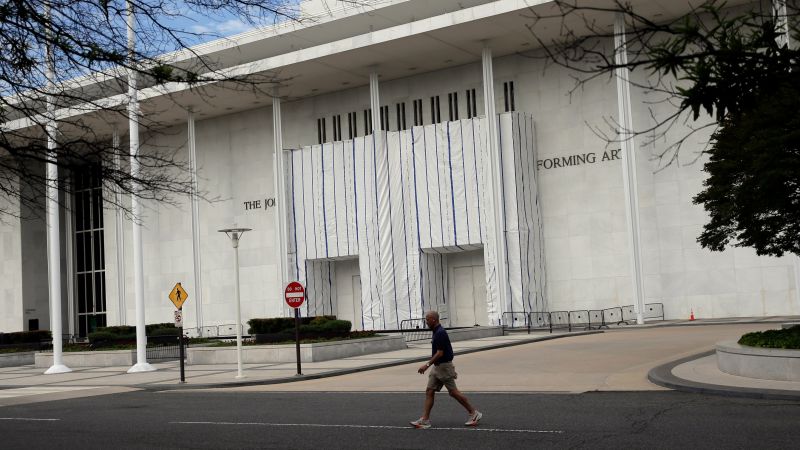
Kennedy Center exterior remains covered after – The exterior of the Kennedy Center in Washington, DC, remained draped in large striped tarps on Sunday, leaving visitors puzzled and frustrated as they arrived at the iconic arts venue. Stephen Caken, a New York resident attending an internship in the city, expressed confusion over the continued coverage of the building’s facade, which had seen the removal of President Donald Trump’s name just a day earlier in accordance with a federal judge’s order. “It seems like they’re trying to just kind of take away attention from this whole charade,” Caken remarked to CNN, highlighting the lingering uncertainty about the completion of the change.
Symbolic Impact of the Name Change
The installation of Trump’s name on the Kennedy Center’s exterior in December had sparked significant debate, particularly among residents who view the institution as a cultural landmark. The decision to remove the name—following an appeals court’s rejection of a request to delay the ruling—was intended to erase the president’s influence from the nation’s capital. However, the partial coverage of the building’s facade has prevented many from fully witnessing the transformation, with some questioning whether the effort to distance the center from Trump’s legacy is complete.
John Mathew Smith, a Maryland resident who visited the Kennedy Center, voiced concerns about the symbolic implications of the name’s removal. “To me, he’s trying to deface America’s symbols before he starts finishing defacing the country itself,” Smith stated. The removal of Trump’s name, he argued, represents a broader attempt to undermine the cultural and historical identity of the city. Meanwhile, Tim Terpstra, a Washington-area resident living nearby, arrived for the second time that weekend hoping to confirm the tarp had been taken down. “It would be nice to be able to see to make sure that it is down, and no vestiges of what was up there still remain,” Terpstra said, emphasizing the desire for a clear visual separation from the former president’s presence.
Legal Context and Ongoing Appeal
The removal of Trump’s name was a direct result of a legal ruling by US District Judge Christopher Cooper, who determined that the Kennedy Center had acted unlawfully in adding the president’s name to its facade. The appeals court’s decision to uphold the ruling prompted the center to proceed with the elimination of the display, though the process was not entirely complete by Sunday. CNN has contacted the Kennedy Center for further clarification on the delay in fully removing the tarp.
The name change, which was implemented during Trump’s second term, was part of his broader campaign to reshape the city’s cultural landscape. The installation of his name on the building—named after assassinated President John F. Kennedy—was seen as a provocative move, given the historical significance of the venue. The decision drew criticism from artists and cultural figures, with some withdrawing from events at the center in protest. This controversy underscored the symbolic weight of the change, as the Kennedy Center became a focal point for discussions about American identity and political influence.
Although the center reversed the name addition in some areas last week, it retained the display in an attempt to avoid full compliance with Cooper’s ruling. The ongoing legal battle reflects the deep divide over the role of public institutions in political messaging. The appeal is expected to continue for weeks, but the removal of Trump’s name marks a pivotal moment in the effort to reclaim the space as a symbol of American culture rather than political allegiance.
Broader Efforts to Reshape Washington
Trump’s influence on the city’s architecture and public spaces extends beyond the Kennedy Center. His administration has undertaken several projects aimed at altering the physical and symbolic environment of Washington, DC. These include the transformation of the White House Rose Garden into a patio reminiscent of Mar-a-Lago, the demolition of the East Wing to accommodate a massive ballroom, and the repainting of the Lincoln Memorial Reflecting Pool. Additionally, plans are underway to construct the tallest arch in the world on a traffic circle near Arlington National Cemetery and to develop a sculpture garden along the Potomac River.
Some of these initiatives have sparked controversy, particularly those tied to ideological considerations rather than aesthetic appeal. White House officials have launched a sustained review of the Smithsonian Institution, seeking to align its historical narratives with the president’s vision of American heritage. At the same time, the administration has reinstalled a Confederate monument, while removing references to George Mason’s paradoxical ownership of slaves from his memorial. These actions have reignited debates about the balance between historical recognition and contemporary values in public spaces.
Despite these changes, the Kennedy Center remains a key platform for Trump’s cultural initiatives. During his presidency, the center hosted the Kennedy Center Honors in December and later premiered the documentary of First Lady Melania Trump. Last week, it also served as the venue for the final round of Trump’s national civics contest for high school students. These events underscore the dual role of the center as both a cultural hub and a political statement, even after the removal of the former president’s name.
Public Reaction and Continued Debate
As the removal process unfolded, public sentiment remained divided. On Friday, crowds gathered at the Kennedy Center to watch the dismantling of the name display, with some protestors chanting “Take it down” and others celebrating the progress. At one point, workers were hailed as “heroes” by supporters of the change, illustrating the polarized reactions to Trump’s presence in the city. The removal of the name, while a step toward neutrality, has not resolved the broader discourse about the president’s impact on American cultural symbols.
Rep. Joyce Beatty, an Ohio Democrat and ex-officio member of the center’s board of trustees, played a central role in challenging the name addition. Her legal actions were swift, and she even celebrated the removal with a social media video featuring a dance popularized by Trump to the song “YMCA” by The Village People. This moment of irony highlighted the personal and political stakes involved in the decision, as Beatty sought to preserve the Kennedy Center’s legacy as a beacon of American art and history.
As the tarp remains in place, the question of whether the name’s removal signifies a permanent shift or a temporary adjustment lingers. For some, the partial coverage is a reminder of the slow pace of change, while for others, it represents an opportunity to fully reassess the symbolism of the building. The Kennedy Center’s journey from a site of political symbolism to a renewed cultural space continues to unfold, with the hope that the final stages of the removal will bring clarity and closure to the ongoing debate.
