AI stocks are getting trampled. South Korean market plunges 10%

AI stocks are getting trampled. South Korean market plunges 10%
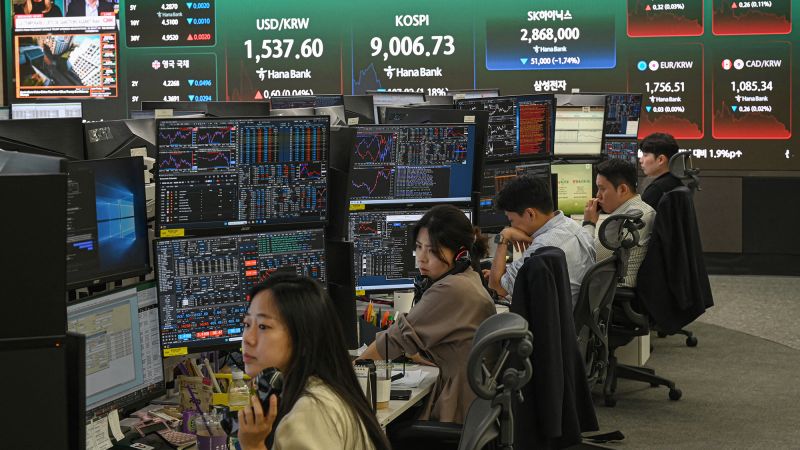
AI stocks are getting trampled South – The stock market has seen a resurgence in volatility, with artificial intelligence (AI) once again at the center of the storm. A modest downturn in US tech stocks on Monday spilled into Asian markets on Tuesday, sending shockwaves across the region. However, the situation escalated dramatically in South Korea, where the Kospi index plummeted by 10% in a single trading session, triggering a circuit breaker that halted trading for 20 minutes. This sharp decline has raised concerns about the stability of the market, particularly as investors grapple with uncertainty about the future of AI-driven growth.
South Korean Market in Freefall
The crash was driven by the collapse of two dominant players in the memory chip industry—SK Hynix and Samsung—both of which dropped over 12% on Tuesday. These companies account for approximately half of the Kospi’s total market value, meaning their performance has a disproportionate impact on the index. The sell-off was not confined to South Korea, as Asian markets collectively experienced declines, with Japan’s Nikkei falling 3.6% and tech giant SoftBank losing 15% of its value. Most other regional indices also dipped by more than 1%, reflecting a broader nervousness among traders.
“The market’s reaction suggests a growing fear that the AI bubble may be nearing its peak,” noted one financial analyst. “Investors are hedging bets, and the lack of clear catalysts only amplifies the panic.”
While the decline in South Korea appears sudden, some experts point to earlier signs of unease. The previous day, Google’s stock had fallen slightly, and SpaceX had shown post-IPO volatility. However, these movements were not enough to spark a full-blown crisis. Instead, the panic seems to stem from a combination of factors, including concerns about the Federal Reserve’s potential rate hikes and the broader trajectory of AI valuations.
Fed Policy and the AI Bubble
The Federal Reserve’s interest rate decisions have long been a focal point for global markets, and this week’s developments may be linked to its ongoing efforts to curb inflation. Kevin Warsh, the newly appointed chair of the Federal Reserve, held his first press conference on June 20, 2026, signaling a commitment to maintaining tight monetary policy. His remarks, which emphasized the central bank’s focus on inflation control, were interpreted by some traders as a hint that rate increases could follow sooner than expected.
Although this is not entirely new information, the timing of Warsh’s statement has intensified fears. The markets had already been in a state of cautious optimism, fueled by AI’s transformative potential. Yet, the prospect of higher borrowing costs has shaken investor confidence, particularly among companies with soaring valuations. Analysts argue that AI stocks, which have surged in the past year, are now more vulnerable to market corrections. “The high valuations of AI firms mean even small doubts can trigger massive sell-offs,” said another market observer.
The Kospi’s 10% plunge underscores the fragility of this growth. The index has gained 90% this year, making the current downturn all the more striking. Investors are now questioning whether the market’s rapid ascent has been built on solid fundamentals or speculative fervor. The analogy of a Jenga tower comes to mind: with so many pieces stacked high, a single misstep can cause the entire structure to collapse.
Global Implications of the Crisis
The ripple effects of the South Korean sell-off extend beyond Asia. In the United States, tech stocks are facing renewed pressure, with Nasdaq futures down 2.8% after a 1.3% drop on Monday. The broader S&P 500 also saw futures fall 1.2%, and the Dow was projected to open 200 points lower. Despite these declines, the US market remains near record highs, with the Nasdaq having lost just 3.4% from its peak set on June 2, 2026. This highlights the uneven nature of the current market correction, where some sectors are more exposed than others.
Analysts suggest that the panic is partly a result of investor sentiment shifting. After President Donald Trump announced a ceasefire in Iran in April, markets briefly turned their focus from geopolitical risks to technological innovation. AI became the dominant narrative, with companies like Google and Meta seeing record valuations. However, the recent turbulence has reminded traders that the market’s euphoria can be fragile. “The war in Iran was a temporary distraction, but the AI narrative is now under scrutiny,” remarked a strategist.
Oil prices also dipped on Tuesday, as traders welcomed the apparent progress in peace talks. This shift in focus from AI and interest rates to energy markets demonstrates the interconnectedness of global financial systems. Yet, the simultaneous decline in tech stocks and the Kospi suggests that the market is still reeling from the combined impact of AI optimism and Fed policy expectations.
The Role of Algorithms in Amplifying Panic
One of the key drivers of the market plunge is the role of algorithmic trading. High-frequency trading systems, designed to react swiftly to market signals, have exacerbated the volatility. These algorithms, which rely on predictive models and sentiment analysis, may have interpreted the initial tech sell-off in the US as a sign of deeper trouble. “Trading algorithms are now more sensitive than ever, reacting to even the smallest cues,” explained a market technician.
The rapid decline in the Kospi also reflects the psychology of crowd behavior. When a few large-cap stocks begin to fall, it can create a self-fulfilling cycle where investors rush to exit, fearing a broader market downturn. This dynamic has been particularly pronounced in South Korea, where the tech sector dominates the economy. The collapse of SK Hynix and Samsung has left the market in disarray, with many smaller companies following suit as investors seek to minimize risk.
Despite the chaos, some analysts remain optimistic. They argue that the market’s ability to rebound quickly may indicate underlying strength. “A 10% drop is severe, but it’s not uncommon in markets that have been on a steep upward trajectory,” one economist noted. “The key question is whether the decline is a temporary correction or the start of a longer trend.”
As the dust settles, the focus remains on the interplay between AI innovation and macroeconomic factors. The recent turmoil serves as a reminder that even the most promising technologies can be vulnerable to shifts in investor sentiment. With the Kospi’s annual gains now in jeopardy, the challenge for markets will be to balance growth with stability. The question on every trader’s mind is: how high can the Jenga tower go before it tips over?
For now, the South Korean market’s plunge is a cautionary tale. It highlights the importance of diversifying risk and the potential for AI to act as both a catalyst and a cause of market instability. As the week progresses, the focus will shift to whether the sell-off is a fleeting episode or the beginning of a more prolonged correction. One thing is clear: the once-unshakable confidence in AI-driven growth is beginning to waver.