
A chance encounter led to one of the largest T. rexes ever found. Now, it could be ‘lost to science’
A Chance Encounter Led to One of the Largest T. rexes Ever Found
A chance encounter led to one of the most significant paleontological discoveries of recent decades. Gary “Gus” Licking, a South Dakota cattle rancher, always sensed that his vast property held something remarkable. His land sits within the Hell Creek Formation, a geological region stretching across Montana, Wyoming, and both North and South Dakota. This area is globally recognized as the premier hunting ground for Tyrannosaurus rex fossils. The first T. rex skeleton was discovered here in 1902, and the species was officially named based on specimens from this region.
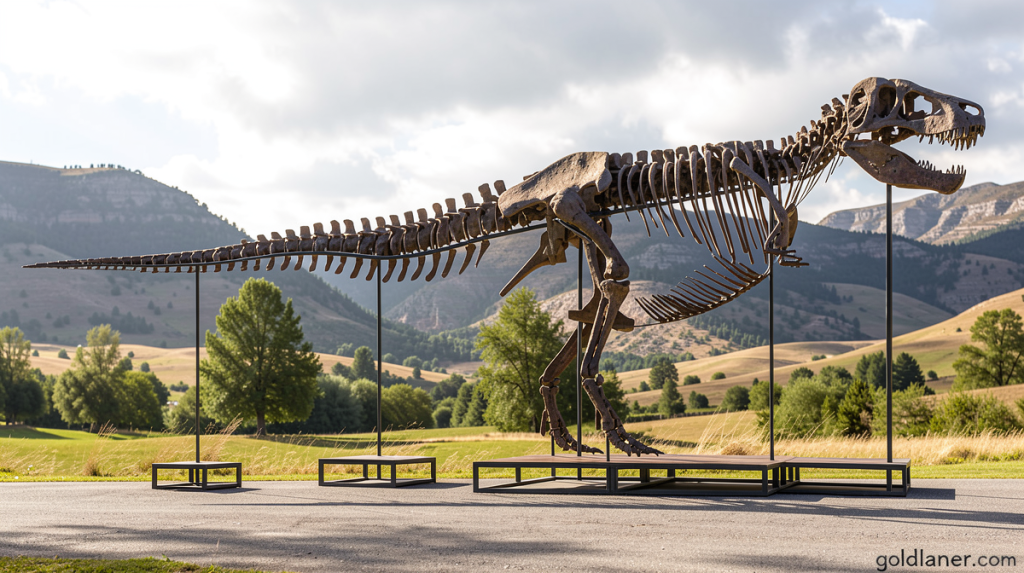
Stan, an nearly complete T. rex skeleton found near Licking’s ranch, sold for $31.8 million in 2020, setting a record at the time. Now, Licking’s own 6,500-acre Harding County estate has produced a comparable specimen. Named Gus in honor of the rancher, this extraordinary fossil goes up for auction Tuesday at Sotheby’s in New York City, potentially becoming the most expensive fossil ever sold. A chance encounter led to one of the most remarkable finds in paleontology history.
The Ongoing Debate About Fossil Ownership
Gus’s upcoming sale to private ownership is expected to fuel continuing discussions about fossil stewardship. Scientists and collectors often have conflicting views on how paleontological treasures should be preserved and shared. This particular controversy began when two people met by coincidence.
Licking had spent years collecting dinosaur teeth and bones, always hoping for a major discovery. That hope became reality through a serendipitous meeting that changed everything. A chance encounter led to one of the most complete T. rex specimens ever unearthed on private land.
“I was passing by the ranch randomly one day and Gary was checking a watering trough near the road, so I stopped and introduced myself,” recalled Thomas Heitkamp, a commercial paleontologist and founder of Theropoda Expeditions, a Texas-based company that specializes in excavating fossils on private land.
“The Licking ranch had been on my radar because of its location within the Hell Creek formation. Gary had always been interested in fossils and artifacts, and he had quite a good collection of things he had found in his home,” Heitkamp explained to CNN via email. “I think he knew how fossil-rich his property was from spending so much of his life there, and he believed if it was hunted thoroughly enough, a specimen might be found someday. I’m happy we were able to give him that experience.”
Heitkamp and his excavation team uncovered Gus on Licking’s property in 2021. Although Licking identified where the skeleton lay, he passed away before the excavation was complete and never saw the full specimen. This timing meant that a chance encounter led to one of the most significant private fossil discoveries in American history.
Size, Completeness, and Scientific Value
According to Sotheby’s, Gus measures 38 feet long and stands 12.5 feet tall, with a skull measuring 54 inches across. The fossil contains 183 bone elements, achieving roughly 61% completeness by bone count and 75 to 80 percent by mass. A chance encounter led to one of the largest T. rex specimens ever documented.
While Sotheby’s describes Gus as one of the most complete T. rex fossils ever discovered, it falls short of both Stan’s approximately 70% bone-count completeness and Sue’s remarkable 90% total completeness. Sue, the first dinosaur fossil ever sold at auction in 1997, established the benchmark for such specimens.
Gus additionally displays bite marks and fracture evidence indicating the dinosaur survived injuries during its lifetime, features that Sotheby’s suggests could enhance its scientific value. Nevertheless, no formal scientific publication has examined Gus, as many researchers decline to study privately owned specimens.
Heitkamp noted that “several independent researchers” have already viewed Gus informally. The auction—completely lawful since the fossil originates from private land—threatens to revive discussions about fossil sales and the possible removal of T. rex skeletons from public view, given that most already reside in private collections.
“If this specimen goes to a private individual, it may or may not ever be seen by the public again,” stated Stuart Sumida, a professor of biology at California State University, San Bernardino, and president of the Society of Vertebrate Paleontology, or SVP, an organization that firmly opposes fossil sales.
When fossils enter private hands, their trajectories become unpredictable. Some receive loans to museums while maintaining private ownership, whereas others vanish entirely into private collections. Furthermore, such specimens rarely undergo rigorous scientific analysis. A chance encounter led to one of the most significant paleontological finds, but whether science benefits remains uncertain.
