
Hobbit-like humans may have scavenged Komodo dragons’ leftovers to survive
Hobbit-like Humans May Have Scavenged Komodo Dragons’ Leftovers to Survive
Hobbit like humans may have scavenged – Researchers have challenged long-held beliefs about the survival strategies of Homo floresiensis, a prehistoric human species known for its small stature. Previously thought to be skilled hunters, these diminutive hominins might have relied more on scavenging than on actively hunting large animals or using fire to cook their meals. A new study published in Science Advances sheds light on this mystery, offering insights into how these ancient beings adapted to life on the remote Indonesian island of Flores.
Unearthing the Evidence
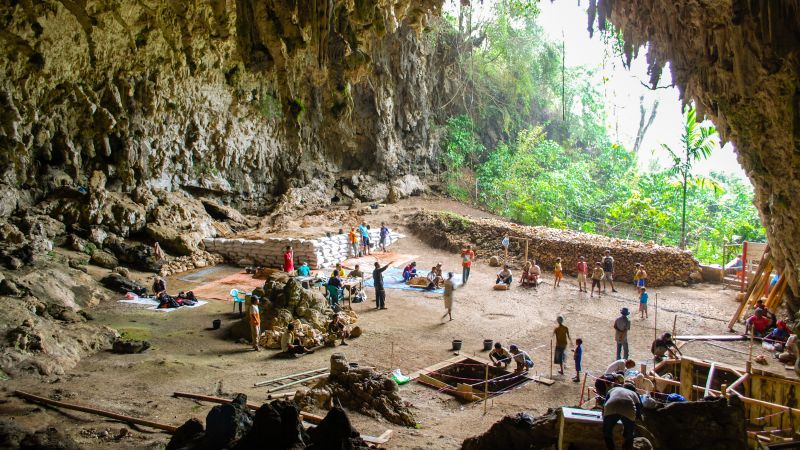
The discovery of Homo floresiensis fossils in Liang Bua cave in 2003 revealed a species with a brain size comparable to that of a chimpanzee. Standing approximately 3.3 feet tall and possessing a skull the size of a grapefruit, these early humans were initially dubbed “hobbits” due to their strikingly small physical size. Archaeological findings near the fossils included stone artifacts and bones of Stegodon florensis insularis, an extinct relative of elephants that weighed around 1,260 pounds and measured about 5 feet in height. These artifacts were interpreted as tools used to process meat from large herbivores, suggesting the species was an active hunter.
However, new research led by Dr. Elizabeth Grace Veatch, a paleoanthropologist specializing in human diet evolution, questions this assumption. Veatch and her team analyzed the post-mortem changes in Stegodon bones to determine if they were shaped by human activity or by natural processes. Their findings indicate that the markings on the bones were more consistent with scavenging behavior than with hunting. This conclusion aligns with the idea that Homo floresiensis may have depended on the remains of animals, particularly those left by the island’s sole carnivore, the Komodo dragon, to sustain itself.
Revisiting the Role of Fire
The use of fire has long been considered a defining trait of advanced hominins, including Neanderthals, Homo sapiens, and even Homo erectus. Burned bones previously found at the site were thought to support this notion, as they implied the ability to cook meat. But Veatch’s study introduces a new perspective. By examining the distribution of bite marks and cut marks on the bones, the team found that the majority of the damage was caused by Komodo dragons, not by human tools or fire. This suggests that Homo floresiensis may have avoided using fire for cooking, relying instead on the leftovers of larger predators to meet their dietary needs.
Veatch explained that the study aimed to investigate the extent of human involvement in the processing of Stegodon remains. “I wanted to see if we really could show that H. floresiensis was the hunter it had been portrayed as for decades,” she wrote in an email. The researchers conducted a feeding experiment involving a Komodo dragon named Rinca at Zoo Atlanta, where the lizard was observed feeding on a goat carcass. This allowed them to compare the tooth marks left on bones by the dragons with those made by human stone tools, providing critical evidence for their scavenging hypothesis.
Comparing Marks and Behaviors
Studying the patterns of damage on the bones, the team noticed that Komodo dragon tooth marks were predominantly found on the most nutrient-rich portions of the Stegodon, such as the meaty areas near the ribs and limbs. In contrast, the cut marks left by stone tools were concentrated on less desirable parts of the animal, like the bones or tougher muscle tissue. This distinction is significant because it implies that Homo floresiensis was not systematically hunting the Stegodon but rather opportunistically feeding on what was available after the dragons had done the work.
Veatch and her colleagues employed a 3D scanning technique to analyze the goat bones from Rinca’s meal, alongside the Stegodon remains from Liang Bua. By comparing these data, they were able to discern the subtle differences between the two types of marks. “After comparing the marks on the Stegodon bones with our sample of Komodo dragon tooth marks and cutmarks, I was surprised by how similar most of the marks were to our Komodo dragon sample,” Veatch noted. This similarity supports the argument that the early humans were not the primary hunters but rather the beneficiaries of the dragons’ predation.
Implications for Human Evolution
The study’s conclusions contribute to a broader reevaluation of Homo floresiensis’s place in the human evolutionary tree. While thousands of stone tools have been found near the fossils, their presence alone does not confirm active hunting. Instead, the tools may have been used to strip flesh from bones or to break open the carcasses of animals already killed by other predators. This behavior would align with a more scavenging-oriented lifestyle, which could mean Homo floresiensis was less advanced than previously thought.
“The number of tools found alongside the fossils suggests the early hominins were crafting tools to process Stegodon meat,” said study coauthor Briana Pobiner, a paleoanthropologist at the Smithsonian Institution. “But the marks on the bones tell a different story. They don’t show signs of active hunting, only the aftermath of a predator’s work.” This insight challenges the idea that tool use and fire control were essential for survival, at least in this species, and opens new questions about how different hominin groups adapted to their environments.
Researchers now speculate that Homo floresiensis’s reliance on scavenging might have been a survival strategy shaped by the ecological constraints of Flores Island. With limited resources and the presence of powerful predators like Komodo dragons, these early humans may have focused on exploiting what was already available rather than investing energy in hunting or cooking. This discovery could redefine how scientists interpret the behaviors of other ancient hominins, particularly those with smaller brain sizes, and highlight the diversity of strategies that contributed to human evolution.
