
Mamdani marks July 4 with a pro-immigration speech, ripping Trump’s policies without using his name
Mamdani Marks July 4 with Pro-Immigration Speech, Critiquing Policies Without Naming Trump
Mamdani marks July 4 with a pro – On the occasion of Independence Day, New York City Mayor Zohran Mamdani delivered a speech that redefined the nation’s patriotic narrative. The event, held at City Hall, centered on the theme of immigration and its role in sustaining America’s founding ideals. By choosing July 4 as the backdrop, Mamdani aimed to contrast the nation’s original vision of inclusivity with its modern challenges, particularly the policies he argued have increasingly excluded newcomers. As a naturalized citizen from Uganda, he framed his remarks as a tribute to the enduring spirit of the United States, emphasizing how immigrants have historically contributed to its progress.
A Call to Reconnect with American Ideals
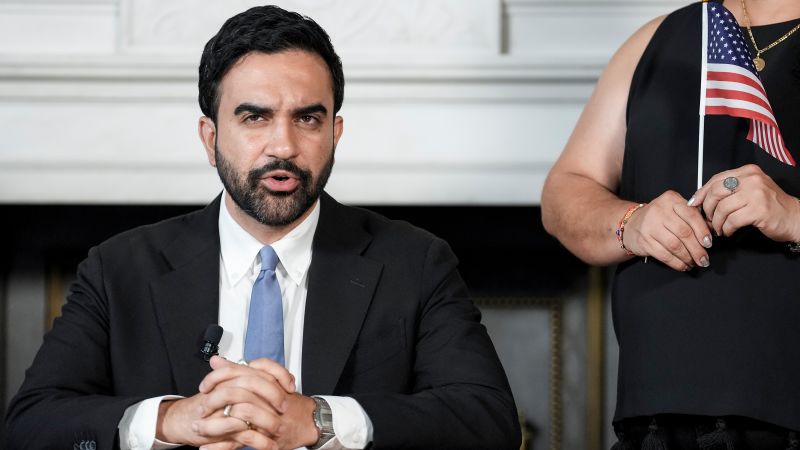
Mamdani’s address was designed to challenge the current direction of the country, highlighting how immigration policies have shifted from supporting opportunity to fostering division. Standing in a historic venue—City Hall, where the Declaration of Independence was once read to the Continental Army—he drew parallels between past leaders and present-day struggles. His podium, a desk used by George Washington, symbolized the continuity of American values. Around him, naturalized immigrants waved flags, underscoring the collective effort that has shaped the nation’s identity over centuries.
While he did not explicitly name Donald Trump, Mamdani’s critique of current policies was unmistakable. He argued that certain groups have manipulated the narrative to prioritize borders over the American dream. “If you ask them, America becomes less the more people it welcomes,” he asserted.
“They tell you America belongs only to those with the right accent or the right shade of skin. The rest of us should be grateful for merely being allowed to visit.”
This sentiment resonated with many who feel alienated by the rhetoric surrounding immigration today.
Transforming the Narrative of National Heritage
Mamdani’s speech painted a picture of America as a country constantly evolving through the contributions of its people. He emphasized that the nation’s strength lies in its adaptability, with immigrants and advocates playing a vital role in redefining its purpose. “We see masked agents terrorizing our streets, eating food cooked by our undocumented neighbors before spiriting them away in unmarked vans,” he said.
“We see a nation built by those with calloused hands and chiseled resolve, yet one that hoards wealth in the soft hands of a privileged few.”
This contrast underscored his argument that the current administration’s priorities are at odds with the values that have long defined the United States.
During the address, Mamdani recounted his first sight of the Statue of Liberty from an airplane, a moment he described as a powerful reminder of the nation’s promise. “That image stays with me,” he said. “It represents a beacon for those who cross oceans to build a better life.” His personal story reinforced his belief that the United States should remain a sanctuary for all, not just those who fit a specific mold. By intertwining history with contemporary issues, he positioned his message as both a celebration and a challenge to the current political landscape.
Mamdani’s speech also touched on the broader debate within the Democratic Party about leadership and direction. As a democratic socialist, he has become a prominent figure in recent months, following his success in New York’s primaries. His focus on immigration and social equity aligns with the party’s progressive agenda, yet he also called for unity among its members. “This is not just about immigration,” he clarified. “It’s about ensuring the Democratic Party remains true to its roots and serves all Americans, not just a privileged minority.” His words reflect a growing urgency to redefine the party’s identity in the face of shifting political dynamics.
Though he has not yet sought the presidency or vice-presidency, Mamdani’s influence continues to grow. His naturalized status makes him ineligible for the highest office under the Constitution, but he has dismissed calls to amend the rule, stating last week that he believes the document “looks good just the way it is.” This stance highlights his balance between tradition and modernity, positioning him as a bridge between America’s past and its future. As the November midterms and the 2028 presidential race approach, Mamdani’s July 4 speech serves as a bold statement about the nation’s path forward.
