
Top general fired by Trump administration criticizes use of military for political missions
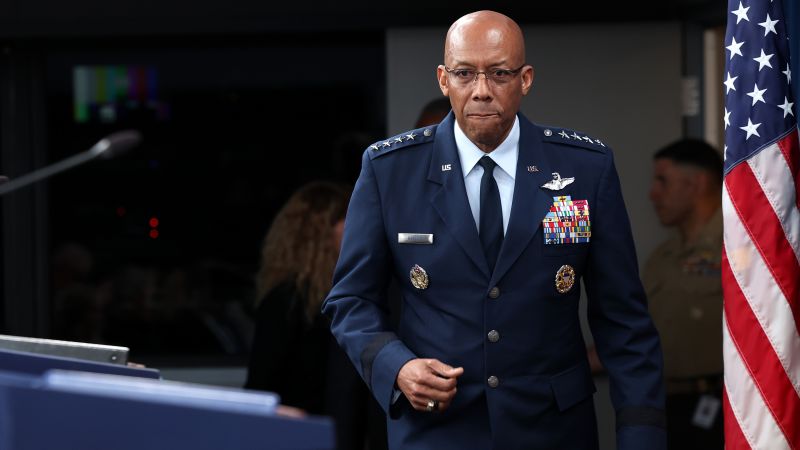
Former Top General Condemns Use of Military for Partisan Purposes
Retired Joint Chiefs Chairman Calls for Separation of Military and Politics in Op-Ed
Top general fired by Trump administration – Charles Q. Brown, the former Chairman of the Joint Chiefs of Staff, has openly criticized the deployment of the U.S. military for politically driven objectives in an op-ed published on Friday. The article, co-authored with Duke political science professor Peter Feaver and North Carolina attorney Andrew Kragie, highlights concerns over how the Trump administration has leveraged the armed forces to address domestic issues, such as crime in urban centers. Brown, a retired Air Force general and the second Black individual to hold America’s highest military rank, was removed from his position in February 2025 as part of a broader reshuffling within the Pentagon. His departure coincided with the administration’s efforts to streamline military operations by emphasizing efficiency over inclusive policies.
“When presidents use the armed forces for more politically contentious missions, such as addressing domestic crime in cities, the work of the military becomes more fraught,” Brown wrote.
Brown and his co-authors argue that assigning the military to resolve crises rooted in civilian governance shifts focus from its core combat role. They stress that such actions risk overburdening the armed forces, which should remain a neutral entity capable of defending the nation without being drawn into partisan disputes. “Resorting to a military solution rather than fixing the underlying incapacity or dysfunction in civilian institutions diverts the military from focusing on its primary combat mission,” they added. “And … it is not the military’s job to save the republic from political impasses. Indeed, if you ask too much of the military, you risk the entire enterprise.”
Administrative Shifts and the Role of Diversity Initiatives
Brown’s firing followed the Trump administration’s decision to curtail diversity and inclusion programs across the military and federal government. The move was part of a broader initiative to reduce perceived ideological influences in institutional decision-making. At the time, Brown and Admiral Lisa Franchetti, the first woman to serve as a Joint Chiefs member, were among those removed from leadership roles. Their ouster sparked discussions about the administration’s prioritization of strategic efficiency over the cultural fabric of the armed forces.
During a recent appearance at the Aspen Ideas Festival, Brown expanded on his criticisms, particularly regarding the administration’s pattern of dismissing experienced Pentagon officials. “What’s starting to happen now is not about merit,” he stated, emphasizing that the firings appeared to target individuals based on political alignment rather than professional competence. “It’s important we understand that all these people that are being removed are very well experienced,” Brown said, adding that the ongoing removals could undermine the morale and opportunities of those still in service. “Are they going to have a fair opportunity to advance in their career going forth?”
Historical Context and Military Deployments
The op-ed, published in *Foreign Affairs*, references the Trump administration’s long-standing use of the military for domestic purposes. Last year, the administration deployed thousands of National Guard troops and hundreds of Marines to cities like Washington, DC, and Los Angeles, aiming to combat rising crime rates. These efforts, according to Brown, exemplify a trend where military assets are repurposed to serve political agendas, a practice he deems problematic for the armed forces’ impartiality.
“Law and order is something all Americans deserve,” Hegseth asserted, framing the deployment of National Guard units as a necessary and nonpartisan action.
Defense Secretary Pete Hegseth, who has supported these strategies since Trump’s return to the presidency, recently praised the National Guard’s role in maintaining order amid protests. “They can’t see law and order and common sense in front of them, that there’s nothing ideological about this group, there’s nothing political about this exercise,” Hegseth said during a press briefing. His remarks underscore the administration’s justification for using the military in domestic contexts, despite Brown’s warnings about the long-term consequences.
Shared Responsibility and the Legacy of American Patriotism
In addition to critiquing current practices, the op-ed reflects on the broader concept of patriotism and its connection to military service. The authors note that the U.S. is celebrating its 250th anniversary, a milestone that offers an opportunity to reaffirm the values of national unity and shared purpose. “Patriotism means recognizing the promise of America’s founding, the progress of its past, and the potential of a shared future,” they wrote, suggesting that true dedication to the nation’s ideals should transcend partisan divides.
Brown’s perspective aligns with the idea that service to a cause greater than oneself is a hallmark of military training. “Service to a cause greater than oneself, a virtue cultivated in military training, is accessible to all regardless of whether they wear the uniform,” the authors added. This sentiment emphasizes the military’s role as a symbol of collective responsibility, even as its missions increasingly intersect with political objectives.
The Trump Administration’s Strategic Use of Military Power
The article also draws a distinction between the Trump administration’s actions and those of previous leaders. While it does not directly condemn President Donald Trump, it acknowledges that both Trump and former President Joe Biden have relied on the military to respond to crises, such as the COVID-19 pandemic. However, the focus of the current critique is on the administration’s use of the armed forces to enforce social order in cities, a strategy that has been expanded under Hegseth’s leadership.
Since Trump’s re-election, the administration has increasingly mobilized military resources to address domestic challenges. This approach, critics argue, blurs the line between defense and governance, potentially eroding public trust in the military’s independence. Hegseth’s tenure has seen a notable shift in the use of troops for policing roles, with the National Guard being deployed to high-profile areas like Washington, DC, where protests have drawn significant attention. The decision to use military force in these contexts has been framed as a response to unrest, yet it raises questions about the long-term implications for the armed forces’ role in American society.
Brown’s op-ed serves as a reminder of the military’s dual function: to protect the nation and to serve as a symbol of unity. While the current administration defends its use of troops for domestic missions, the article suggests that such actions risk diminishing the military’s credibility as a force for impartiality. By juxtaposing historical examples with contemporary strategies, the authors aim to highlight the need for a balanced approach to military deployment, ensuring that the armed forces remain a trusted institution for both national defense and civic responsibility.
Broader Implications for Military and Political Institutions
Brown’s critique extends beyond immediate policy decisions, touching on the evolving relationship between the military and the political system. He argues that when the armed forces are consistently called upon to address civilian governance failures, they become entangled in the nation’s political struggles. This, he warns, could lead to a perception of the military as an extension of partisan interests rather than a separate, apolitical branch of the government.
“The military’s role should be to secure the country, not to serve as a tool for political agendas,” Brown said, reiterating his belief in the importance of maintaining clear boundaries between military and civilian functions. His comments resonate with those who worry that the Trump administration’s emphasis on efficiency and ideological purity has come at the expense of institutional balance. The firing of senior officials, coupled with the shift in military deployment strategies, underscores a broader trend of politicizing the armed forces and redefining their purpose in the context of contemporary challenges.
As the nation continues to grapple with the intersection of military power and political strategy, Brown’s op-ed offers a compelling analysis of the risks and rewards of such an approach. By highlighting the 250th anniversary of American independence, the authors tie the discussion to the foundational ideals of the country, urging a return to principles that prioritize the military’s role as a guardian of freedom over a mediator of political conflict.
Conclusion: A Call for Reflection and Reform
The op-ed’s release has reignited debates about the appropriate use of the military in domestic affairs. While the Trump administration justifies these deployments as necessary for maintaining order, Brown and his co-authors advocate for a more measured and strategic approach. Their work not only critiques the current direction of military policy but also invites reflection on the enduring legacy of American patriotism and the role of the armed forces in shaping national identity.
CNN’s Oren Liebermann and Haley Britzky contributed to this report. Their coverage highlights the ongoing discourse about the military’s evolving role in the political landscape, emphasizing the importance of preserving its independence while addressing complex domestic challenges.
