
Trump heads to Mount Rushmore, where efforts to impose his likeness have stalled
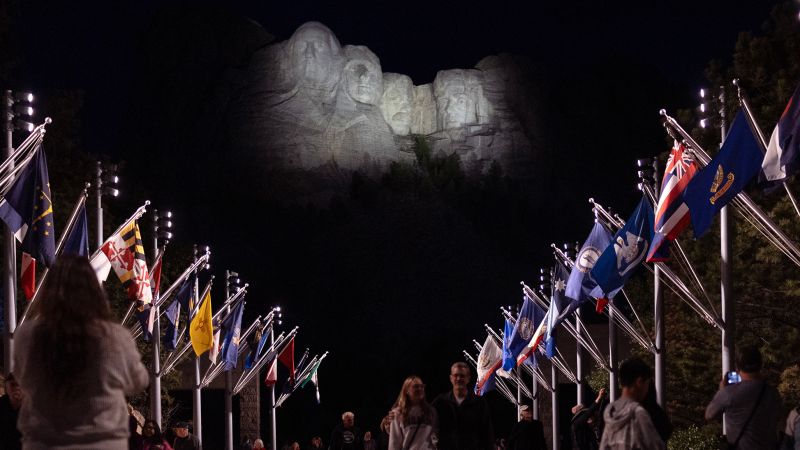
Trump Returns to Mount Rushmore Amid Ongoing Efforts to Add His Likeness
Trump heads to Mount Rushmore where – President Donald Trump’s upcoming visit to Mount Rushmore has reignited debates over his vision for the iconic national monument. While the president has long expressed interest in having his portrait carved alongside the existing figures of George Washington, Thomas Jefferson, Theodore Roosevelt, and Abraham Lincoln, the proposal remains mired in logistical and political challenges. This trip, part of a broader cultural tour, marks a significant moment in Trump’s second term, where he continues to push for his legacy to be etched into the nation’s historical landscape.
The Structural Hurdles of a Fifth Face
Mount Rushmore’s unique design presents a major obstacle for Trump’s ambitions. The monument, carved into a granite mountain in South Dakota, features four colossal faces that have stood for nearly a century. As Trump prepares to address the crowd, the question remains: can the monument accommodate another face? The answer lies in the engineering constraints of the site. Sculptor Gutzon Borglum, who designed the original monument, had already warned of the stone’s limitations in 1936. His words, preserved in historical records, remain relevant:
“I doubt if it would be possible to change the composition, which is fixed, in any way to include a fifth head.”
The existing structure is a masterpiece of precision, with each face meticulously aligned to the natural contours of the mountain. Adding a fifth figure would require reshaping the granite, a task that would be both technically complex and visually disruptive. While Trump has championed the idea with characteristic enthusiasm, the feasibility of such a change remains uncertain, even as he seeks to make his mark on the monument.
Legislation and Political Hurdles
Efforts to formalize Trump’s vision have been spearheaded by his allies, including Republican Representative Anna Paulina Luna of Florida. In 2024, Luna introduced a bill aimed at securing the necessary permissions to carve Trump’s likeness into Mount Rushmore. The legislation, which she described as a tribute to “his towering legacy,” has drawn mixed reactions. While supporters argue it would solidify his place in American history, critics note its stalled status in the Senate. Interior Secretary Doug Burgum, who manages the National Park Service, has offered cautious optimism, stating that “there is certainly room” for Trump’s face on the monument. However, the path to approval remains fraught with challenges. The bill’s progress depends on securing Democratic support, a key hurdle given the shifting political landscape. With the Senate majority still held by Democrats, the proposal’s fate hangs in the balance. Trump’s office has not yet confirmed whether this visit will accelerate the legislation’s passage, but the event underscores his persistence in promoting his historical legacy.
2020 Visit: A Pivotal Moment
Trump’s 2020 visit to Mount Rushmore occurred during a period of national turmoil. The country was grappling with the early stages of the pandemic, and racial tensions had reached a boiling point following the death of George Floyd. During that trip, Trump’s speech focused on themes of national unity and historical preservation, framing his remarks as a defense of American values. He thanked first responders and scientists for their work against the virus, yet the tone of his address quickly turned contentious. In front of the iconic carving, Trump criticized what he called “cancel culture,” labeling it a “political weapon” and “the very definition of totalitarianism.” The speech, delivered on a red, white, and blue-decorated stage, targeted recent efforts to remove statues of Confederate leaders and other historical figures from public spaces. “Our nation is witnessing a merciless campaign to wipe out our history, defame our heroes, erase our values, and indoctrinate our children,” he declared, drawing parallels between current protests and his broader vision of honoring the past. The message resonated with his base, becoming a cornerstone of his 2020 and 2024 campaigns. Interestingly, the irony of Trump’s speech was amplified by the monument’s own history. Gutzon Borglum, who oversaw the project, was known for his association with the Ku Klux Klan, a detail that has sparked renewed scrutiny of the monument’s symbolic significance. Despite this, Trump framed his visit as a celebration of American identity, contrasting his message with the progressive interpretations of history that had gained traction during the pandemic.
Cultural Legacy and Future Ambitions
Trump’s second term has seen him expand his cultural influence beyond the White House. He has already left his mark on the nation’s capital, with the renaming of a Washington, D.C. airport in his honor. However, his efforts to reshape the landscape of historical monuments remain a focal point of his agenda. The proposed addition to Mount Rushmore is part of a larger strategy to elevate his legacy as a figure of national importance. The president’s return to the monument this year coincides with the country’s 250th anniversary celebration. The event will include a flyover, remarks, and a fireworks display, all of which highlight the intersection of patriotism and politics. While the immediate impact of the visit is unclear, it signals Trump’s determination to align his image with the nation’s founding icons. Beyond Mount Rushmore, Trump has also promoted the “Garden of American Heroes,” a project he announced in 2020. This initiative aims to honor historical figures in a new space within the National Mall. Though the project was initially established through an executive order and later revoked by the Biden administration, it was reinstated in 2025. The garden’s progress, however, has been slow, with no sculptures yet completed. Trump’s cultural initiatives reflect a broader effort to redefine the national narrative. By leveraging historical landmarks, he seeks to position himself as a unifying figure, despite the controversies surrounding his policies. His 2020 speech, which emphasized the importance of preserving historical achievements, laid the groundwork for this approach. As he returns to Mount Rushmore, the question remains: will his presence on the monument help solidify his place in the pantheon of American leaders, or will the political and structural challenges ensure that his likeness remains an aspiration rather than a reality?
While the structural limitations of Mount Rushmore are clear, the political will to overcome them is still in question. Trump’s ability to influence public opinion has waned slightly since 2020, but his allies continue to champion the cause. Whether this visit sparks a new wave of support or reinforces the monument’s status as a symbol of resistance, the event highlights the enduring intersection of politics and history. As the president prepares to address the crowd, the world watches to see if his dream of a fifth face will finally take shape—or if it will remain a footnote in the story of one of America’s most iconic landmarks.
