
Papyrus scroll burnt to a crisp during Vesuvius eruption deciphered with help of AI
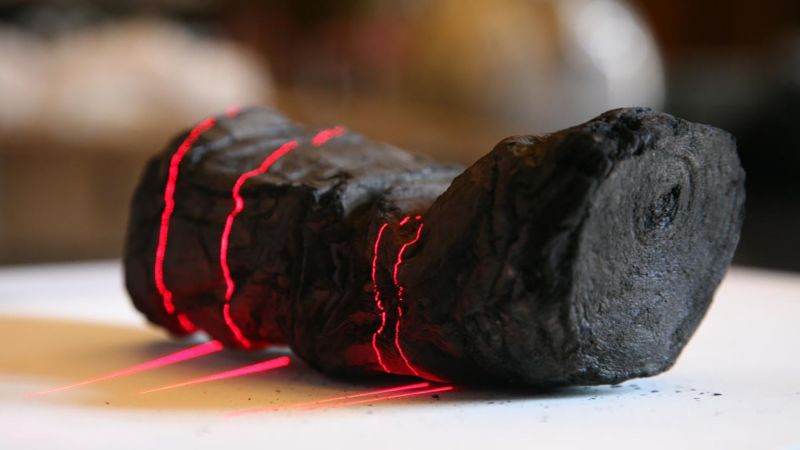
Papyrus Scroll Burnt by Vesuvius Deciphered Through AI Innovation
Papyrus scroll burnt to a crisp – A significant milestone in ancient text restoration has been achieved with the aid of artificial intelligence, as a papyrus scroll carbonized by the eruption of Mount Vesuvius nearly two millennia ago has been virtually unrolled and partially decoded. The scroll, cataloged as PHerc. 1667, is among hundreds of Herculaneum manuscripts that were entombed in volcanic material during the 79 AD eruption, according to the Vesuvius Challenge—a collaborative project dedicated to interpreting these texts without physical unrolling. The initiative has enabled researchers to unlock the secrets of the scrolls through advanced imaging and computational techniques, marking a transformative step in classical archaeology.
The scrolls, preserved under layers of mud and ash, are believed to originate from a villa associated with the father-in-law of Julius Caesar. Discovered in the 18th century by an Italian farmer, the collection represents the sole surviving large-scale library from classical antiquity. However, the intense heat of the Vesuvius eruption left them in a fragile, carbonized state, making traditional methods of unrolling risky. Despite centuries of effort, scholars have struggled to access their contents, often damaging or destroying the delicate material in the process.
The Vesuvius Challenge was launched in 2023 by Brent Seales, a computer science professor at the University of Kentucky, alongside entrepreneurs Nat Friedman and Daniel Gross. The project’s goal was to inspire global researchers to explore new ways of deciphering the scrolls using digital technologies. By employing CT scans, the team has been able to create detailed virtual models of the coiled papyri, allowing them to flatten the layers and analyze the text without physical intervention. This approach has been refined over recent years, culminating in a breakthrough that has now been announced at a conference in Naples, Italy.
The recent advancements have revealed a substantial portion of PHerc. 1667’s text, spanning nearly 1.5 meters across 20 columns. This achievement is particularly notable because the scroll was once considered completely unreadable. In the 1980s, when part of it was first unrolled, only a few isolated letters were visible, and overlapping layers made interpretation nearly impossible. The scroll was even assigned a readability score of zero. Yet, through the integration of machine learning models and AI-driven analysis, researchers have managed to reconstruct coherent arguments and insights from the text.
“For nearly two millennia, many of these texts have been physically preserved but intellectually inaccessible,” remarked Seales in a statement released on Thursday. “Today—after years of interdisciplinary work combining advanced imaging, artificial intelligence, academic research, and an innovation contest—we are finally able to read them.” His comments underscore the significance of this breakthrough, which bridges the gap between preservation and understanding in ancient document studies.
At the heart of this discovery is Federica Nicolardi, an assistant professor of papyrology at the University of Naples Federico II, who led a team in developing the AI models used to interpret the scroll. The newly translated text appears to engage with philosophical themes related to ethics, the arts, and human behavior, potentially reflecting Stoic thought. The manuscript touches on the Stoic concept of “horme,” or impulse, suggesting that uncontrolled behavior can lead to destructive passions or deviations from one’s goals. It also highlights “phronesis,” or practical wisdom, as a cornerstone of Stoic virtue.
One of the most intriguing findings from PHerc. 1667 is a line that reads: “We will inquire into something, but we will not grasp it, if in some way we depart from ourselves and from our own nature.” This passage reflects a deep engagement with self-awareness and the pursuit of knowledge, themes that resonate with Stoic philosophy. The scroll’s compact size—approximately 8 centimeters in height and 2 centimeters in diameter—contrasts sharply with the larger dimensions of typical Herculaneum papyri, indicating it may have been a fragment of a more extensive original document.
Additionally, the team announced another remarkable discovery within the charred layers of another scroll, PHerc. 139. By analyzing the scorched sections, researchers were able to identify the words: “Philodemus, On Gods, Book 8.” This revelation marks the first confirmation that “On Gods” was a series of at least eight books by the Greek philosopher Philodemus, expanding the known scope of his work. Prior to this, only the first book of the series had been identified, leaving the rest of the collection a mystery.
The Herculaneum scrolls have long been a puzzle for scholars, with their carbonized state complicating efforts to access their contents. While previous attempts to unroll them using weights, chemicals, gases, or mechanical methods yielded partial success, they often resulted in irreversible damage. The current approach, however, leverages non-invasive imaging and AI algorithms trained to detect ink patterns, offering a more precise and sustainable way to study these ancient texts. This method not only preserves the physical integrity of the scrolls but also unlocks their intellectual potential for the first time in centuries.
The success of the Vesuvius Challenge has sparked renewed interest in the application of artificial intelligence to archaeological research. By combining cutting-edge technology with traditional papyrology, the project has demonstrated the power of interdisciplinary collaboration. The decoded text from PHerc. 1667, dating back to the second or late third century BC, provides a rare glimpse into the philosophical discourse of the ancient world. Its survival as a fragment suggests that the original scroll may have contained even more profound insights, now accessible through modern innovation.
As the project continues, researchers aim to apply these techniques to other scrolls in the collection, further expanding the understanding of Herculaneum’s rich intellectual heritage. The ability to virtually unwrap and interpret these texts represents a paradigm shift in how we approach ancient manuscripts, blending the physical and digital to reveal hidden knowledge. For the first time, the voices of the past are not only being heard but also being preserved for future generations to explore and appreciate.
