
Astronomers trace a ghostly cosmic particle to distant ‘Shadow Blaster’ galaxy
Astronomers Trace Ghostly Cosmic Particles to Distant Shadow Blaster Galaxy
Astronomers trace a ghostly cosmic particle – In a groundbreaking revelation, astronomers have successfully traced a ghostly cosmic particle—neutrinos—to a faraway galaxy known as the Shadow Blaster. Located about 11 billion light-years from Earth, this galaxy has become a critical point of study for astrophysicists aiming to uncover the origins of these elusive particles. The breakthrough came after a rare detection by the IceCube Neutrino Observatory in Antarctica, which provided a rare link between a high-energy neutrino event and a specific celestial object. This discovery marks a pivotal moment in neutrino astronomy, offering new insights into the universe’s most mysterious phenomena.
The Elusive Nature of Neutrinos
Neutrinos, often called ghostly due to their minimal interaction with matter, have long perplexed scientists. These subatomic particles carry no electric charge, have negligible mass, and can traverse vast cosmic distances without being detected. Their ability to pass through the universe unnoticed has made them difficult to trace, even though they are abundant. Supernovae, stellar reactions, and the decay of heavy particles are all potential sources of neutrinos, but pinpointing their exact origin has remained a challenge. “Even when IceCube detects a high-energy neutrino, its position in the sky is usually uncertain, often spanning an area larger than a galaxy itself,” explained Dr. Yuji Urata, a researcher at MITOS Science Co. Ltd. in Taiwan. This uncertainty has complicated efforts to connect neutrinos to specific cosmic events.
“Neutrinos alone tell us that something energetic happened somewhere in the sky, but they usually do not tell us exactly what the source is, how far away it is, or what kind of object produced them,” Urata wrote in an email. “To answer those questions, we need light: radio, submillimeter, infrared, optical, X-ray, and gamma-ray observations.”
Uncovering the Cosmic Connection
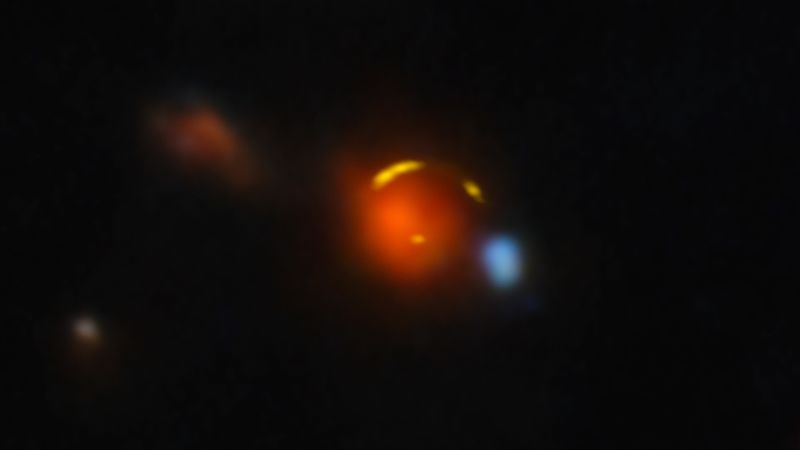
The recent discovery hinged on a rare cosmic event that triggered a detection by the IceCube observatory in 2021. The neutrino, labeled IC 210922A, initially appeared to originate near the Eridanus constellation. However, its source remained elusive until a cosmic coincidence revealed the connection. Days after the neutrino event, Urata and his team observed a galaxy rich in star formation, later named the Shadow Blaster. Its infrared luminosity surpassed that of our sun by trillions of times, indicating intense activity hidden from optical view. This discovery suggests that such galaxies might be key to understanding neutrino production.
Combining neutrino data with multi-wavelength observations allowed researchers to confirm the galaxy’s role. While the neutrino’s signal alone is insufficient to pinpoint its origin, the accompanying light provided crucial evidence. “By observing the galaxy’s light, we could confirm its role in producing the neutrino,” Urata said. This method of cross-referencing neutrino and electromagnetic data is now seen as vital for future cosmic investigations.
Gravitational Lensing as a Key Clue
Further analysis using the Atacama Large Millimeter/submillimeter Array in Chile revealed a critical detail: the Shadow Blaster galaxy was positioned behind a gravitational lens. This phenomenon occurs when a massive object, like a foreground galaxy, bends light from a distant source, magnifying it. “This lensing effect made the galaxy visible to us, even though it was otherwise invisible in optical or gamma-ray wavelengths,” Urata explained. “It allowed us to study a hidden, compact star-forming region that would have been nearly impossible to detect.”
The galaxy’s star-forming region, referred to as a stellar nursery, is dense and highly active. Such environments are theorized to create the conditions necessary for neutrino production. However, this discovery redefines how we approach neutrino astronomy, suggesting that these galaxies might be powerful emitters of high-energy particles. “The fact that we found this galaxy connected to a neutrino indicates it could be a significant source,” Urata added. This connection could revolutionize the study of cosmic phenomena.
Implications for Future Research
The identification of the Shadow Blaster galaxy as a possible neutrino source has opened new avenues for research. Previously, astronomers relied on neutrino detectors to confirm the presence of high-energy events, but without accompanying light signals, the exact nature of these events remained unclear. Now, the combination of neutrino and optical data offers a more precise way to trace their origins. “This breakthrough demonstrates the power of multi-messenger astronomy,” said Erik Blaufuss, a research scientist at the University of Maryland. “It allows us to connect particles like neutrinos to visible cosmic events.”
With this new approach, scientists can better understand the high-energy processes that shape the universe. The study, published June 17 in the journal Nature Astronomy, highlights the importance of interdisciplinary methods in modern astrophysics. “The Shadow Blaster galaxy serves as a reminder that even the most mysterious cosmic particles have origins we can uncover,” Urata concluded. This discovery could inspire further research into other neutrino sources across the universe.
