
Alito’s testy reaction to Sotomayor underscores tensions at Supreme Court
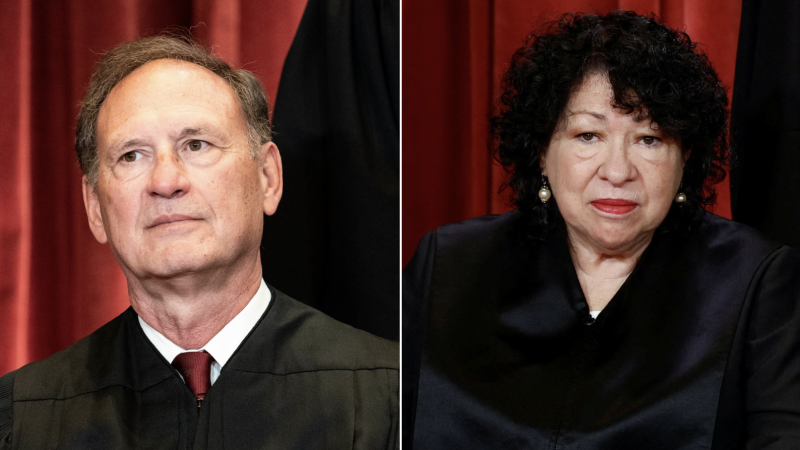
Supreme Court Tensions Emerge as Alito Reacts to Sotomayor’s Dissent
Alito s testy reaction to Sotomayor – During the Supreme Court’s routine case announcements, justices typically maintain a composed facade, masking their reactions to rulings with deliberate neutrality. Whether opposing a colleague’s decision or dissenting from the majority, the elevated bench becomes a stage for measured restraint. Yet, Justice Samuel Alito has long stood out for his more expressive demeanor, often revealing frustration or disbelief through subtle gestures. This pattern resurfaced on Thursday when Alito’s irritation was palpable during a dissenting statement by Justice Sonia Sotomayor, marking a rare moment of emotional visibility in the otherwise stoic proceedings.
A Sharp Response in the Courtroom
Alito’s reaction came during a hearing on refugee policy at the southern border, a contentious issue that has drawn sharp ideological divides. As Sotomayor delivered an oral dissent opposing his ruling, the 78-year-old justice’s frustration became evident. According to observers, Alito’s voice carried a tone of exasperation as he remarked to the audience:
“There’s much that I would have added to my bench statement had I known there would be a dissent read.”
This moment, captured by media, highlighted the growing friction among the justices, particularly between the conservative majority and the liberal dissenters.
The ruling in question centered on the definition of “arrival” in U.S. immigration law, determining when refugees can initiate asylum claims. Alito argued that asylum eligibility begins only after a person physically steps onto American soil, overturning lower court interpretations that allowed refugees near the border to seek protection. The 6-3 decision, which aligned with the Republican-appointed justices, reflected the court’s current ideological split. However, the dissenting trio—Sotomayor, Elena Kagan, and Ketanji Brown Jackson—underscored their ongoing disagreements with the majority’s approach to immigration issues.
Historical Context of Alito’s Temper
Alito’s visible reactions are not new. In 2013, his eye-rolling while Justice Ruth Bader Ginsburg read an opinion sparked headlines, illustrating his tendency to display annoyance in response to rulings he finds unsatisfactory. This behavior, though occasionally provocative, has become a hallmark of his judicial presence. On Thursday, his response to Sotomayor’s dissent appeared particularly pointed, suggesting a deepening sense of frustration with the court’s current composition.
Despite his volatility, Alito has maintained a consistent role as a pivotal figure in the conservative bloc. His opinions frequently sway the court’s direction, particularly on issues like immigration, where his legal interpretations have shaped recent rulings. However, the incident with Sotomayor revealed a tension that has been simmering beneath the surface. The court’s traditional decorum, which emphasizes restraint and formality, was momentarily disrupted by Alito’s sharp words, drawing attention to the ideological rift among its members.
Clarifying the Misunderstanding
Following the episode, the Supreme Court issued a statement on Friday, clarifying that Alito had been informed in advance by Sotomayor’s chambers that she would read a dissent. The court described the incident as a “misunderstanding” on Alito’s part, suggesting that his reaction was not intentional but rather a result of unanticipated timing. This clarification comes amid ongoing speculation about the justices’ interactions and the internal dynamics of the court.
Thursday’s session, held in the iconic white marble courtroom, was unusually brisk. Three opinions were delivered in about nine minutes, setting a fast-paced tone before Sotomayor’s dissent. Her statement, which recounted the tragic fate of the M.S. St. Louis, a ship carrying 900 Jewish refugees in 1939, added a poignant layer to the discussion.
“The M.S. St. Louis was turned away from the United States, Cuba, and Canada, leaving many Jewish refugees to face the horrors of the Holocaust,”
she said, emphasizing the humanitarian stakes of the asylum policy under review.
Alito’s Possible Retirement and Court Dynamics
Throughout this term, Alito’s testy attitude has raised questions about his long-term commitment to the bench. With his 20th year on the Supreme Court, some analysts speculated that his frequent outbursts might signal a desire to retire, driven by dissatisfaction with the court’s current direction. However, insiders close to Alito reassured Fox News earlier this year that he plans to stay for at least another term, countering those concerns.
The incident with Sotomayor also brought to light the broader context of the court’s schedule. With the annual term nearing its end, the justices have been racing to issue rulings on key issues, including immigration, which has been a central focus for President Trump. The court’s decision on refugee policy, which favored the administration, marked a significant victory in its immigration agenda. Yet, the dissent from Sotomayor and her colleagues highlighted the ongoing debate over how to balance national security with humanitarian considerations.
As the court winds down its term, the tension between the conservative and liberal justices has become more pronounced. Alito’s reaction, while brief, served as a reminder of the personal stakes involved in each ruling. The justices, though often seen as impartial arbiters, are increasingly vocal in their disagreements, a trend that may influence future decisions. The court’s reliance on written opinions, which are typically read without interruption, makes oral dissents a rare but impactful event, further amplifying the emotional undercurrents of its proceedings.
Looking ahead, the Supreme Court’s final days of the term will likely feature more high-profile cases, testing the limits of its ideological divisions. Alito’s continued presence ensures that the conservative majority will remain a dominant force in shaping rulings, particularly on issues like asylum and refugee status. However, the incident with Sotomayor suggests that even within this majority, there may be moments of friction. The court’s ability to maintain its institutional authority will depend on how it navigates these internal tensions, balancing the need for unity with the space for dissent.
Meanwhile, the public continues to watch closely for signs of change, both in the court’s decisions and the justices’ behavior. Alito’s reaction, though a single moment, encapsulates the broader struggle between legal principles and political pressures. As the nation’s highest court prepares for its next term, the dynamics of its internal debates will remain a critical factor in shaping the legal landscape for years to come.
